



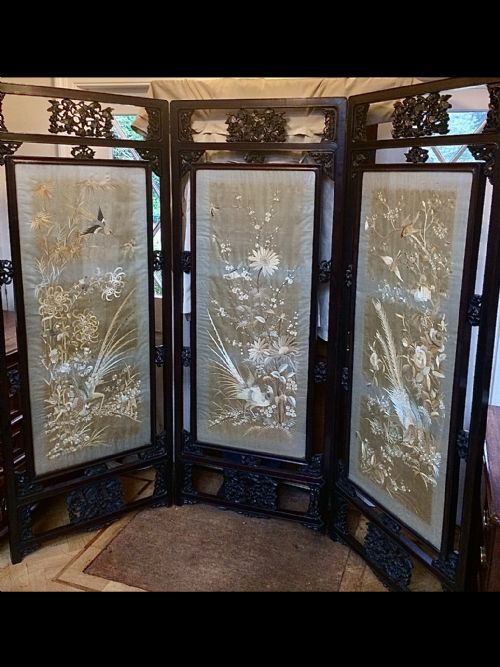


Dark Hardwood Screen
A dark hardwood screen is a functional divider or decorative panel, built to partition a room or grace a tabletop.
Dark Hardwood Screen
A dark hardwood screen brings substantial presence and intricate craftsmanship into a room, serving either as a grand floor-standing room divider or a delicate tabletop display. When you search for a dark hardwood screen, you encounter pieces that range from towering four-panel architectural partitions to small revolving silk embroidery stands designed for furniture.
The selection on this page draws heavily from Eastern and Revival traditions, spanning the nineteenth century alongside pieces from the early twentieth century. You will frequently find examples originating from Chinese workshops, alongside Japanese Meiji period work, Islamic Revival mashrabiya panels, and Burmese or Anglo-Indian interpretations.
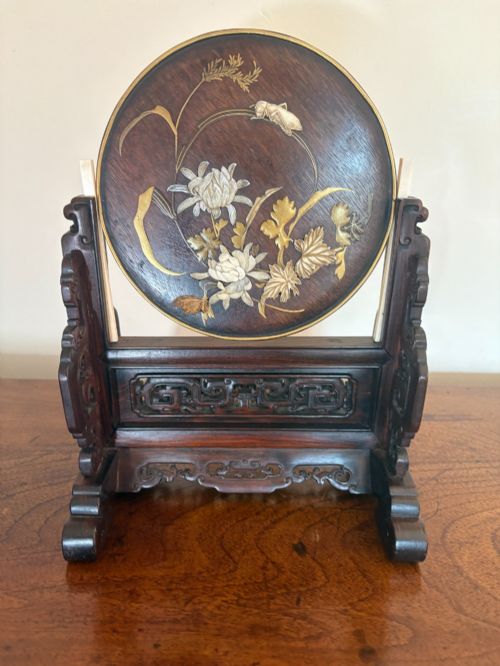
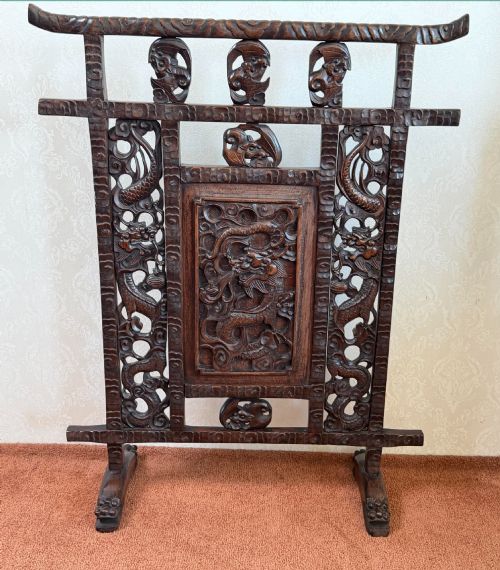
Formats vary widely across the inventory, encompassing folding room dividers, firescreens, rotating table screens, and occasionally associated stands. The timber frame almost invariably supports a secondary medium, such as hand-embroidered silk, lacquered panels, bone, brass, or glass, creating a rich interplay of dark wood against lighter decorative surfaces.
How they were made
Makers constructed the primary frames of these screens using dense timbers such as teak and rosewood, carved with deep relief or assembled through traditional joinery. This dark hardwood provides a stable, heavy armature capable of supporting large folding panels or intricate internal compartments.
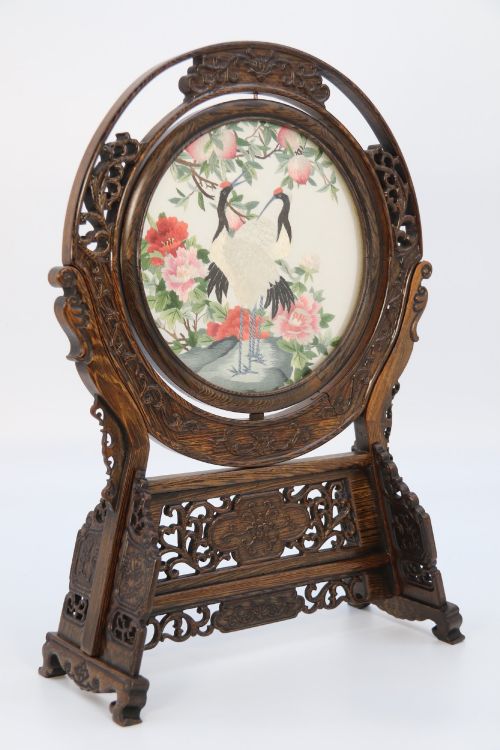
Internal panels frequently incorporate fine textile work, notably double-sided Chinese silk embroidery stretched across rotating pivots or fixed frames. Other variations integrate bone inlay, mother-of-pearl, and lacquered surfaces, requiring specialist skills in both carpentry and decorative arts to mount delicate inlays securely into stubborn hardwoods.
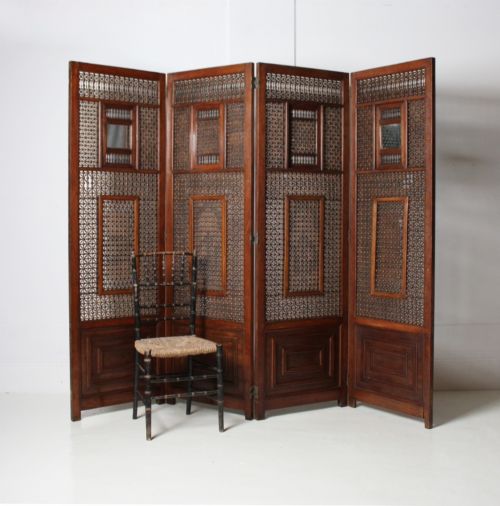
Architectural examples utilise turned wooden lattice work, as seen in mashrabiya panels, where individual pieces of timber are fitted together geometrically without glue or nails to filter light and air. In Japanese pieces, lacquer and carved bone relief are applied to the dark wooden ground to depict natural scenes with high contrast.
Dark Hardwood Screen Retail Price Guide 2026
Typical asking prices for dark hardwood screen among the pieces listed under this phrase on Sellingantiques today, from the lower quarter to the upper quarter. They describe what is for sale here now, not the wider market.
Some table screens rotate on their stands, allowing an embroidered bird to turn upside down with a gentle flick.
What varies in quality
Quality in a dark hardwood screen rests primarily on the depth and crispness of the carving, and the fidelity of the secondary materials. Superior examples demonstrate meticulous hand-embroidery on silk or precisely fitted lattice work, whereas lesser pieces rely on simpler, mechanical cutting and plain wooden panels.
The integration of materials dictates the upper tier of the range, where bone, brass, and mother-of-pearl are flush-fitted and securely anchored into the dense grain of the teak or rosewood. Inferior construction shows in loose joints, poorly seasoned timber that has warped over time, or replacement textiles that lack the original needlework finesse.
The Dark Hardwood Screen Glossary
- Mashrabiya
- An architectural element consisting of turned wood pieces arranged in a geometric lattice grid. It is frequently employed in panels and room dividers to create patterned screens.
- Shibayama
- A Japanese decorative technique involving the inlay of precious materials such as bone, ivory, shell, and mother-of-pearl into a wooden base. These inlays form raised pictorial motifs.
- Firescreen
- A decorative panel placed in front of a fireplace aperture when the hearth is not in use. They often feature embroidered silk or glass panels set into a wooden frame.
- Table Screen
- A miniature decorative screen supported by a fitted stand, designed for display on a desk, table, or cabinet. They often incorporate rotating mechanisms for double-sided viewing.
Dark Hardwood Screen: Frequently Asked Questions
How were dark hardwood screens used?
These pieces served practical and decorative roles in historic interiors, functioning as room dividers to partition living spaces or as firescreens to block unlit hearths.
Tabletop versions provided decorative focal points for desks and cabinets, often featuring reversible silk panels for varied display.
What woods are typically used?
Makers utilised dense tropical timbers grouped broadly under hardwood, with specific listings identifying rosewood and teak.
These heavy woods provided the structural integrity needed for large folding panels and intricate carved frames.
How do I care for a hardwood screen?
Keep the wood conditioned with appropriate furniture wax and avoid placing the screen in direct sunlight to protect integrated silk panels.
Handle folding hinges and rotating stands with care to prevent stress on historic joinery and delicate bone or mother-of-pearl inlays.
How do I distinguish regional styles?
Chinese pieces often feature deep vegetative carving and intricate silk embroidery, while Japanese examples frequently incorporate lacquer and bone inlay.
Islamic Revival items are characterised by geometric turned wood lattice work, and Anglo-Indian variants combine heavy British furniture forms with Eastern relief carving.