
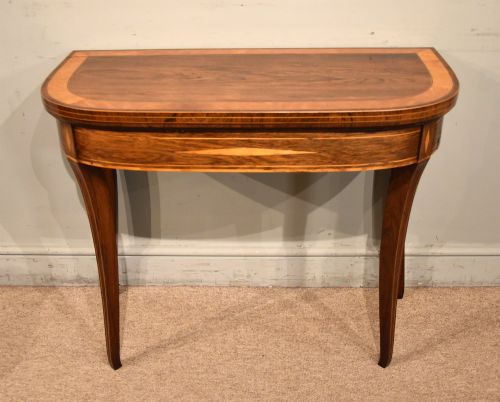

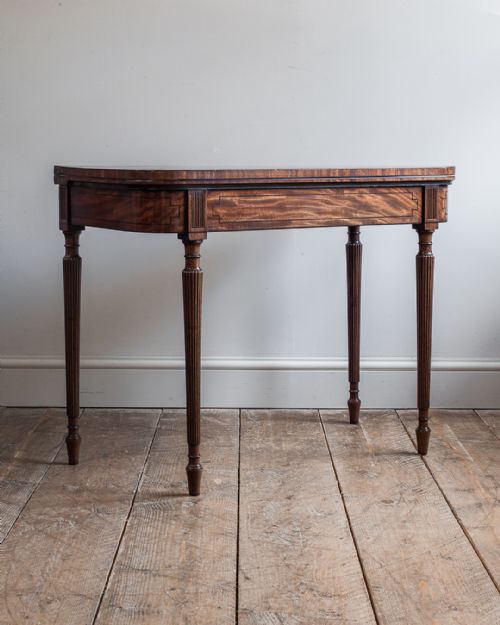


D Shaped Tea Table
A d shaped tea table brings the architectural grace of the Georgian and Regency periods directly into a modern interior.
D Shaped Tea Table
A d shaped tea table is an ingenious piece of historical furniture designed with a flat straight back to sit flush against a wall when closed. When the top folds out or pivots, it forms a generous surface originally intended for serving tea or playing card games. The evidence shows these pieces appearing most prominently across the 18th century, Georgian, and Regency eras.
The version you are most likely to encounter on this page is constructed from rich mahogany, often displaying a demi-lune or D-shaped top that conceals a clever folding mechanism. Many examples bridge the gap between console tables and functional tea tables, reflecting the changing social rituals of polite society. These tables survive from periods spanning the 18th century through to the Victorian age.
Materials and construction
Cabinet makers relied heavily on solid mahogany and figured mahogany veneers, frequently enhancing the primary timbers with contrasting satinwood and boxwood inlay. These woods were chosen for their stability and grain pattern, allowing craftsmen to shape straight-backed consoles that opened smoothly on hinges or pivots.
Surface decoration often included intricate marquetry and fine brass details, particularly on examples originating from the Georgian and Regency periods. The structural integrity of the folding top required precise joinery so the piece could serve as both a wall console and a stable tea table.
Some tables double as secret gaming boards, proving that ancestors took their after-dinner entertainment very seriously indeed.
Judgement of quality
The distinction between ordinary and exceptional pieces lies in the choice of timber figures and the crispness of any inlay. Figured mahogany with strong natural grain and neatly fitted satinwood banding commands attention, whereas flat or unfigured timber indicates a simpler grade of manufacture.
Proportion and the execution of the folding mechanism further separate the work. A well-proportioned frame with tight joints and smooth movement demonstrates the superior skill of the original workshop.
The D Shaped Tea Table Glossary
- Demi-lune
- Half-moon shape. This term describes tables with a curved front and a straight back designed to stand against a wall.
- Marquetry
- Inlaid wood patterns. Craftsmen used various coloured woods to create decorative pictures and geometric designs on the surface.
- Satinwood
- A pale lustrous timber. It was frequently used for contrasting stringing and banding on darker mahogany furniture.
- Teapoy
- A small stand or box for holding tea. In historical contexts, these accompanied the main tea tables of the parlour.
D Shaped Tea Table: Frequently Asked Questions
How were these tables used originally?
These tables stood against the drawing room wall as decorative consoles when not in use. When tea was served or guests gathered for cards, the top unfolded to double the surface area.
This dual purpose made them essential items for entertaining in polite Georgian and Regency households.
Where should I place a d shaped tea table?
The flat straight edge allows the piece to fit neatly against any hallway or living room wall. Opening the top requires a little clearance space, making them ideal as occasional side tables.
They work particularly well beneath a mirror or painting where a full round table would block foot traffic.
How do I distinguish Georgian from Victorian examples?
Georgian and Regency pieces typically display restrained classical lines, finely figured mahogany, and subtle satinwood stringing. Victorian interpretations often feature heavier proportions, bolder carving, and sometimes burr walnut veneers.
Examining the internal hinges and secondary woods helps confirm the period of manufacture.
Are the tops secured with hinges?
Most folding versions utilise brass hinges recessed into the back edge of the top leaves. Some designs incorporate a swing leg or a pivoting frame to support the opened leaf safely.
These mechanical elements should operate smoothly without straining the surrounding timber.