
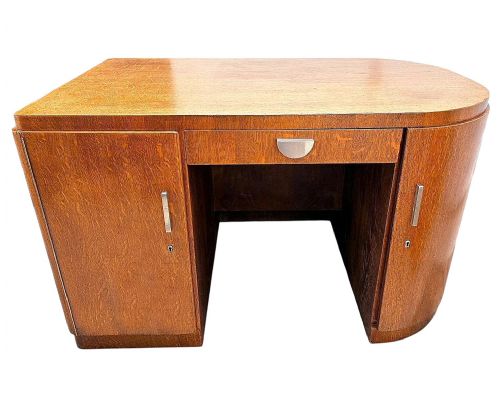

D End Writing Desk
A d end writing desk offers a balanced workspace with curved ends, combining practicality with formal elegance.
D End Writing Desk
A d end writing desk comprises workspace furniture finished with semicircular ends, appearing across Georgian, Regency, and Edwardian periods.
The evidence shows these pieces often double as library tables, sofa tables, or centre tables depending on their configuration.
Buyers seeking this phrase frequently encounter mahogany and rosewood examples alongside occasional painted or walnut variants.
How they were made
Cabinet makers utilised dense timber such as mahogany, rosewood, and walnut, often applying figured veneers to main surfaces.
Table tops frequently incorporate inset leather writing surfaces and turned pillar ends or lyre supports.
Inlaid stringing in satinwood and brass details appear on select Edwardian and Regency pieces.
Some nineteenth-century writing desks include concealed compartments for postage stamps and secret drawers for private correspondence.
What varies in quality
Timber selection dictates the visual depth of a piece, with finely figured mahogany and burr oak sitting above plain domestic woods.
Joinery execution around the curved d ends reveals the maker's competency, alongside the crispness of carved mouldings and inlaid stringing.
Williams and Gibton·James Winter and Sons·Gillow Lancaster·Edwards and Roberts·Shapland and Petter
The D End Writing Desk Glossary
- D End
- A table end shaped in a semicircle resembling the capital letter D, allowing multiple pieces to combine or stand independently.
- Sofa Table
- A rectangular table designed to stand in front of a sofa, typically featuring drop leaves at either end.
- Library Table
- A large freestanding table utilised for reading and writing, finished on all sides for placement in the centre of a room.
- Satinwood
- A durable, yellowish timber native to India and Sri Lanka, frequently utilised for contrasting stringing and inlay.
- Lyre Support
- A table base carved in the symmetrical, curved outline of a classical stringed instrument.
D End Writing Desk: Frequently Asked Questions
Where should a d end writing desk be placed?
These pieces function well in the middle of a room because their finished backs allow freestanding placement. They also sit comfortably against walls when floor space requires a compact arrangement.
Positioning depends on light sources and the specific room layout, though central placement highlights the curved ends most effectively.
How do I identify a Regency period desk?
Regency pieces often display classical motifs, such as lyre supports or brass inlay, alongside dark tropical timbers like rosewood and mahogany. Proportions tend to be architectural and refined.
Construction details on the underside and drawer linings help confirm the period alongside timber choice and finish.
What is the difference between a writing table and a desk?
Writing tables generally feature lighter frames with open undercarriages and shallow drawers, designed primarily for correspondence. Desks often incorporate heavier pedestals or enclosed storage compartments.
Both forms utilise inset leather surfaces across many surviving examples from the Georgian and Victorian eras.
How should I care for the leather top?
Leather writing surfaces require occasional treatment with specialist wax or neutral conditioning creams to prevent drying and cracking. Keeping them away from direct sunlight preserves the original colour and gold tooling.
Regular dusting with a soft cloth prevents abrasive particles from damaging the delicate surface finish over time.