
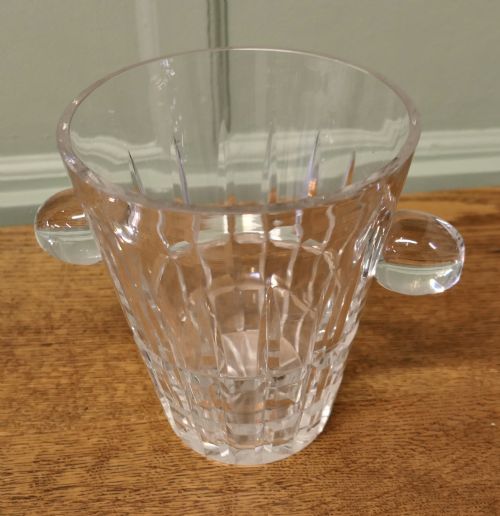
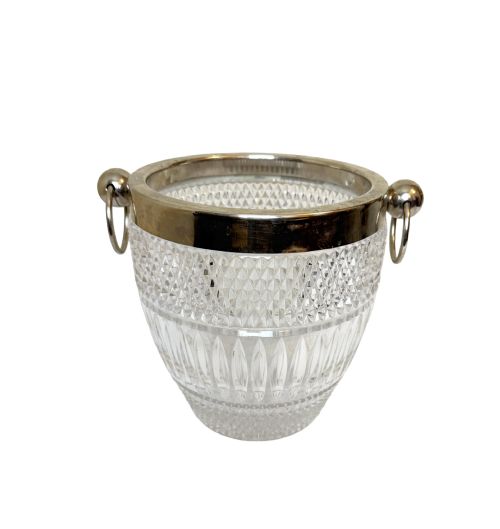


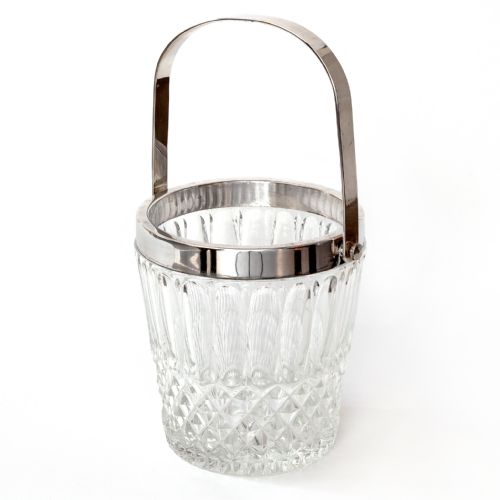


Cut Glass Wine Cooler
These cut glass wine coolers bring weight, brilliance and practical elegance to any table.
Cut Glass Wine Cooler
A cut glass wine cooler is a substantial vessel designed to hold ice and bottles for the table, appearing across periods from the nineteenth century through the Art Deco era. The selection ranges from robust lead crystal bodies paired with silver plate to French creations featuring gilt bronze mounts.
Buyers meet forms classed variously as ice buckets, champagne coolers and barware, spanning Regency, Edwardian and French Empire aesthetics. Hand blown crystal and heavy cut glass dominate the offerings, often accompanied by silver-plated rims, handles or liners.
Origin points shift between English workshops and continental makers, giving rise to distinct profiles such as the geometric lines of Art Deco pieces and the classical restraint of earlier Regency designs.
How they were made
Makers utilised thick lead crystal and glass blanks, applying deep wheel-cut facets to catch the light and add tactile grip to the heavy walls. This glasswork was frequently combined with metalwork elements, including silver plate and gilt bronze mounts.
Metal collars, swing handles and fitted liners in silver-plate were securely attached to the glass bodies to withstand the constant weight of ice and bottles. Hand-blown manufacturing methods ensured each vessel retained subtle individual variations in its silhouette and pattern depth.
Listings span periods from the early nineteenth century through the 1940s, featuring materials such as lead crystal, gilt bronze and silver-plate.
What varies in quality
Quality rests primarily on the depth and crispness of the glass cutting, where sharper facets and heavier lead crystal create superior resonance and brilliance. The integration of auxiliary materials like silver plate and gilt bronze also dictates the tier of the piece.
Proportion and mass separate standard barware from exceptional display pieces. Heavier lead crystal bodies with balanced, securely fitted metal mounts demonstrate superior craftsmanship compared to lighter, purely utilitarian vessels.
Karl Palda
The Cut Glass Wine Cooler Glossary
- Lead crystal
- Glass containing a high lead content that increases weight, refractive index and clarity. This material allows for deeper and sharper cutting.
- Silver-plate
- A base metal coated with a thin layer of silver. It provides the bright finish of solid silver while offering durability for functional barware mounts.
- Gilt bronze
- Bronze decorated with a fine layer of gold applied by mercury amalgamation or electroplating. It adds a warm, decorative accent to nineteenth-century mounts.
- Regency
- An English design style spanning the early nineteenth century. Pieces from this period favour classical lines and restrained, architectural ornamentation.
- Art Deco
- A twentieth-century design movement favouring bold geometric patterns and streamlined forms. Items from this era often showcase stark, modern facets.
Cut Glass Wine Cooler: Frequently Asked Questions
How do I date an antique wine cooler?
Dating relies on observing the combination of glass-cutting style, metal mounts and overall silhouette. Regency pieces display classical proportions, while 1920s examples often feature geometric Art Deco motifs.
Examining the weight of the lead crystal and the manufacturing technique of the silver-plate also helps determine the period of origin.
Can I still use these for serving wine?
These robust vessels remain fully functional for holding ice and chilling bottles at the dining table. Their thick glass construction was built precisely for this regular use.
Care should be taken with older silver-plate mounts and heavy lead crystal bodies during cleaning to preserve their original finish.
What is the difference between an ice bucket and a wine cooler?
While both terms describe heavy glass vessels used in entertaining, wine coolers are generally sized to accommodate a wine or champagne bottle alongside ice. Ice buckets may serve a more general cube-holding purpose.
In practice, many historical examples described under these terms share identical forms and can serve both functions interchangeably.