
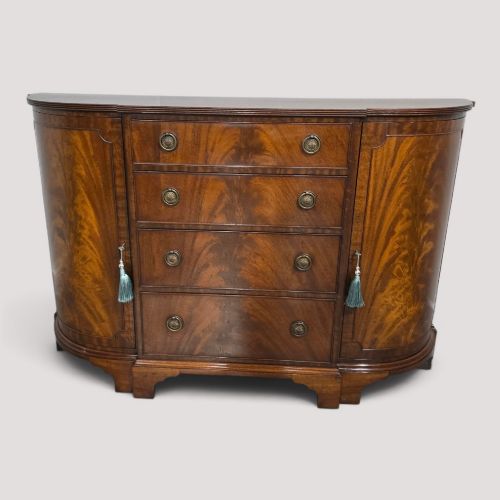
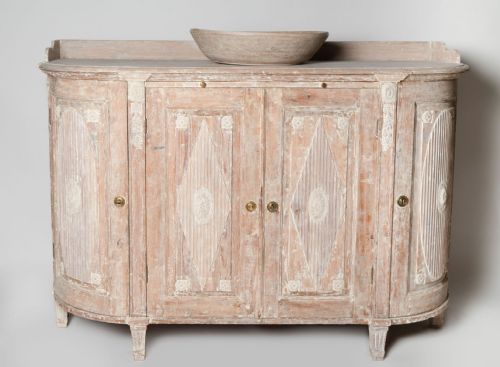


Curved Side Buffet
A curved side buffet offers generous storage with a sweeping silhouette, bringing architectural grace to a dining room or hall.
Curved Side Buffet
A curved side buffet provides long lines and gentle radiuses designed to sit flush against a dining room wall while softening the room's geometry. These serving pieces include bowed, serpentine, demi-lune, and convex shapes that distinguish them from standard rectangular furniture.
The versions met here span the eighteenth, nineteenth, and twentieth centuries, taking the form of sideboards, credenzas, side cabinets, and serving tables. Makers deployed styles ranging from George III and Regency to Victorian, Art Deco, and Gustavian to satisfy changing tastes.
Buyers seeking a curved side buffet encounter substantial timber constructions designed to hold plate, linen, and glassware. The scale ranges from compact bowed sideboards to large credenzas fitted with glass doors and marble tops.
How they were made
Construction relies on solid and veneered timbers including mahogany, walnut, burr walnut, and kingwood over sturdy pine or oak carcases. Cabinetmakers employed steam bending and laminated curved layers to achieve the sweeping bows and serpentine fronts without compromising structural integrity.
Surface enrichment often incorporates boxwood inlay, marquetry, and parcel gilt highlights to define the curved contours. Mounts in brass and ormolu secure corners and frame glazed doors, while marble tops provide durable surfaces on specific neoclassical and continental cabinets.
Art Deco dining rooms demand a dramatic curve to hold heavy silver teapots without wobbling.
What varies in quality
Quality rests upon the selection of timber figures, such as symmetrical burr walnut or figured mahogany, matched carefully across curved drawer fronts and doors. Superior workshops ensured that veneers follow the radius of the buffet without lifting or splitting along the grain.
The execution of fine details like hand-cut inlay, cast brass ormolu mounts, and tightly fitted dovetailed drawer construction separates standard production from exhibition pieces. Interior fittings, original glass panels, and the smoothness of the curved drawers further indicate the standard of manufacture.
Harry And Lou Epstein
The Curved Side Buffet Glossary
- Bow front
- A convex, outwardly curving cabinet or drawer front that swells from the corners towards the centre. This shape softens the profile of a heavy dining room piece.
- Serpentine
- A front contour featuring a convex curve flanked by two concave curves, resembling the undulating motion of a snake. It requires considerable skill from the cabinetmaker to execute.
- Demi-lune
- A half-moon or semicircular shape often seen on side cabinets and serving tables designed to stand flat against a wall. Such tables frequently feature marble tops.
- Marquetry
- The art of applying decorative veneer pieces in geometric or pictorial patterns onto a structural surface. Craftsmen used contrasting woods to achieve tonal depth.
- Credenza
- A low dining or reception room cabinet used for storing plate and serving food, typically enclosed by doors. Victorian examples frequently incorporate glazed central sections.
Curved Side Buffet: Frequently Asked Questions
What is a curved side buffet used for?
These pieces function primarily as dining room servers for storing dinnerware, linens, and silver while providing a surface for food and drink during meals.
They also serve as display cabinets and focal points in entrance halls and drawing rooms, holding decorative objects on their upper surfaces.
How do I style a curved side buffet?
Place the piece against a principal wall in a dining room or wide hallway where its sweeping contours can be appreciated without obstruction.
Balance the top surface with table lamps, tall candlesticks, or a centered mirror to complement the architectural shape of the woodwork.
How do I identify a Victorian credenza?
Victorian credenzas frequently feature figured walnut veneers, intricate marquetry, and glazed central doors flanked by curved side cabinets.
They often incorporate gilt bronze or ormolu mounts and standing plinths characteristic of mid-nineteenth-century cabinet making.
What is the difference between a sideboard and a credenza?
Sideboards traditionally feature a combination of drawers and cupboards specifically arranged for serving food and storing dining accessories.
Credenzas originated as low cabinets often enclosed entirely by doors and frequently display finer marquetry and decorative mounts suited for formal display.