



Curule Style Armchairs
Curule style armchairs are scissor-form seats tracing their lineage back to ancient Rome, prized for their striking X-frame geometry and authoritative presence.
Curule Style Armchairs
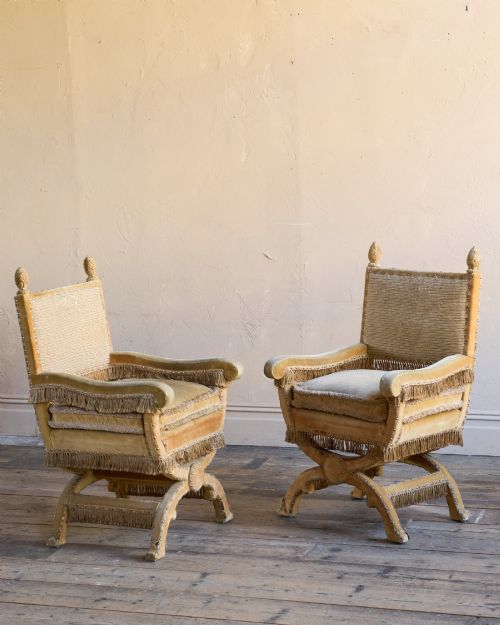
Curule style armchairs take many guises across the nineteenth century, uniting classical X-frame geometry with varied regional revival aesthetics. Buyers searching for curule style armchairs will encounter pieces spanning Renaissance, Baroque, Gothic, and Moorish revivals, alongside specific regional forms such as Dante, Savonarola, and Spanish hip-joint chairs.
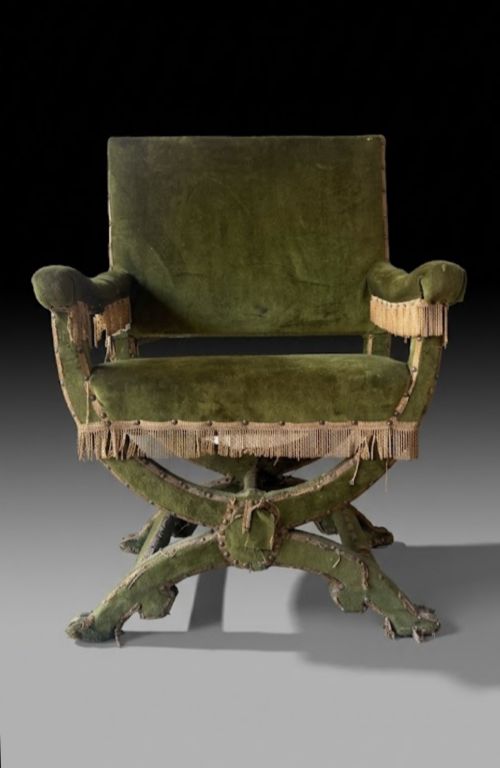
The materials and construction vary widely across the selection, featuring timbers such as walnut, mahogany, oak, and fruitwood, often complemented by intricate mother-of-pearl inlay or brass details. Upholstery ranges from original as-found velvet to green leather, reflecting the diverse periods of production from the early decades through to the 1930s.
How they were made
Maker construction relies heavily on solid hardwoods like walnut, mahogany, and oak, shaped into intersecting members that form the characteristic X-frame or cross-frame base. Joints require precise carpentry to support the folding or fixed structural load of the seat.
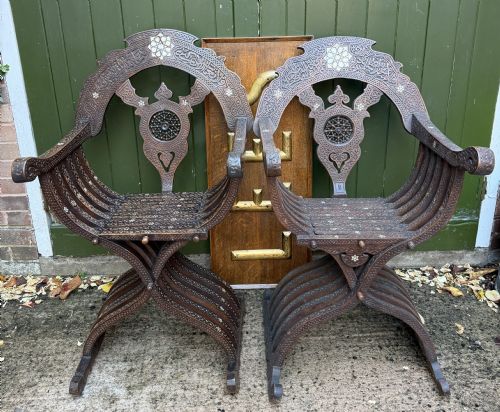
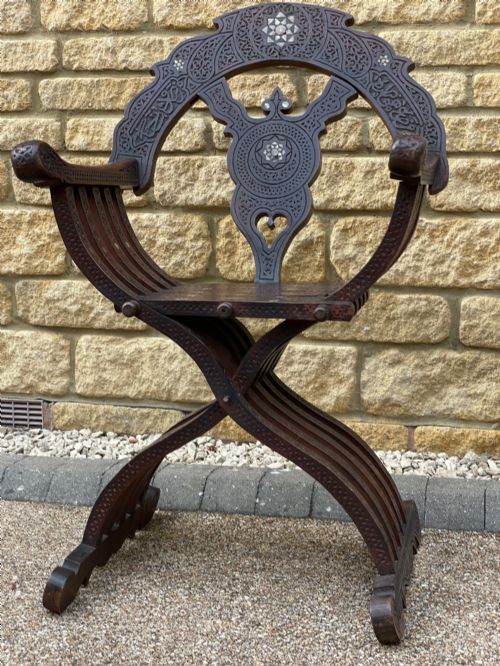
Decorative surface techniques distinguish the regional and revival styles, incorporating hand-carved fruitwood, nacre-shell and mother-of-pearl inlay, and brass elements. Upholstered variants secure velvet or leather directly to the timber frame using traditional tacks.
Curule Style Armchairs Retail Price Guide 2026
Typical asking prices for curule style armchairs among the pieces listed under this phrase on Sellingantiques today, from the lower quarter to the upper quarter. They describe what is for sale here now, not the wider market.
Revival styles represented include Renaissance, Baroque, Gothic, Jacobean, and Moorish, alongside Syrian and Andalusian regional forms.
What varies in quality
Quality rests in the precision of the timber carving and the complexity of the inlay work, distinguishing simple utility frames from master-carved statement pieces. The integrity of the intersecting X-frame joints dictates structural longevity and the success of the mechanical folding action where present.
The survival of original surface finishes, such as untouched patinated walnut or authentic mother-of-pearl nacre work, elevates the standing of a piece. Upholstery condition ranges from well-preserved period velvet to later replacements, influencing the overall historical presentation.
The Curule Style Armchairs Glossary
- Curule
- An ancient Roman form of folding seat used by magistrates, characterised by curved X-shaped legs. This classical silhouette forms the direct ancestor of the nineteenth-century revival chairs seen here.
- X-Frame
- A structural furniture base formed by two intersecting diagonal members resembling the letter X. It provides inherent strength and underpins the design of Dante and Savonarola chairs.
- Nacre
- An organic-inorganic composite material also known as mother-of-pearl, produced by mollusc shell inner layers. Artisans use it to create intricate geometric inlay patterns on Syrian and Middle Eastern frames.
- Renaissance Revival
- A nineteenth-century design movement resurrecting sixteenth-century architectural and decorative motifs. Pieces in this style often incorporate heavy walnut carving and formal classical drapery.
Curule Style Armchairs: Frequently Asked Questions
Are curule style armchairs comfortable to sit in?
These chairs were historically designed for status and formal posture rather than lounging for hours. Many feature supportive wooden backs and upholstered seats that provide a firm sit.
Adding a small cushion can improve comfort for modern daily use while preserving the historic character of the seat.
How do I identify a Renaissance Revival curule chair?
Look for heavy carved walnut framing, symmetrical classical motifs, and architectural elements drawn from sixteenth-century Italy. They often present a solemn, monumental appearance compared to lighter Moorish or Syrian variants.
The cross-frame geometry remains crisp, frequently paired with rich velvet upholstery that mirrors the period aesthetic.
Can these armchairs fold up like historical examples?
Some X-frame and scissor designs retain their folding capability, while others are built as rigid, fixed armchairs. The construction method dictates whether the crossed members pivot on a central pin or are permanently secured.
Checking the underside reveals the joinery approach used by the nineteenth-century maker.
How do I care for mother-of-pearl inlay on wood?
Keep inlaid pieces away from direct sunlight and fluctuating humidity to prevent the timber from warping and loosening the nacre sections. Dust gently with a dry, soft cloth without applying liquid polishes that might seep into the shell crevices.
Stable indoor environments ensure the delicate shell segments remain firmly seated in the fruitwood or walnut matrix.