


Crystal Glass Wall Lights
Crystal glass wall lights bring brilliant reflection and period illumination to a room, ranging from Edwardian brass to French Chateau sconces.
Crystal Glass Wall Lights
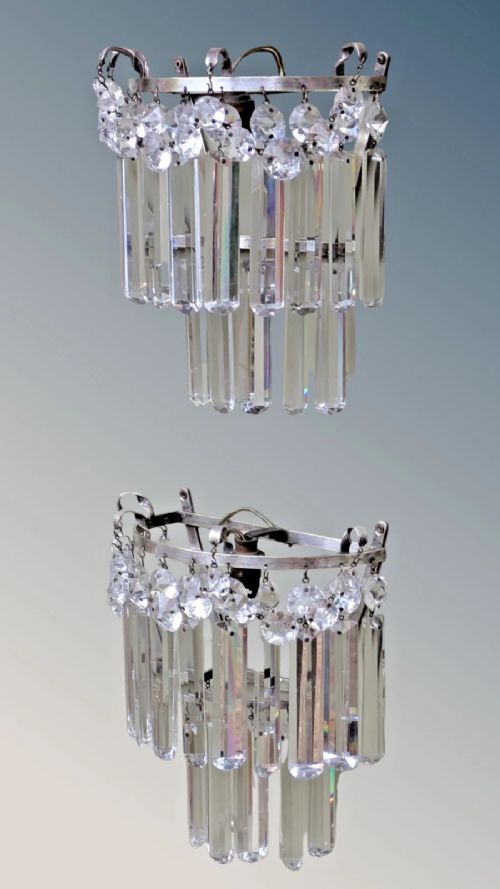
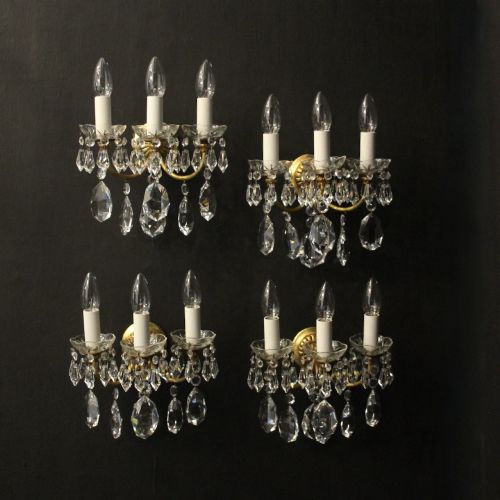
Crystal glass wall lights encompass wall sconces, wall chandeliers, and bag lights designed to mount directly onto interior walls. Buyers searching for crystal glass wall lights will frequently encounter matching pairs dating from the nineteenth century up through the nineteen-thirties.
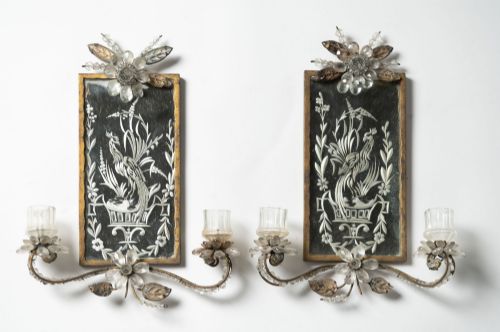
Common configurations include tent and bag styles suspended from backplates, as well as wrought iron frames and mirrored backs that amplify the illumination. These pieces bridge functional home lighting and decorative wall art through the integration of cut crystal elements.
Materials and construction methods
Maker workshops constructed these wall fixtures using structural metals such as brass, gilt bronze, wrought iron, and silver, providing durable armatures for heavy glass components. Skilled artisans shaped and faceted the glass and crystal drops by hand to catch and refract ambient light.
Mounts and backplates frequently combined cast gilt brass or gilt metal with pinned crystal pendants, drops, and beads threaded on fine wire. Complex assemblies like French triple-arm lights and Italian beaded sconces required careful mechanical joining of metal branches and crystal prisms.
Materials across these listings span basic glass and metal alongside cut crystal, brass, gilt bronze, and wrought iron.
Assessing quality in period fixtures
Quality rests upon the depth of hand-cut facets in the crystal and the weight and chasing of the metal mounts, whether brass, gilt bronze, or wrought iron. Superior examples exhibit crisp casting details on backplates and arms, alongside clear, high-lead crystal drops that disperse light cleanly.
The completeness and originality of the crystal drops and hanging prisms strongly influence the overall integrity of a wall light. Fixtures retaining their matching period components and robust internal wiring frames demonstrate superior craftsmanship compared to later assembled replacements.
Maison Baguès·F. & C. Osler·Baccarat
The Crystal Glass Wall Lights Glossary
- Wall sconce
- A decorative wall-mounted lighting fixture designed to hold candles or electric lamps. These units project outward to illuminate hallways and living spaces.
- Cut crystal
- Glass containing lead oxide that is mechanically or manually cut and polished to increase refractive brilliance. This material forms the sparkling pendants seen on period wall lights.
- Gilt bronze
- Bronze metal treated with a thin layer of gold or gold-coloured alloy to produce a rich metallic surface finish. It appears frequently on nineteenth-century French lighting frames.
- Mirror back
- A reflective glass panel set behind the light source to bounce illumination back into the room. This backing enhances the brightness of candles or early electric bulbs.
- Lustre
- A glass or crystal pendant hung from a lighting fixture to refract light. Lustres swing gently from arms and bobeches.
- Tent and bag
- A lighting configuration where crystal strands drape upward in a tent shape and downward into a gathered bag. This style creates a pyramidal silhouette against the wall.
Crystal Glass Wall Lights: Frequently Asked Questions
How do I wire antique wall lights?
Period wall lights typically require professional rewiring to meet modern electrical safety standards while preserving their original metal and glass structure.
Qualified electricians can run modern internal wiring through the brass or bronze arms without altering the exterior appearance of the fixture.
How do I clean crystal wall lights?
Cleaning requires removing individual crystal drops and washing them gently in warm soapy water before drying them with a lint-free cloth.
The metal frames should be dusted carefully with a soft brush to protect the gilt bronze, brass, or silver finishes.
What periods do these lights cover?
The selection spans from mid-nineteenth-century Regency and Victorian designs through Edwardian brass work and nineteen-thirties Art Deco styles.
French Chateau, Italian Florentine, and Gustavian aesthetics represent the primary stylistic traditions found across these eras.