
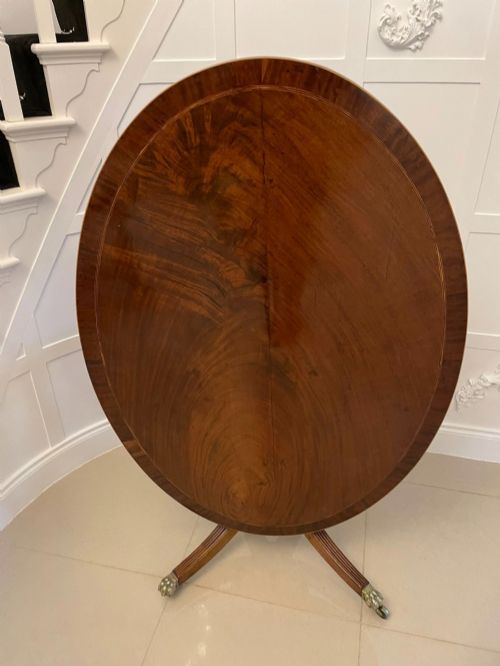
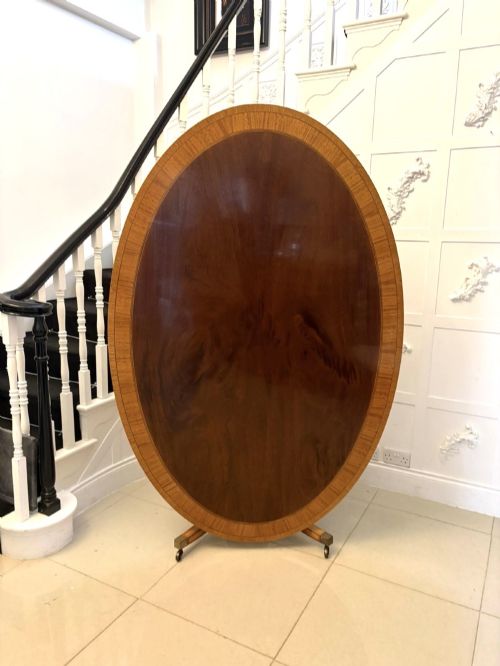
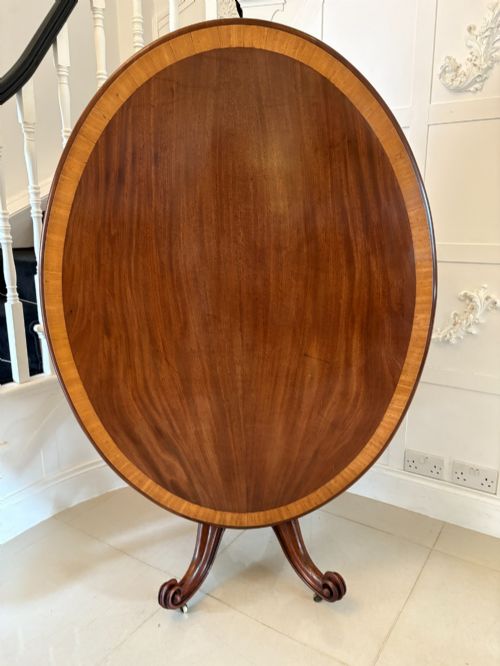
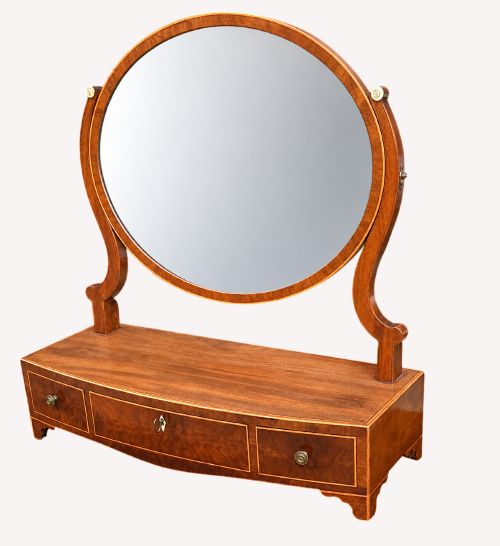


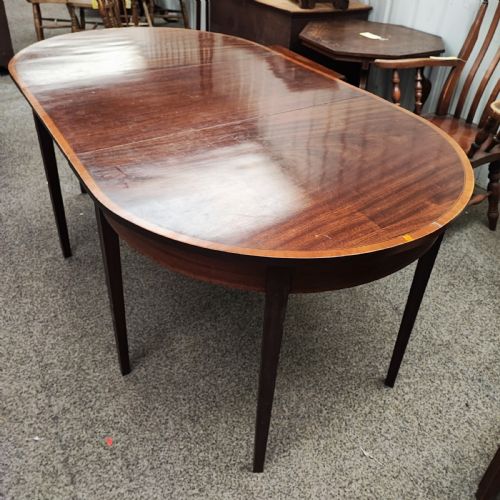


Crossbanded Oval Table
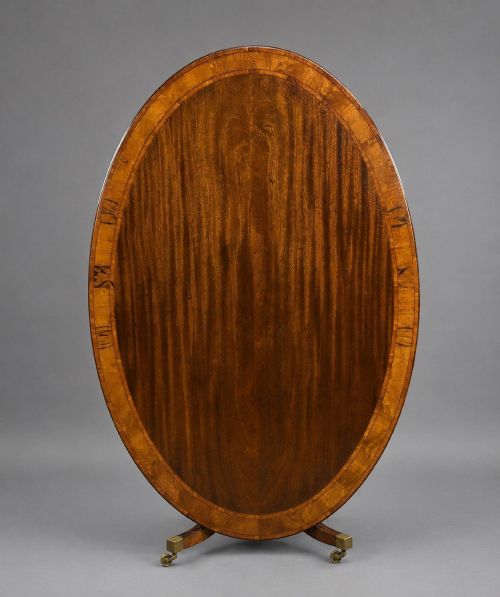
A crossbanded oval table brings figured timber and crisp perimeter borders together, offering a softer footprint than a rectangle.
Crossbanded Oval Table
When searching for a crossbanded oval table, buyers encounter a variety of forms spanning dining tables, breakfast tables, occasional tables, and coffee tables. These pieces date from the eighteenth century through to the Edwardian era and the early twentieth century, taking in Georgian, Regency, and Victorian periods alongside later revival styles.
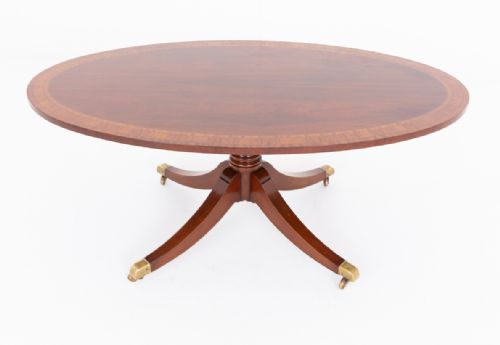
The dominant forms on this page include large breakfast tables with tilt tops, extending dining tables, and smaller occasional or coffee tables. Dining and breakfast versions frequently rest upon central pedestals or pillars with splayed legs, while occasional and Pembroke formats rely on slender uprights or drop leaves.
Timbers such as mahogany, rosewood, and satinwood dominate the construction, often enhanced by contrasting perimeter bands and inlay work. Whether utilised for formal dining or as a centre table in a drawing room, the oval format softens the geometry of a room while providing a generous surface area.
How they were made
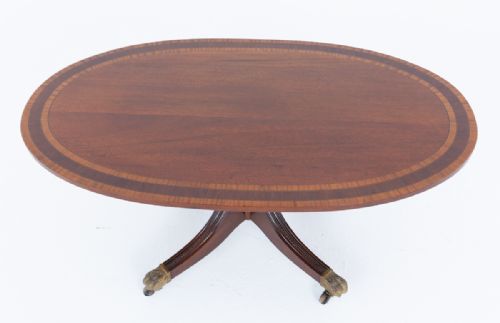
Cabinet makers constructed these tables using solid and veneered timbers, predominantly mahogany, rosewood, and satinwood, laid over robust secondary woods. The characteristic crossbanding involves running veneer strips perpendicularly or at an angle to the main grain of the top, creating a framed border that accentuates the oval silhouette.
Inlay techniques incorporate boxwood, satinwood, and darker stringing lines to delineate the borders and geometric panels. Tilt-top breakfast tables utilise pivoting wooden mechanisms and brass catches, allowing the heavy top to stow vertically when not in use.
Larger dining and loo tables employ sturdy pillar and tripod or quadruped leg assemblies, frequently terminating in brass castors for mobility. Smaller occasional and Pembroke tables rely on tightly jointed frames, drop-leaf hinges, and turned or tapered legs.
Listings on this page span the 18th Century, 19th Century, Georgian, Regency, Victorian, and Edwardian periods, employing mahogany, satinwood, rosewood, and burr walnut.
What varies in quality
The distinction between ordinary pieces and exceptional examples rests upon the choice of timber and the precision of the veneer work. Figured mahogany with strong flame patterns or richly variegated rosewood sits at the upper end of the scale, contrasted with plainer stock.
The execution of the crossbanding and inlay demonstrates the maker's skill, where tight mitres and balanced contrasting timbers create a seamless perimeter frame. Subtleties in the turning of pedestal columns, the carving of leg mounts, and the integration of original brass castors further separate standard production from superior craftsmanship.
The Crossbanded Oval Table Glossary
- Crossbanding
- A border of veneer applied to the edge of a table top where the grain runs perpendicular to the central panel. This technique frames the top and highlights the curved outline of an oval table.
- Tilt-top
- A hinged table top mechanism that allows the surface to pivot into a vertical position. It enables the table to be stored against a wall when floor space is required.
- Pembroke table
- A small rectangular or oval table featuring two hinged drop leaves on opposing sides. These tables often include a single drawer and tapered legs.
- Loo table
- A large Victorian centre or dining table, frequently oval, designed for card games and social gatherings. They often feature tilt mechanisms and heavy pedestal bases.
- Stringing
- A narrow inlay of contrasting wood used to create fine linear borders on table tops and friezes. It provides definition around panels and crossbanded sections.
Crossbanded Oval Table: Frequently Asked Questions
What is a crossbanded oval table?
A crossbanded oval table is a piece of furniture featuring a curved top bordered by veneer laid perpendicularly to the central grain. These tables range from large dining and breakfast pieces to smaller occasional and coffee formats.
Originating primarily across the Georgian, Regency, and Victorian periods, they combine functional surfaces with decorative timber framing.
How do I use a tilt-top breakfast table?
A tilt-top breakfast table utilises a pivoting wooden catch mechanism beneath the top. This allows the surface to be unlocked and tipped vertically.
Historically, this design saved floor space in smaller rooms when the table was not in active use for dining.
How do I tell an 18th-century table from a revival piece?
Eighteenth-century tables exhibit period construction methods, timber ageing, and hand-cut joinery consistent with Georgian workshops. Later Sheraton Revival and Regency Revival pieces from the Victorian and Edwardian eras show machine assistance and different secondary woods.
Examining the underside, drawer linings, and the depth of the timber patination helps clarify the era.
Where should I place an oval centre table?
An oval centre table suits the middle of a principal room or a spacious drawing room where it can be walked around freely. The absence of sharp corners eases circulation flow in busy living areas.
Ensure sufficient clearance is left around the perimeter for chairs or movement.