

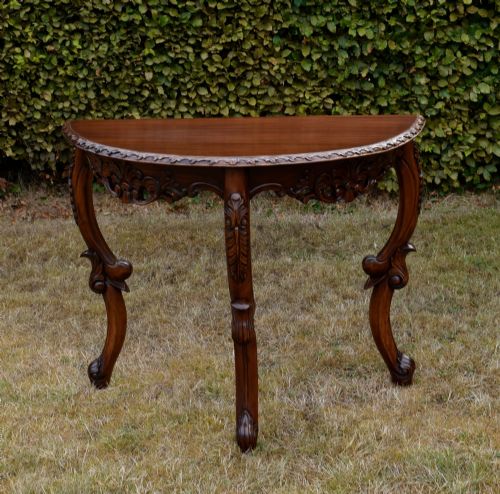


Crescent Hall Table
A crescent hall table sits flat against the wall, offering a curved surface that takes up little space in an entrance.
Crescent Hall Table
A crescent hall table, also known in listings as a demi lune console table, provides a curved front edge and a straight back designed to fit snugly against a wall. These pieces function primarily as console tables, side cabinets, or occasional tables within entrance halls and reception rooms.
The selections span numerous periods and aesthetics, including the 18th Century, Grand Regency, Georgian Style, English Country, Edwardian, 1930, Chinese Antique, and Qing Dynasty. Mahogany, satinwood, painted wood, rosewood, elm, walnut, and glass constitute the primary materials used in their construction.
Shoppers will encounter variations such as inlaid mahogany with matching wall mirrors, English painted versions, marquetry inlaid demilune tables, pie crust mahogany pairs, red lacquer Chinese pieces, and burr walnut side occasional tables. Dutch and Chippendale style examples also appear within the selection.
How they were made
Cabinetmakers utilised timber such as mahogany, satinwood, rosewood, elm, and walnut, often shaping them into curved demi lune tops supported by slender legs. Marquetry inlay and painted finishes decorate the surfaces of specific examples.
Specialised techniques include red lacquer work found on Chinese items and pie crust edging carved into mahogany tops. Glass components integrate into select designs, whilst matching wall mirrors accompany particular console tables.
Crescent Hall Table Retail Price Guide 2026
Typical asking prices for crescent hall table among the pieces listed under this phrase on Sellingantiques today, from the lower quarter to the upper quarter. They describe what is for sale here now, not the wider market.
Red lacquer travels from Qing Dynasty traditions straight into British hallways.
What varies in quality
The refinement of timber selection and the execution of decorative details set individual examples apart. Finely figured mahogany or satinwood displays greater natural depth than plain painted wood.
The precision of marquetry inlay work and the execution of carved elements such as pie crust edges distinguish finer workshops from simpler regional production. Attribution to notable makers like Edward and Roberts elevates specific pieces.
Edward and Roberts
The Crescent Hall Table Glossary
- Demi lune
- Half-moon shape. This term describes tables with a flat back for wall placement and a curved front.
- Marquetry
- Inlaid wood patterns. Craftsmen fit contrasting veneers together to create pictorial or geometric designs on the surface.
- Pie crust
- Raised, carved border. This decorative edge resembles the fluted crust of a pastry pie.
- Console table
- Table fixed or placed against a wall. These surfaces support decorative objects in hallways and parlours.
Crescent Hall Table: Frequently Asked Questions
Where should I place a crescent hall table?
These tables fit flat against a wall, making them suitable for narrow entranceways and hallways where floor space is limited.
Their curved fronts allow people to walk past easily without catching sharp corners.
How do I distinguish a Georgian style table from an Edwardian one?
Georgian style pieces often reflect 18th-century proportions and heavy mahogany construction. Edwardian examples frequently incorporate lighter satinwood and delicate marquetry inlay.
Examining the underlying timber and secondary woods helps determine the manufacturing period.
What is the difference between a console table and an occasional table?
Console tables are specifically designed to stand against a wall, sometimes anchored for stability. Occasional tables can often move more freely around a room.
Both serve surface functions for lamps, mirrors, and decorative objects.
Can I use a matching wall mirror with these tables?
Certain listings include a matching wall mirror designed to hang directly above the console table. This combination creates a unified focal point in an entrance hall.
Mirrors also reflect light to brighten smaller passageways.