
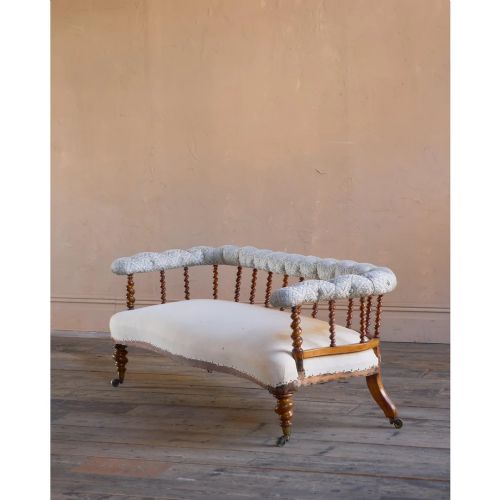
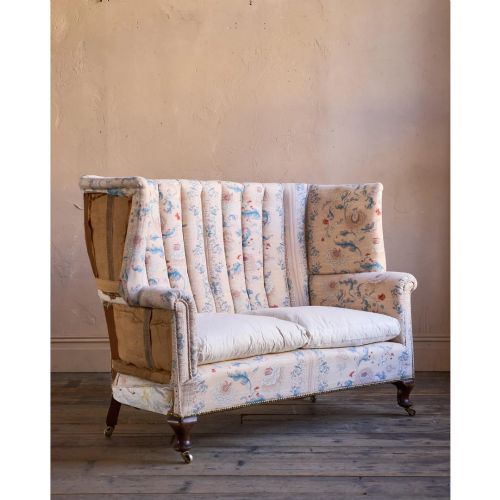


Cream Fabric Mahogany Settee
A cream fabric mahogany settee brings timeless warmth to a drawing room, offering the perfect blend of structural timber and soft upholstery.
Cream Fabric Mahogany Settee
A cream fabric mahogany settee is a seating piece built from rich hardwood frames and upholstered in pale textiles, encompassing forms from the eighteenth century through to the Edwardian period. Buyers searching for a cream fabric mahogany settee will encounter various stylistic interpretations, including George III camel backs, William IV scroll arms, and elaborate parlour suites.
The most common examples on this page date from the nineteenth century, featuring robust mahogany frames paired with neutral upholstery fabrics like cotton chintz and hessian. These settees range from large country house sofas to triple-back designs, all anchored by the dark, reddish grain of traditional timber.
Materials and construction methods
Makers built these frames using solid mahogany, frequently shaped with carved scroll arms, fluted details, or spindle backs that display the natural grain of the wood. Brass fittings and inlay work in satinwood occasionally accent the primary timber structure on finer examples.
Traditional upholstery techniques involved securing fabric over hessian and stuffing layers, creating supportive seats and backs that complemented the rigid wooden skeletons. These construction methods ensure that the frames remain durable while supporting soft, cream textile coverings.
Listings feature mahogany, brass, cotton chintz, and hessian across eighteenth-century to Edwardian periods.
Distinguishing craftsmanship and design
Quality in these settees rests on the crispness of the mahogany carving and the architectural proportion of the frame, where restrained lines and balanced proportions separate superior cabinet work from simpler builds. The integration of decorative elements like satinwood inlay or well-executed scroll arms elevates a piece above standard workshop production.
The sophistication of the silhouette defines the upper tier of the range, seen in classic camel backs and triple-back forms that require precise joinery. Material selection also plays a role, with dense, deeply figured mahogany providing a more substantial presence than plain utility timber.
C. Hindley & Sons
The Cream Fabric Mahogany Settee Glossary
- Mahogany
- A durable, reddish-brown tropical hardwood prized for its stability and fine grain, widely used in quality furniture frames throughout the eighteenth and nineteenth centuries.
- Camel back
- A traditional sofa or settee back shape featuring a graceful, continuous upward curve resembling a camel's hump, popular in Georgian designs.
- Scroll arm
- A curved, volute-shaped wooden or upholstered armrest that rolls outward at the end, frequently seen on nineteenth-century seating.
- Parlour suite
- A matching set of upholstered seating furniture designed for formal reception rooms, often comprising a sofa and complementary armchairs.
- Cotton chintz
- A smooth, densely woven cotton fabric often used for traditional upholstery, providing a crisp surface that complements dark wood frames.
Cream Fabric Mahogany Settee: Frequently Asked Questions
What periods do these settees come from?
The listings span several centuries, including eighteenth-century pieces, numerous nineteenth-century examples, and Edwardian or later interpretations.
Craftsmanship evolved across these eras, moving from formal Georgian proportions to more eclectic Victorian and Edwardian revival styles.
How do I identify a George III style settee?
George III style settees often feature characteristic outlines such as the arched camel back or traditional chair-back arrangements.
These designs lean on historical proportions, emphasising clean structural lines and restrained decorative carving rather than heavy Victorian ornamentation.
What textiles are used for the upholstery?
Upholstery materials typically include cream fabrics, cotton chintz, and foundational layers like hessian beneath the surface.
These pale textiles provide a neutral contrast to the dark reddish tones of the underlying mahogany frames.
Where should I place a settee in my home?
These pieces suit formal drawing rooms, spacious hallways, or living areas where a substantial wooden frame can anchor the space.
The neutral cream fabric allows them to integrate easily into both traditional and transitional interior schemes.