


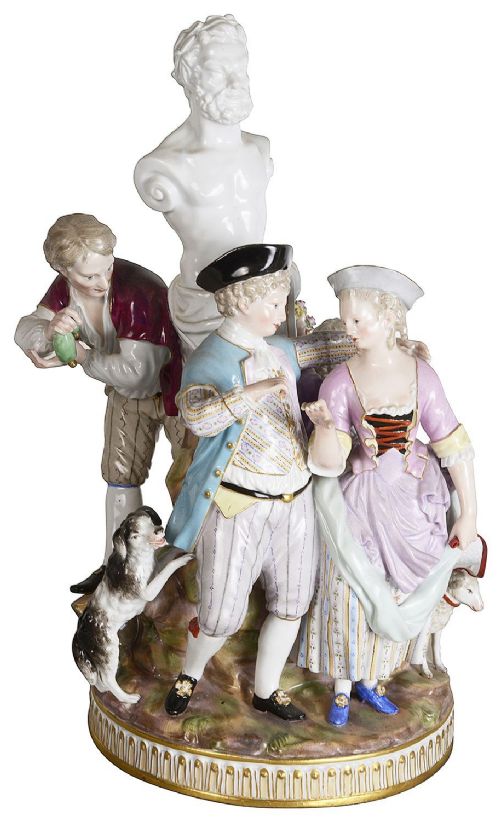


Courting Couple Porcelain
These courting couple porcelain figures bring theatrical romantic charm into a room, offering rich historical detail and fine craftsmanship.
Courting Couple Porcelain
When searching for courting couple porcelain, you encounter figures, decorative figurines, and lamp bases that depict romantic pairs in elaborate dress. These pieces primarily date from the eighteenth and nineteenth centuries, with Victorian examples appearing frequently.
The selection ranges from German pairs and groups originating from Meissen, Volkstedt, and Dresden to French biscuit figures and Paris porcelain lace groups. Forms include table lamps, musical figures, and delicate groups complete with harps or classical busts.
How they were made
Makeries shaped hard-paste porcelain, bisque porcelain, and faience, applying enamel painting and intricate gold leaf or gilding by hand. Some French works incorporate metal mounts or delicate applied porcelain lace.
German factories such as Meissen and Volkstedt utilised precise moulding and hand-modelling techniques to capture the fine textures of eighteenth-century and Rococo Revival costume.
Some romantic couples come equipped with miniature harps or classical busts, ensuring the romance remains thoroughly musical and architectural.
What varies in quality
Quality rests in the crispness of the modelling and the finesse of the hand-painted enamel details, particularly across the faces and garments of the figures. Superior examples display delicate articulation in floral elements, lace work, and gilt highlights.
The prestige of the manufactory, from Meissen to Paris studios, dictates much of the standing, alongside the complexity of the grouping, such as multi-figure musical scenes or incorporated classical architecture.
Bourdois & Bloch Paris·Letu & Mauger Paris·Triebner Ens & Co·Carl Thieme Dresden·Augustus Rex
The Courting Couple Porcelain Glossary
- Bisque porcelain
- Unglazed porcelain with a matte, marble-like texture that highlights sculptural detail. This material is frequently used for nineteenth-century romantic figures.
- Hard-paste porcelain
- A durable ceramic composition fired at high temperatures, developed in Europe during the eighteenth century. It forms the body of many German figurines.
- Gilding
- The application of gold leaf or powdered gold to porcelain surfaces for decoration. It often accents the Rococo Revival bases and garments.
- Rococo Revival
- A nineteenth-century design style reviving the asymmetrical scrolls, curves, and ornate flourishes of the earlier French movement. It shapes the pedestals and frames of many figures.
- Faience
- Tin-glazed earthenware produced in France and other European regions. It appears in alternative antique figurine pairs depicting Gallants and ladies.
Courting Couple Porcelain: Frequently Asked Questions
What periods do these pieces date from?
The pieces span from the eighteenth century through the nineteenth century, including Victorian era examples and later twentieth-century German works. Eighteenth-century pieces often originate from factories like Ludwigsburg, while nineteenth-century items reflect Rococo Revival tastes.
Victorian interpretations frequently incorporate musical elements or table lamp adaptations, reflecting changing domestic uses for decorative ceramics over the decades.
How were courting porcelain figures used historically?
These figures served as decorative mantel ornaments and table centerpieces in wealthy European parlours and chateaux. They expressed romantic ideals and pastoral fantasies popular among the upper classes.
Later Victorian iterations sometimes functioned as musical automatons or were later converted into functional table lamps, integrating romantic art into daily lighting.
How do you tell German and French pieces apart?
German pieces often emerge from noted centres like Meissen, Dresden, and Volkstedt, frequently utilising hard-paste porcelain with bright enamel and gilt decoration. French works often include biscuit porcelain, Paris porcelain lace groups, or faience bodies.
Stylistic cues also separate them, as French items frequently lean towards sophisticated Paris studio aesthetics or Second Empire interpretations, while German pieces often reference earlier Meissen traditions.
What is the difference between bisque and glazed porcelain?
Bisque porcelain remains unglazed after firing, presenting a matte, porous surface resembling white marble that captures fine facial expressions and clothing folds. Glazed porcelain receives a glassy coating before its final high-temperature firing, yielding a shiny, reflective finish.
Glazed surfaces protect painted enamel and gilding more easily, whereas bisque requires careful handling to prevent staining on its porous matte exterior.
How should I display porcelain figures at home?
Place figures in stable cabinets or on sturdy mantelpieces away from direct traffic to protect delicate extremities like outstretched hands, harps, and applied lace. Ensure display areas avoid direct sunlight to preserve hand-painted enamel colours.
Keep pieces clear of sources of vibration, particularly if displaying musical figures or table lamps with delicate porcelain components.