
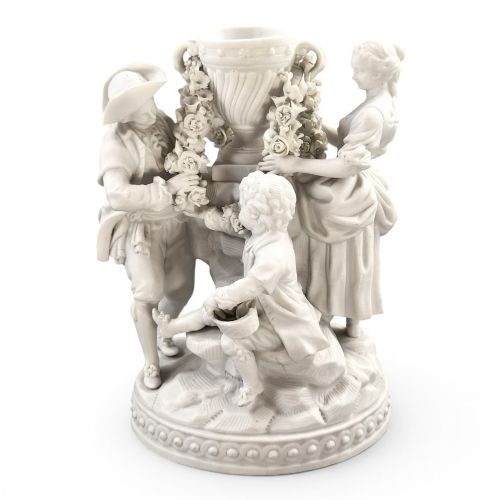


French Porcelain Group
These french porcelain group figures bring theatrical movement and fine modelling to a room, ranging from rococo pastorals to classical mythology.
French Porcelain Group
A french porcelain group depicts multiple figures interacting in pastoral, mythological or theatrical scenes, capturing elaborate narratives in three dimensions. These pieces often take the form of sculptural groups, lace figures with musical instruments, or mythological pairings such as Venus and Cupid.
The versions most frequently met on this page date from the nineteenth century, including Victorian interpretations and pieces in the French Rococo Revival style. Earlier examples stretch back to the eighteenth century, showing soft-paste figures and chinoiserie compositions.
Originating largely from Parisian workshops and factories such as Vieux Paris, Niderviller and Samson, these decorative sculptures reflect diverse European tastes. Makers often drew inspiration from earlier Meissen or Chelsea styles, adapting them with distinct French flair.
Materials and Techniques
The foundation of these pieces is hard-paste or soft-paste porcelain, sometimes left unglazed as bisque or biscuit porcelain to resemble carved marble. Makers also utilised delicate ceramic lace applied directly to the porcelain body, requiring immense skill during high-temperature firing.
Enamel colours and gold leaf accents bring surface detail to the figures, highlighting garments and facial expressions. Selected nineteenth-century groups integrate gilt bronze or ormolu mounts, combining metalwork with ceramic sculpture.
Listings feature 18th-century soft-paste pieces alongside 19th-century Victorian works, utilising bisque porcelain, glaze, gold leaf, and gilt bronze mounts.
Assessing Quality
The prestige of the maker or workshop influences distinction, with signed works or pieces bearing factory marks from established Parisian houses commanding greater attention. The preservation of fragile appendages and gilding also marks the difference between average examples and finer survivals.
Bourdois and Bloch Paris·Luca Madrassi·Eugene Clauss of Paris·Vion et Baury
The French Porcelain Group Glossary
- Soft-paste porcelain
- An artificial ceramic composition developed before hard-paste porcelain became widespread in Europe. It possesses a warmer tone and a softer glaze that interacts distinctly with enamel colours.
- Ormolu
- Gilded bronze used for decorative mounts and stands on ceramic objects. It provides a bright metallic contrast to the porcelain bodies.
- Rococo Revival
- A nineteenth-century design movement that revived the asymmetrical scrolls, shell motifs and playful pastoral themes of the eighteenth century. It dominates many of the sculptural groupings found in this category.
- Chinoiserie
- A European artistic interpretation of Chinese and East Asian motifs. It appears on mid-eighteenth-century figures dressed in theatrical oriental costume.
French Porcelain Group: Frequently Asked Questions
What is a porcelain group?
A porcelain group is a multi-figure ceramic sculpture depicting a narrative scene, such as a musical performance, a mythological encounter or a pastoral idyll. These pieces are modelled in the round and designed as centrepieces for display.
They bring considerable sculptural presence to a room, combining the ceramic artist's skill in modelling with detailed hand-painting and gilding.
How do I date a french porcelain group?
Dating relies on factory marks, glaze characteristics, and stylistic cues such as whether a piece adheres to strict eighteenth-century rococo aesthetics or nineteenth-century revival styles. Examining the base and the composition gives further clues to the period of manufacture.
Finer details like the application of enamel colours and the presence of unglazed biscuit porcelain also help place a piece within the eighteenth or nineteenth century.
Where were these figures made?
The majority originate from established French workshops and factories, particularly in Paris, alongside regional production sites like Niderviller. Some makers also produced pieces in the style of German or English factories such as Meissen and Chelsea.
Parisian houses dominated much of the nineteenth-century output, supplying ornate decorative objects to an international market.
How should I display porcelain figures?
These delicate sculptures require a stable surface away from heavy foot traffic or direct sunlight, which can fade delicate enamel colours over time. Enclosed cabinets or shelves with adequate depth protect fragile elements like lace and floral garlands from accidental damage.
Because many groups are finished on all sides, placing them where they can be viewed from multiple angles allows full appreciation of the modelling.