
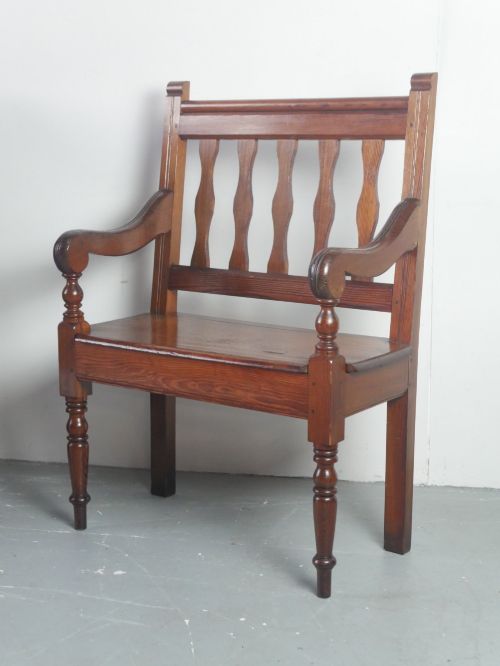
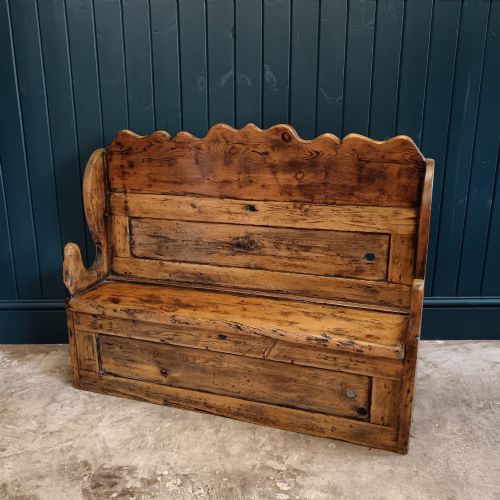

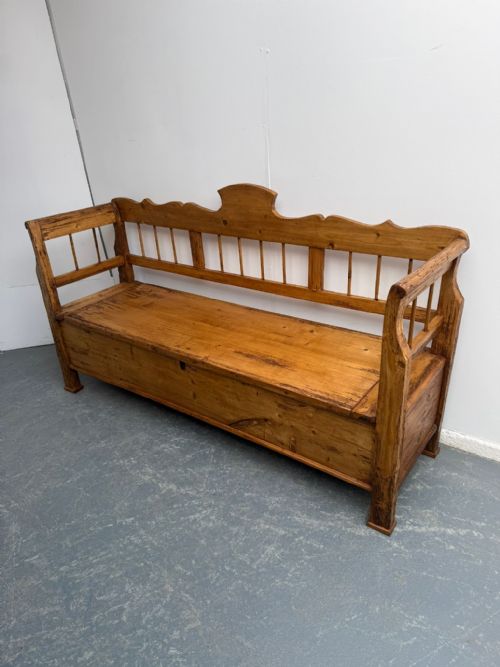
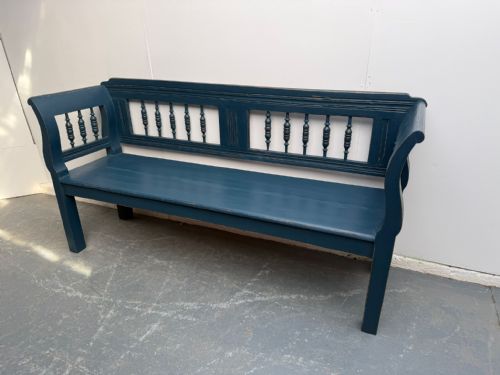


Country Pine Entry Bench
These country pine entry bench examples offer practical seating and storage, bringing robust vernacular character and timeless utility to hallways.
Country Pine Entry Bench
A country pine entry bench serves as a functional seating and storage solution, frequently appearing as a hall bench, settle bench, or box settle. These pieces originate across various regions including England, Wales, Hungary, Sweden, and Austria, dating from the eighteenth century through to nineteen hundred.
The selection encompasses tall-backed box settles with integrated storage compartments alongside slimmer hallway benches and tavern benches. Buyers will encounter both natural waxed finishes and original painted surfaces in colours such as grey, blue, and white.
Forms range from simple two-seater boards to large panelled seating designed to block draughts in traditional domestic spaces. Stylistic influences span from Georgian country and Victorian country to Gustavian and Arts and Crafts traditions.
Materials and construction
Construction relies heavily on solid pine and pitch pine, occasionally supplemented with elm for seating boards and iron fixings or ceramic elements. Master carpenters utilised straightforward joinery such as panelled construction and pegged mortise and tenon joints to ensure daily durability.
Surface treatments vary between simple wax polishing to highlight the natural grain and coats of original paint. Many regional pieces preserve their historical painted finishes, showing the accumulation of wear across generations of domestic use.
Materials span solid pine, pitch pine, elm, iron, and ceramic, finished in either natural wax or historical paint schemes.
Assessing quality in vernacular seating
Quality rests upon the integrity of the original construction and the preservation of authentic surface finishes. Pieces retaining undisturbed original paintwork or deep natural wax patination hold distinct character compared to those with modern intervention.
Proportion and structural balance dictate the success of the piece, particularly where storage boxes or high panelled backs are integrated. The retention of original fixings and timber stability distinguishes superior examples from heavily restored furniture.
The Country Pine Entry Bench Glossary
- Settle
- A wooden bench with a high back, solid arms, and often a box base for storage. This form was designed to keep out cold draughts in traditional rooms.
- Box Settle
- A variant featuring a hinged seat lifting to reveal a deep storage compartment underneath. It combines seating with domestic utility.
- Pitch Pine
- A dense, resinous variety of pine timber utilised for durability and strong grain patterns. It provides robust structural support for heavy use.
- Gustavian
- A Swedish neoclassical style originating in the late eighteenth century, known for lighter proportions and pale painted surfaces. It influences many Scandinavian country pieces.
- Tavern Bench
- A long, sturdy seating form originally built for public houses and commercial spaces. These pieces prioritise simple strength and stability.
Country Pine Entry Bench: Frequently Asked Questions
What is a box settle?
A box settle is a traditional wooden bench that incorporates a hinged seat lifting to reveal a storage compartment beneath.
These pieces were historically placed near hearths or in hallways to store blankets and boots while keeping out cold draughts.
Are these benches comfortable?
Most vernacular benches feature upright wooden backs and solid seats designed for utility rather than lounging.
Buyers often add loose cushions or squabs to soften the seating for everyday hallway use.
How do I care for wax finished pine?
Wax finished pine requires occasional treatment with a quality beeswax to nourish the timber and maintain its protective sheen.
Avoid placing these benches in direct sunlight or near heat sources to prevent the wood from drying out.
How to spot original paint?
Original painted surfaces display natural craquelure, authentic wear patterns, and layered tones that indicate age.
Inspection under close light reveals the integration of the pigment into the underlying timber pores rather than a modern uniform coating.