

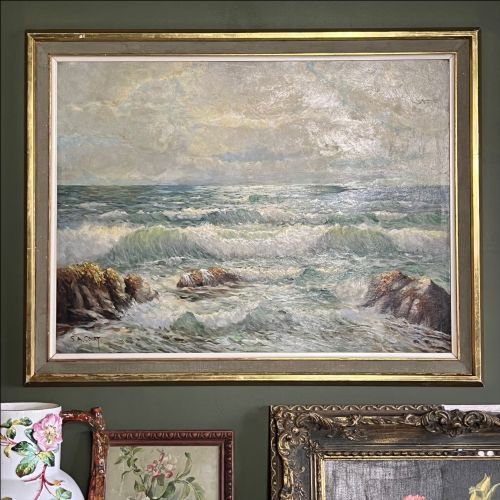



Cornish Impressionist Marine Painting
These Cornish impressionist marine painting examples capture Atlantic light and harbour life across shifting coastal decades.
Cornish Impressionist Marine Painting
A cornish impressionist marine painting records the fishing ports, rocky coves, and tidal harbours of the southwestern peninsula. These works span from late nineteenth-century Victorian fine art and Edwardian watercolours through to mid-century impressionism and the Newlyn school tradition.
Most examples concentrate on specific coastal locations such as St Ives, Polperro, Looe, and Mevagissey. The compositions range from bustling harbour scenes with fisherfolk to quiet en plein air studies of coastal Cornwall.
The dominant forms are traditional oil paintings on canvas or wood, alongside detailed watercolours on paper. Buyers encounter framed pieces protected by glass as well as unglazed canvases.
Materials and Methods
Artists painted using oil paint on canvas and wood panels, or applied watercolour directly onto paper. These mediums allowed painters to work en plein air, capturing rapid shifts in weather and sea conditions along the shore.
Brushes were handled with varying degrees of looseness to render the movement of water and the texture of stone buildings. Support materials like paper and canvas were selected to hold pigment against damp maritime air.
Cornish Impressionist Marine Painting Retail Price Guide 2026
Typical asking prices for cornish impressionist marine painting among the pieces listed under this phrase on Sellingantiques today, from the lower quarter to the upper quarter. They describe what is for sale here now, not the wider market.
Salt-tinged air has spent a century whispering behind these watercolours.
Evaluating Quality and Hand
Quality rests upon the sureness of the brushwork and the artist's ability to command light on water. Stronger pieces demonstrate a confident handling of pigment that defines harbour architecture and sea spray without heavy outlining.
Provenance and signature clarity elevate certain works within the tradition. Works linked directly to established regional groups or known signatories carry greater historical weight in the composition range.
Sidney A. Court·William Banks Fortescue·Frank Kelsey·Ernest F. Hill·Frederick Stuart Richardson·William Lambert Bell·Jack R. Mould·William Lee Hankey·S. J. Lamorna Birch
The Cornish Impressionist Marine Painting Glossary
- En plein air
- Painting out of doors to capture direct natural light and atmospheric effects. This method defined much of the plein air output found in British impressionism.
- Newlyn School
- An art colony based in Cornwall focused on realist and impressionist depictions of local fishermen and coastal life. Members worked closely with the surrounding landscape.
- Watercolour
- A paint consisting of pigment suspended in a water-soluble vehicle, typically applied to paper. It offers transparent washes suited to coastal skies.
- Oil paint
- A slow-drying paint made with pigmented particles suspended in oil. It allows rich texture and depth in marine studies.
Cornish Impressionist Marine Painting: Frequently Asked Questions
What periods do these paintings cover?
The selection spans from the late nineteenth century through the early decades of the twentieth century, with examples extending into the nineteen-sixties. This covers Victorian fine art, Edwardian studies, and mid-century impressionism.
Changes in style across these decades show a gradual shift towards looser brushwork while maintaining a focus on Cornish harbours.
Are these works painted outdoors?
Many of these pieces were executed en plein air directly on location by the coast. Artists set up easels in places like St Ives and Polperro to record immediate changes in light.
Studio finishing sometimes followed initial outdoor watercolours and oil sketches.
What mediums were used?
Artists utilised oil paint on canvas and wood boards, alongside watercolour applied to paper. These materials handled the coastal atmosphere differently, with oils offering rich texture and watercolours providing luminous washes.
Frames often include glass protection for works on paper.
Which Cornish locations appear most often?
St Ives, Polperro, Looe, and Mevagissey feature frequently in the titles and subject matter. These ports provided artists with active harbours, boats, and stone quays.
Surrounding coastal cliffs and fishing quarters also form core subjects.