



Cornish Coastal Wall Art
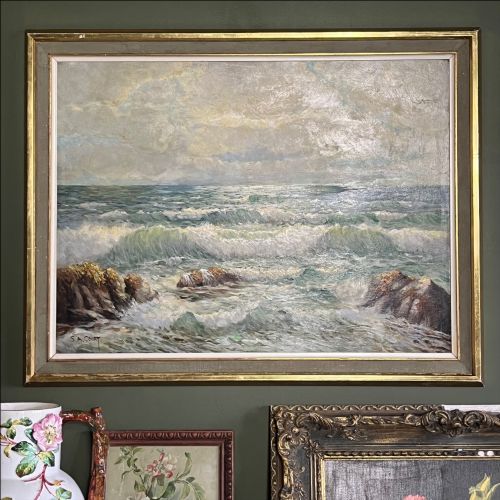
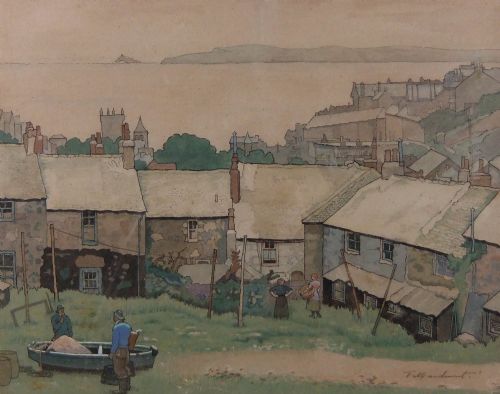
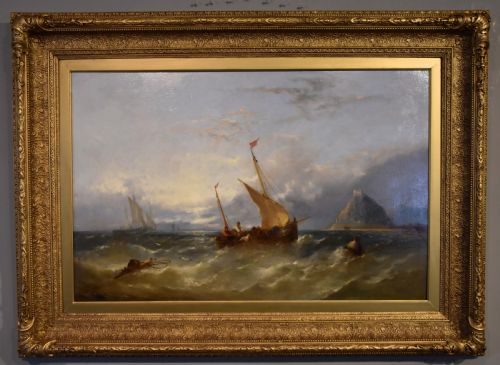
These pieces of cornish coastal wall art capture the harbours, luggers, and rocky shores of the far south-west through traditional brushwork.
Cornish Coastal Wall Art
Cornish coastal wall art encompasses paintings, watercolours, and framed artwork depicting harbours, fishing boats, and maritime scenes across the south-west peninsula. Buyers encounter Victorian watercolours alongside early twentieth-century oil paintings that record fishing communities and dramatic tides.
The selection ranges from detailed nineteenth-century harbour views to impressionist interpretations of coastal villages like St Ives, Mevagissey, and Polperro. Many pieces reflect the distinct regional output associated with the Newlyn and St Ives schools.
Framed works in oil and watercolour dominate the selection, often preserved in original gilt wood or simple wooden frames. These works span from the Victorian period through to the mid-twentieth century, capturing changing coastal light.
Materials and technique
Artists painted en plein air or in studios using oil paint on canvas or watercolour on paper, capturing maritime atmosphere and coastal light. Selected works also utilise pastel drawing and woodblock print techniques to render local topography.
Support materials typically include prepared canvas, stretched paper, and wooden panels housed within period wooden or gilt wood frames. These traditional substrates have preserved the pigments of nineteenth and twentieth-century coastal scenes.
Listings feature paper and canvas supports using oil paint, watercolour, and pastel across periods spanning the Victorian era to the mid-twentieth century.
Evaluating quality
Quality rests upon the artist's command of light and atmosphere, distinguishing evocative coastal topography from standard topographical illustration. Stronger examples display assured brushwork and accurate observation of maritime conditions.
The survival of original framing and the clarity of the artist's signature or attribution elevate a piece's historical integrity. Provenance linking the work to established regional art colonies further defines the better items in the range.
Sidney A. Court·William Banks Fortescue·Thomas Maidment·William Henry Williamson·George F Pennington·Edward Matthew Elliott·Charles Napier Hemy·Richard Harry Carter·Gyrth Russell·Charles Sim Mottram·William Pitt·Ernest F. Hill·Ralph Todd·Jack R Mould·William Lee Hankey·S. J. Lamorna Birch·Herbert James·Cuthbert Crossley
The Cornish Coastal Wall Art Glossary
- En plein air
- Painting outdoors to capture direct observations of natural light and weather. This method defined much of the realist work produced along the coast.
- Newlyn school
- An art colony based in West Cornwall from the late nineteenth century onwards. Artists associated with this group focused on realist depictions of local fisherfolk and harbour life.
- Lugger
- A traditional two-masted fishing vessel common off the Cornish coast. These boats frequently appear in maritime paintings from the Victorian and Edwardian eras.
- Gilt wood
- Wood covered with a thin layer of gold leaf or gold paint. Frames treated in this manner often accompany formal Victorian and Edwardian fine art pieces.
Cornish Coastal Wall Art: Frequently Asked Questions
What periods do these pieces date from?
The works span from the Victorian era and the late nineteenth century through to the mid-twentieth century. Most examples cluster around the Edwardian period and the interwar decades.
Artists active during these times recorded the traditional maritime trades and coastal topography of Cornwall before modern development altered the harbours.
Where were these coastal scenes painted?
Locations focus primarily on Cornish fishing ports and landmarks, including St Ives, Mevagissey, Polperro, and St Michael's Mount. Neighbouring Devon is also represented through maritime views.
Many painters worked directly on location in these harbours, recording local luggers, fish markets, and dramatic tidal shifts.
Are the artworks framed?
Many listings include period frames, ranging from gilt wood surrounds to simple wooden mouldings. These housings often complement the age and origin of the painting.
Buyers should examine the description to confirm whether a particular artwork retains its original period frame or has been remounted later.
How do I identify Newlyn school art?
Newlyn school pieces typically feature realist portrayals of fisherfolk, harbour activities, and coastal life painted with naturalistic lighting. The artists lived and worked in West Cornwall to observe local subjects firsthand.
Signatures, exhibition records, and biographical details help attribute works to this specific regional movement.