


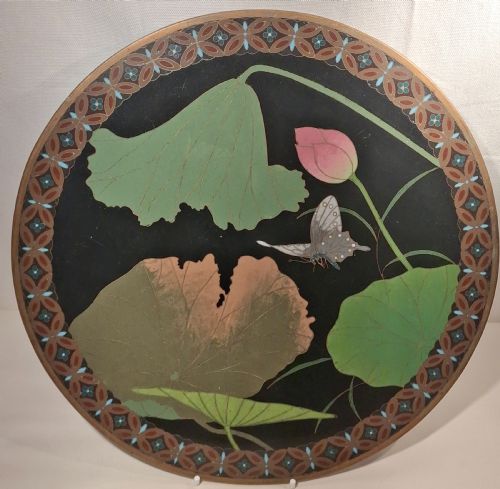


Copper Cloisonne Wall Charger
These copper cloisonne wall charger pieces bring intricate Japanese metalwork and enamel into a room, offering rich colour and historic detail.
Copper Cloisonne Wall Charger
A copper cloisonne wall charger is a decorative plate or plaque designed for display, typically featuring detailed imagery created with applied wire and coloured glass. When searching for a copper cloisonne wall charger, buyers encounter substantial circular pieces measuring up to forty centimetres in diameter.
The objects originate primarily from the late Edo period through to the Meiji period, spanning the mid-nineteenth century to the turn of the twentieth century. These works take the form of chargers, medium plates and large plaques featuring subjects such as dragons, koi, phoenix birds and Mount Fuji.
Japanese artisans produced these display items to satisfy both domestic demand and export markets during a period of intense artistic refinement. The examples found here demonstrate the traditional craftsmanship of Meiji and late Edo workshops.
Materials and construction
The foundation of each piece is a heavy copper body shaped into a circular charger or plate, sometimes accompanied by brass elements or wooden framing components. Artisans hammer and shape the copper base to form a rigid canvas for the subsequent decorative layers.
Fine wire, often brass or copper, is bent into intricate patterns and soldered onto the metal surface to form compartments known as cloisons. These individual cells are then filled with vitreous enamel paste and fired in a kiln before the entire surface is ground and polished smooth.
Copper Cloisonne Wall Charger Retail Price Guide 2026
Typical asking prices for copper cloisonne wall charger among the pieces listed under this phrase on Sellingantiques today, from the lower quarter to the upper quarter. They describe what is for sale here now, not the wider market.
The listings span the late Edo period and the Meiji period, utilising copper, brass wire and vitreous enamel.
Assessing quality and execution
Quality rests upon the complexity and precision of the wirework, where thinner lines and denser compartments denote greater skill on the part of the artisan. The variety of motifs, from single dragons to complex figurative scenes involving samurai, also marks the distinction between standard production and masterworks.
The depth of colour within the vitreous enamel and the smoothness of the final polished finish separate standard decorative plates from exceptional plaques. Pieces bearing signatures reflect individual workshop pride and a higher standard of artistic ambition.
The Copper Cloisonne Wall Charger Glossary
- Cloisonne enamel
- A decorative technique where metal wire is soldered to a metal base to create compartments that hold enamel paste. This method allows for intricate pictorial designs on metal objects.
- Charger
- A large ornamental plate or dish intended primarily for display on a wall or sideboard rather than for serving food. These pieces often feature prominent central imagery.
- Vitreous enamel
- A material made by fusing powdered glass to a substrate by firing, usually at high temperatures. The resulting glossy coating provides durable and vibrant colour.
- Meiji Period
- A Japanese historical era spanning from 1868 to 1912, characterised by rapid modernisation and the flourishing of decorative arts for export. Many fine metalwork pieces date from this time.
- Mon
- A Japanese heraldic badge or emblem used to identify families or individuals. These traditional crests frequently appear within the decorative borders of Japanese metalwork.
Copper Cloisonne Wall Charger: Frequently Asked Questions
How do I hang a heavy charger safely?
Displaying a large copper plaque requires a specialised wall mount that supports the entire base rather than relying solely on a simple wire hanger. Ensure the fixing is secured directly into wall studs to bear the weight of the metal securely.
Position the piece away from direct sunlight and moisture to protect the delicate vitreous enamel surface from temperature fluctuations and fading over time.
What subjects typically appear on these plates?
The ornamentation draws heavily from traditional Japanese mythology and nature, frequently depicting creatures such as dragons, Ho-o birds, koi and owls. Figures including samurai and Buddha also form the central narrative of specific plates.
Backgrounds often incorporate natural landmarks like Mount Fuji alongside detailed botanical tendrils and geometric Mon crests.
How do I distinguish Meiji pieces from earlier works?
Dating relies on stylistic markers and construction traits associated with Japanese metalwork evolution across the nineteenth century. Pieces attributed to the late Edo period reflect early techniques that preceded the large-scale export boom.
Meiji examples frequently exhibit refined wirework and diverse pictorial themes developed during the later decades of the nineteenth century.
How should I clean my enamel charger?
Maintenance involves gentle dusting with a soft, dry cloth to prevent the accumulation of particles within the wire channels. Avoid liquid cleaners, chemical polishes or abrasive cloths that can scratch the polished enamel or corrode the exposed metal elements.
Professional assessment is recommended if the surface requires deeper conservation or restoration work.