

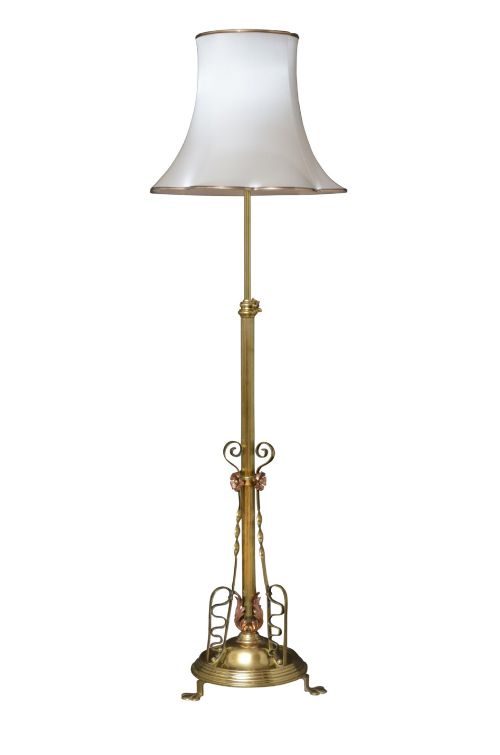


Copper and Brass Floor Lamp
These copper and brass floor lamps combine warm metalwork with practical height adjustment to illuminate period rooms.
Copper and Brass Floor Lamp
A copper and brass floor lamp offers a sturdy vertical standard designed to hold a light source well above floor level in principal rooms. These pieces combine the bright polish of brass with the rich, warm tone of copper, often featuring telescopic stems or adjustable mechanisms.
Buyers on this page most frequently encounter Victorian, Edwardian, and turn-of-the-century examples spanning styles from Late Victorian to Art Nouveau and Arts and Crafts. Many of these standard lamps began life as oil lamps before later conversion to electricity.
The surviving selection includes single floor standing examples alongside matched pairs suitable for larger drawing rooms. Their forms range from simple telescopic pillars to elaborate designs incorporating cranberry glass fonts and extended metal brackets.
How they were made
Maker workshops utilised solid brass and sheet copper, hammering and joining the metals to create stable weighted bases and slender upright columns. Extending sections relied on internal sliding tubes and screw keys to allow height adjustment.
Some examples incorporated delicate glass components, such as cranberry glass reservoirs, held securely within metal galleries. Fabric elements often completed the shade assembly above the metallic structure.
Copper and Brass Floor Lamp Retail Price Guide 2026
Typical asking prices for copper and brass floor lamp among the pieces listed under this phrase on Sellingantiques today, from the lower quarter to the upper quarter. They describe what is for sale here now, not the wider market.
W A S Benson once patented lighting so clever that even Arthur Conan Doyle's fictional detectives might have struggled to trace the wiring.
What varies in quality
The distinction between standard production and superior work rests on the weight of the metal and the precision of the adjustable mechanism. Heavier gauge brass and thick copper sheet ensure the standard remains stable when fully extended.
Artistry in the joining and the crispness of decorative detailing separate ordinary utilitarian lighting from pieces bearing distinct stylistic markers of the Arts and Crafts or Art Nouveau movements.
W A S Benson
The Copper and Brass Floor Lamp Glossary
- Standard lamp
- A tall freestanding floor lamp designed to illuminate a room from a vertical pillar. This term appears frequently alongside floor lamp in period descriptions.
- Telescopic
- An adjustable shaft design featuring concentric tubes that slide within one another to alter the overall height. This mechanism allowed users to direct light downwards as required.
- Cranberry glass
- A rich pinkish-red glass produced by adding gold chloride to the molten batch. It frequently forms the oil reservoir portion of late nineteenth-century standards.
- Arts and Crafts
- A design movement valuing visible construction and honest materials over machine-made ornamentation. Pieces from this tradition often display hand-hammered copper surfaces.
Copper and Brass Floor Lamp: Frequently Asked Questions
What is a standard lamp?
A standard lamp is simply a traditional British term for a tall floor lamp designed to stand upright in a room.
These pieces typically feature a heavy base and a central column that holds a light fixture or burner at reading height.
How do adjustable floor lamps work?
Adjustable models use a telescopic mechanism where an inner brass or copper tube slides inside an outer shaft.
A thumbscrew or key secures the upper section at the desired height for the room.
Were these originally oil lamps?
Many nineteenth-century examples started as oil-burning standards before being adapted for electric lighting later on.
Surviving evidence includes reservoirs and galleries originally intended to hold glass fonts and burners.
How do I identify an Art Nouveau lamp?
Art Nouveau examples display flowing organic lines and stylised floral motifs in the brass and copper metalwork.
This aesthetic dominated around nineteen hundred, moving away from strict Victorian symmetry.