
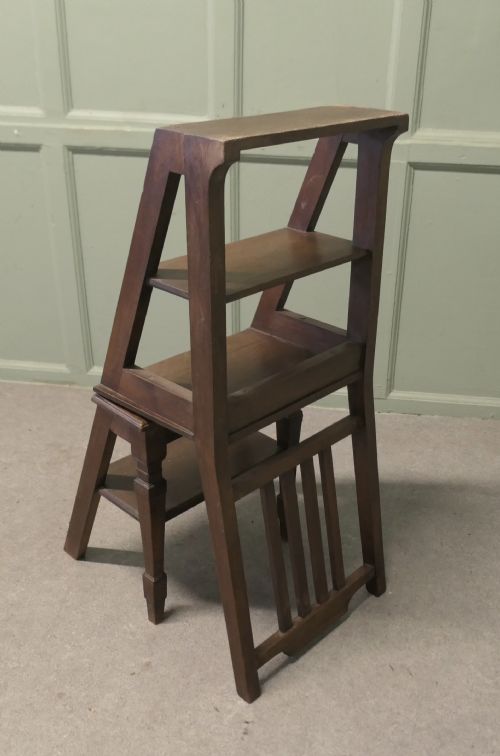
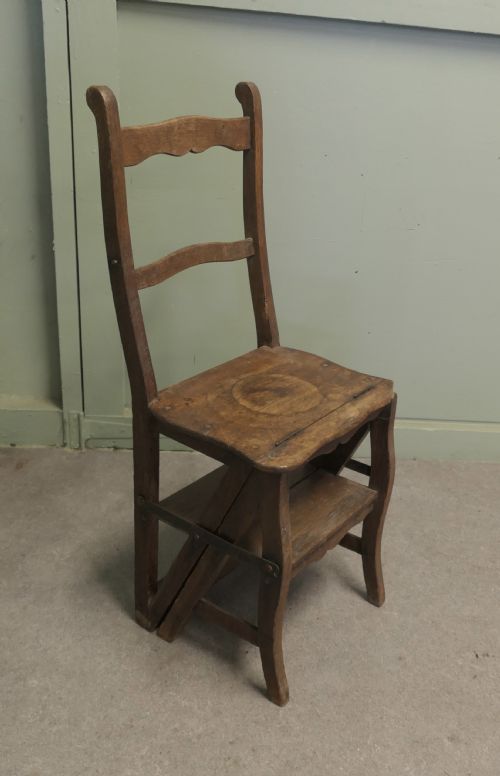
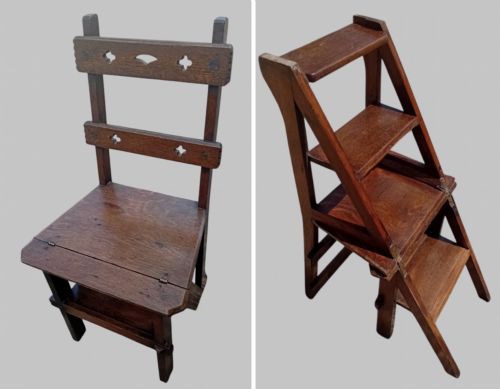


Convertible Library Stool
These convertible library stool examples transform from seating into sturdy steps for high shelves, offering dual utility that practical collectors prize.
Convertible Library Stool
A convertible library stool combines a seat with a set of steps, providing dual utility for domestic spaces with high shelving. When searching for a convertible library stool, buyers encounter pieces functioning primarily as armchairs, chairs, or standalone steps that unfold or rotate.
The selections span periods from the Georgian and 18th Century eras through the 19th Century, Victorian, Edwardian, and 1890 periods. Styles represented include Georgian, Regency, Gothic Revival, Victorian Gothic Revival, Arts & Crafts, and French Country.
Object types appearing in this category include library steps, armchairs, metamorphic chairs, and library chairs. The most common forms merge a chair with folding ladder steps housed beneath the seat or pivoting into position.
Materials and construction methods
Timbers employed in these pieces consist of oak, mahogany, and hardwood, providing the structural strength required to support weight during both seating and climbing. These woods are occasionally paired with secondary elements like cane or leather.
Functional movement relies on metal components, specifically brass and iron hinges, pivots, and locking brackets that allow the framework to shift smoothly between configurations. These mechanical parts enable the transformation from stool or chair to ladder without compromising stability.
Some chairs conceal their climbing duties so thoroughly that unsuspecting guests risk a startling descent straight into the bookshelf.
Factors that separate examples
The sophistication of the mechanical transitions distinguishes standard workshop output from more ambitious designs. Pieces that move with precise alignment and secure locking mechanisms reflect superior initial planning.
The choice of primary timber and secondary materials dictates visual and structural success. Examples utilising finely figured mahogany or substantial oak with complementary leather or cane retain greater integrity through frequent transformation.
J.Jarvis·Richard Hicks Bridgens
The Convertible Library Stool Glossary
- Metamorphic furniture
- Pieces designed to transform from one furniture form into another, such as a chair turning into a set of steps. This ingenuity was particularly popular in domestic libraries during the Georgian and Victorian eras.
- Library steps
- Free-standing flights of stairs used to reach high bookshelves before the widespread adoption of built-in rolling ladders. They often incorporated handrails or enclosed treads.
- Arts and Crafts
- A design movement emphasising handcraftsmanship, simple forms, and traditional materials over industrial mass production. Pieces from this era often highlight exposed construction joints and solid oak.
- Gothic Revival
- An architectural and decorative style drawing inspiration from medieval forms, featuring pointed arches and heavy ornamentation. In seating, this translates to structured frames and geometric carvings.
- Regency
- A British design period spanning the early 19th century, known for classical restraint and inspiration drawn from ancient Greece and Rome. Mahogany and brass inlay frequently appear in items from this phase.
Convertible Library Stool: Frequently Asked Questions
How do convertible library steps work?
These pieces use concealed hinges, pivots, and sliding tracks to reconfigure the wooden frame. Sections of the seat or backrest unfold outward to form a stable flight of steps.
Once the user finishes climbing, the steps fold back into the footprint of the chair or stool. This clever mechanism allows a single piece of furniture to serve two distinct domestic functions.
What woods were used for library steps?
Cabinetmakers primarily relied on hardwoods like mahogany and oak to ensure the structure could bear weight safely. These timbers provided the necessary density and load-bearing capacity for frequent transformation.
Secondary materials such as leather inserts for seats and brass or iron for the mechanical joints appear regularly. Cane is also utilised on specific seating surfaces within the selection.
How do I date a library stool?
Dating relies on stylistic clues and construction methods corresponding to periods like the Georgian era, Victorian period, or Edwardian years. Details such as Gothic Revival motifs or Arts and Crafts simplicity point to specific design movements.
Makers' marks or stamps, when present, offer further historical context. Examining the type of hardware and secondary woods helps narrow down the decade of production.
Where were these pieces used?
They originated in domestic libraries, studies, and private drawing rooms where floor-to-ceiling bookshelves required physical access. Homeowners needed a practical way to reach upper shelves without keeping bulky ladders permanently in the room.
By hiding the steps inside an armchair or stool, the furniture maintained the formal appearance of a seated workspace. They remained functional household items rather than purely decorative objects.