









Continental School Painting
A continental school painting brings centuries of European artistry into your home through oil on canvas, panel, copper, and board.
Continental School Painting
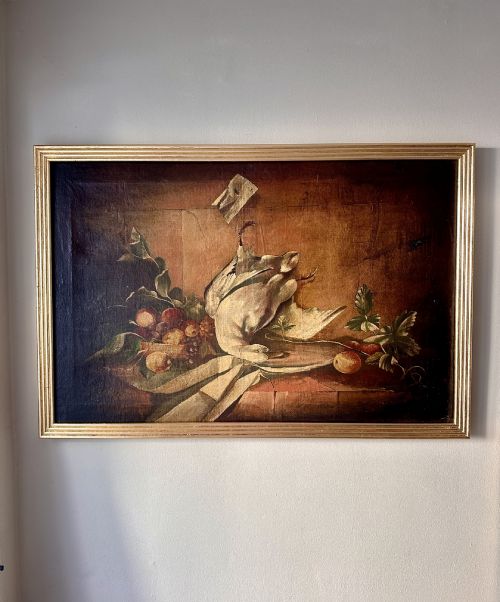
A continental school painting represents works produced across mainland Europe rather than within Britain, spanning centuries from the seventeenth through to the twentieth. When exploring this selection, buyers frequently encounter nineteenth-century pieces alongside earlier seventeenth- and eighteenth-century examples. The subjects vary widely, encompassing landscapes, still lifes of game and fruit, portraits, and harbour scenes.
The evidence shows diverse regional classifications such as Dutch, Italian, German, and French schools. Formats range from large framed canvases and oak panels to delicate copper plates and portrait miniatures. Many works arrive in original giltwood frames that complement the painting style.
Materials and Technique
These works rely primarily on oil paint applied to supports of canvas, wood panels, copper, or board. Artists built compositions using layered pigments, sometimes incorporating heavy impasto for texture, particularly in later periods. Supports like oak panels and stretched canvas required careful preparation with grounds to receive the oil medium.
Frames form an integral part of the physical object, often constructed from carved giltwood or wood with applied gesso and gilding. Techniques evolved from the fine glazes of earlier centuries toward more direct brushwork and impasto in nineteenth- and twentieth-century pieces.
Subjects range widely from grand historic portraits to games played inside a church interior.
Judging Quality
Quality rests in the handling of light, brushwork, and anatomical or spatial proportion within the composition. Stronger works display confident draughtsmanship and atmospheric depth, whether rendering a Dutch frozen landscape or an Italian harbour scene.
The preservation of the paint surface and the originality of the frame contribute significantly to the standing of a piece. Works retaining their early or original giltwood frames demonstrate higher integrity than those altered or rehoused later.
Allan Douglass Mainds·Philipp Peter Roos·Pompeo Batoni·T Bergman·J Haupt
The Continental School Painting Glossary
- Continental school
- A term used in art history to categorise paintings originating from mainland Europe rather than Britain.
- Impasto
- Paint applied thickly to a canvas or panel, leaving visible brush or palette knife marks that stand proud of the surface.
- Giltwood
- Wood carved and covered with a thin layer of gold leaf or metallic gilt, commonly used for antique picture frames.
- Oil on panel
- A painting technique where oil paint is applied directly to a prepared wooden board rather than woven canvas.
Continental School Painting: Frequently Asked Questions
What does continental school mean?
The term denotes artworks created by artists working on the mainland of Europe, encompassing various regional styles from Dutch to Italian traditions.
It groups together pieces where the specific hand of the artist remains unrecorded or attributed to a broader continental tradition.
How are these paintings framed?
Many examples retain their original giltwood or ornamented frames, which reflect the aesthetic tastes of their period of creation.
Original frames provide context and help date the artwork alongside the style of the painting itself.
What surfaces were used?
Artists utilised stretched canvas, wooden panels such as oak, copper sheets, and board as supports for their oil pigments.
Each surface imparts a distinct texture and preservation quality to the finished work.
How do I care for an oil painting?
Keep the artwork away from direct sunlight, extreme temperature fluctuations, and high humidity to protect the canvas and oil paint.
Dust the surface gently with a soft, dry brush and avoid liquid cleaners on both the painting and the frame.