

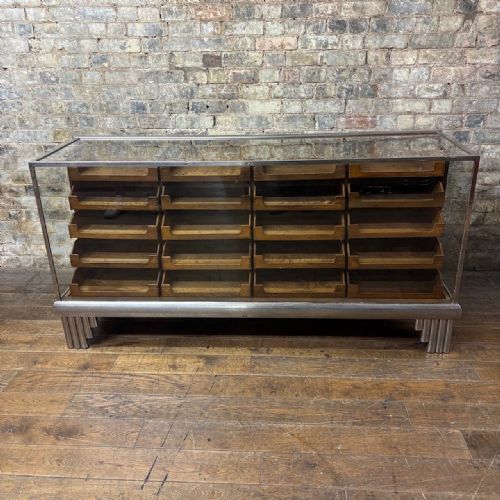


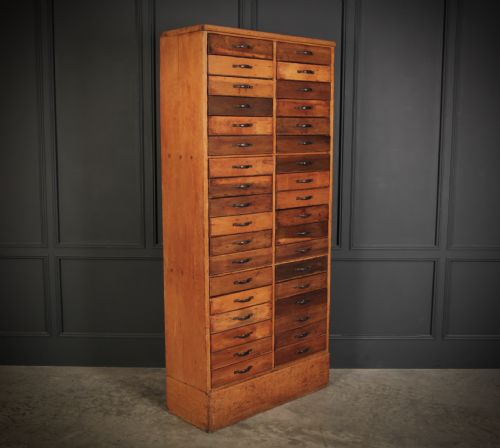


Commercial Shop Drawers
Commercial shop drawers are utilitarian storage pieces built for trade, offering robust proportions and divided compartments that suit modern homes needing characterful organisation.
Commercial Shop Drawers
Commercial shop drawers encompass large banks of drawers, haberdashery cabinets, and shop counters designed for merchants and retail trade across the nineteenth and early twentieth centuries. These pieces originate from chemists, drapers, and general stores, built to organise small stock efficiently behind the counter or on the shop floor.
The most common versions on this page are pine and oak pieces from the Victorian era up to the 1930s, often featuring numerous small compartments for haberdashery, hardware, or dry goods. Forms range from low countertop till units and needle drawer cabinets to massive freestanding banks of twelve or sixteen drawers.
Origin details in the listings point to English, French, and Hungarian workshops, spanning industrial commercial designs and rustic country styles. Buyers find both natural timber finishes and originally painted surfaces, sometimes retaining period sign-writing or brass label holders.
Materials and Construction
Construction relies heavily on durable timbers such as pine, oak, mahogany, and fruitwood, chosen for their ability to withstand heavy daily use in busy retail environments. Cabinets often feature robust dovetailed drawer construction and fielded panels designed to maintain stability across wide banks of storage.
Metal hardware plays an essential role in the construction, utilising brass handles, drop pulls, and card frames alongside iron brackets and chrome trim on later twentieth-century pieces. Glazed panels appear on specialised haberdashery counters and display cabinets to allow customers to view merchandise while keeping stock protected.
Surface finishes include unpainted waxed hardwoods alongside painted pine showing layers of historic colour, from light green and white to black with gold detailing. Sign-written lettering applied directly to drawer fronts or timber fascias identifies specific agricultural merchants and traders of the period.
Commercial Shop Drawers Retail Price Guide 2026
Typical asking prices for commercial shop drawers among the pieces listed under this phrase on Sellingantiques today, from the lower quarter to the upper quarter. They describe what is for sale here now, not the wider market.
Form variations include haberdashery cabinets, shop counters, butchers blocks, and large banks of drawers originating from English, French, and Hungarian trade.
Assessing Quality
Quality in commercial shop drawers rests upon the integrity of the timber framing and the unhindered movement of numerous individual drawers within their banks. Superior pieces maintain their original internal dividers, backboards, and handles without excessive replacement or modern timber repairs.
The sophistication of the hardware and cabinetry distinguishes standard utility storage from high-end retail fittings produced by established makers. Finely executed dovetailing, substantial timber thicknesses, and intact original glass or sign-writing elevate a piece's standing within the period range.
Dudley & Co·G H Gledhill Halifax·Trussant & Cie
The Commercial Shop Drawers Glossary
- Haberdashery cabinet
- A multi-drawer storage unit originally used in drapery shops to organise ribbons, buttons, and sewing notions. These cabinets typically feature shallow drawers to maximise storage capacity for small items.
- Bank of drawers
- A large assembly of numerous drawers housed within a single heavy carcass or framework. They provide extensive compartmentalised storage suitable for commercial stock.
- Shop counter
- A substantial retail furnishing featuring a flat top for serving customers and a functional rear elevation fitted with drawers, cupboards, or open shelving. They anchor the layout of traditional retail spaces.
- Butchers block
- A heavy-duty preparation table constructed from thick end-grain timber mounted on sturdy legs. These utilitarian kitchen pieces were built to absorb heavy chopping and cutting in food trades.
- Sign-written
- Painted lettering or signage applied by hand directly to the timber surface of a piece of furniture. This technique identified the original merchant, trade, or business owning the fitting.
Commercial Shop Drawers: Frequently Asked Questions
What were commercial shop drawers used for?
Merchants utilised these multi-drawer cabinets and counters to store and organise retail stock such as sewing supplies, hardware, and dry goods out of sight yet close to hand. The numerous small compartments kept different sizes and varieties separated behind the serving counter.
In modern interiors, buyers repurpose these functional units for organising office supplies, kitchen utensils, or craft materials while adding period character to a room.
How do I date a shop cabinet?
Dating relies on observing the timber species, construction methods, and hardware styles present across the piece. Victorian examples often feature hand-cut dovetails and heavy pine or mahogany carcasses, while 1930s pieces incorporate chrome trim or machine-made components.
Maker's marks, brass label holders, and original sign-writing also provide reliable chronological markers that help narrow down the period of manufacture.
Are painted finishes original?
Many trade pieces received coats of protective paint during their working lives in shops and merchant houses to withstand daily wear. Listings often identify originally painted surfaces, such as early white Hungarian pine or light green finishes.
Examining the paint layers for natural wear, craquelure, and integration with the hardware helps determine whether the finish dates to the piece's commercial period.
How do I fit a large bank of drawers into a home?
These substantial pieces require careful measurement of room dimensions and access points, particularly stairways and doorways, before placement. Their deep footprints and heavy timber construction make them ideal as freestanding kitchen islands or statement sideboards.
Ensuring the floor can support the weight of a dense hardwood cabinet filled with stored items is an important consideration for placement.