




Coastal Vessel Painting
These coastal vessel painting works record maritime life and harbour scenes across centuries of maritime history.
Coastal Vessel Painting
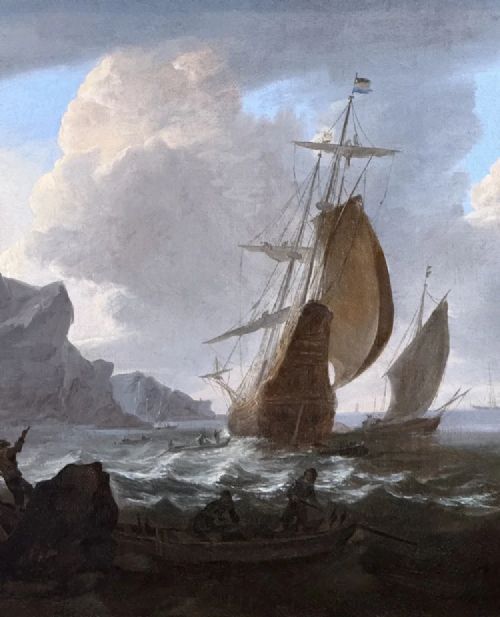
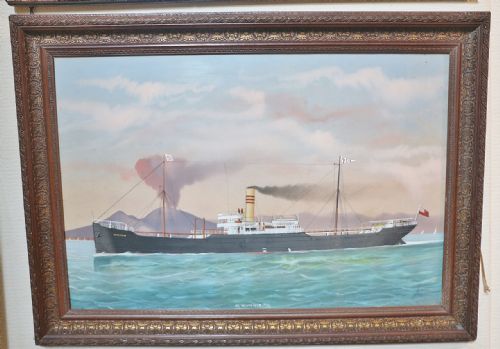
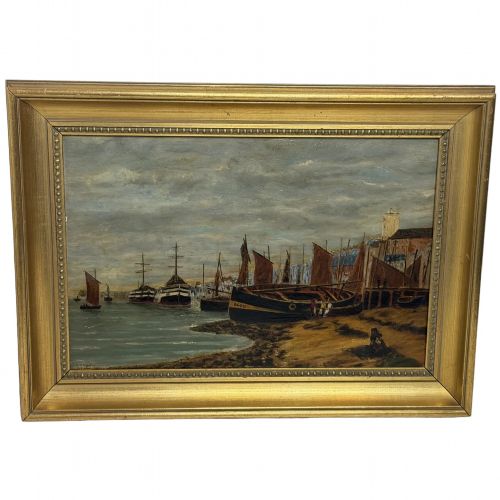
A coastal vessel painting depicts marine scenes, harbour traffic, and ships at sea, anchored off ports, or navigating coastal waters. These works encompass various vessel types, from modest fishing boats and pilot cutters to masted merchantmen and warships.
Buyers encounter oil paintings on canvas and panel alongside watercolours on paper, spanning from the seventeenth century through the Victorian period into the mid-twentieth century. The selection ranges from detailed topographical harbour views to atmospheric depictions of boats in gales or calm coastal waters.
Materials and construction
Artists utilise oil paint on stretched canvas or wooden panels, applying pigment to capture the transparency of water and the play of light on sails and hulls. Watercolour on paper remains common for lighter, more luminous coastal and harbour studies.
Works are typically framed in wood, occasionally retaining gilt surrounds that complement the maritime subject matter. Support materials range from traditional linen canvas to heavy paper sheets and solid wooden panels.
Listings feature works spanning from the 17th century to the 1960s, executed in oil and watercolour.
Distinctions in quality
Quality rests upon the artist's ability to render marine architecture, rigging, and water movement with convincing anatomical and meteorological accuracy. Stronger works display confident brushwork and a sophisticated understanding of light, atmosphere, and maritime perspective.
The degree of historical or topographical detail elevates certain examples, particularly those identifying specific ports, vessels, or coastal landmarks. Condition of the paint layer or paper surface, along with the appropriateness of the framing, also influences the standing of individual pieces.
Bonaventura Peeters·Bernard Benedict Hemy·Charles William Adderton·George Shaw·Hendrik Willebrord Jansen·Samuel Owen·Gustave de Breanski·William Shayer·Frank Wood·John Davison Liddell·Hubert Thornley·Arthur Joseph Meadows·George Stainton·Thomas Bush Hardy·John W Gilroy·Edward Wesson·Francis Holman
The Coastal Vessel Painting Glossary
- Oil on Canvas
- Pigment mixed with drying oil applied to a woven fabric support stretched over a wooden frame. This medium allows for rich colour saturation and textured impasto application.
- Watercolour
- A paint consisting of colour pigments suspended in a water-soluble binder, traditionally applied to paper. It yields translucent washes suitable for capturing atmospheric coastal skies and water.
- Panel
- A rigid wooden support used by artists instead of canvas. Panels often preserve early works well due to the stable nature of the rigid ground.
- Gilt
- A thin layer of gold leaf applied to wood frames or decorative objects. It provides a reflective border that enhances the framed artwork.
- Provenance
- The documented history of ownership of an artwork. Clear provenance assists in confirming attribution and authenticity.
Coastal Vessel Painting: Frequently Asked Questions
What periods do these paintings cover?
The available selection spans from the seventeenth century through the Georgian and Victorian eras up to the mid-twentieth century.
Earlier examples reflect seventeenth-century Dutch maritime traditions, while nineteenth and twentieth-century pieces capture British and European coastal scenes.
How were these artworks created?
Artists worked primarily in oil on canvas, oil on panel, or watercolour on paper.
They applied these mediums using traditional brushes to build up maritime scenes, capturing the details of rigging, water texture, and atmospheric coastal light.
How do I identify different types of vessels in the paintings?
Vessels are identified by their rigging, hull shape, and purpose, ranging from single-masted fishing boats and pilot cutters to full-rigged merchant ships and warships.
Topographical details and named harbours often provide further context regarding the location and vessel type.
How should I care for a coastal painting?
Protect works on canvas and paper from direct sunlight and excessive humidity to prevent paint cracking or paper degradation.
Display them in stable indoor environments away from direct heat sources and handle them carefully by their frames.