



Coastal Fishing Boat Picture
A coastal fishing boat picture brings the salt air and rhythmic motion of the sea directly into a room through historic marine art.
Coastal Fishing Boat Picture
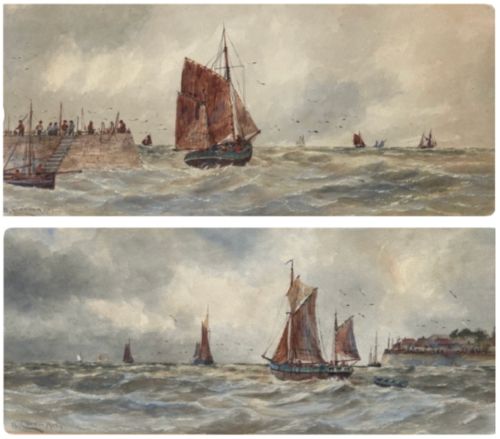
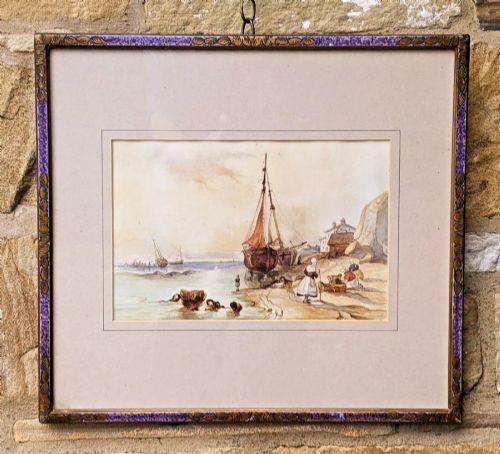
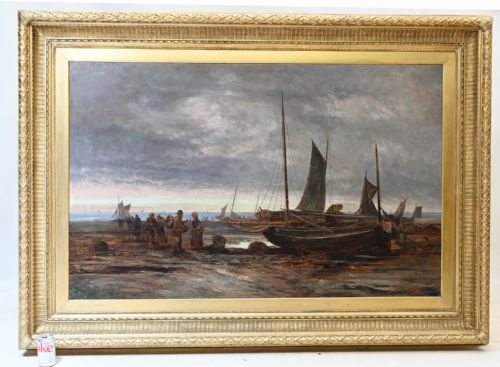
A coastal fishing boat picture captures maritime life across the nineteenth and twentieth centuries, depicting working vessels, harbours, and coastal shores. Buyers encounter these works in various forms, including oil paintings on canvas or board, delicate watercolours, and occasional prints and etchings.
The pieces on this page span several distinct periods, running from Victorian marine art and Edwardian realism through to British impressionism and mid-century British modernism. Subjects range widely from Cornish and Norfolk coasts to French ports and Mediterranean scenes.
Most examples concentrate on the daily labour of fishermen, beached boats at low tide, or vessels making their way home to harbour. These works reflect both documentary interest in maritime trades and an artistic fascination with coastal light and weather.
Materials and methods
Artists working on a coastal fishing boat picture relied primarily on oil paints on canvas or board, or watercolour pigment on paper, often protected beneath glass within framed artwork. The choice of medium dictated the final character, allowing oils to build rich textural seas and watercolours to capture translucent light.
Substantial works frequently incorporate heavy wooden or gilt frames that complement the maritime subject matter. Draftsmanship combined with pigment application, utilising gouache or aquatint in specific prints and drawings to achieve depth and atmospheric coastal effects.
Several artists clearly preferred getting salt spray on their boots, documenting specific Cornish harbours with remarkable precision.
Factors of quality
Quality in a coastal fishing boat picture rests on the artist's command of maritime atmosphere, light, and the structural rigging of working vessels. Stronger examples demonstrate confident brushwork and a convincing rendering of water and weather conditions rather than mere mechanical illustration.
The handling of medium also separates standard decorative pieces from accomplished fine art, particularly in how watercolours retain luminosity or how oils build surface depth. Provenance, legible signatures, and strong compositional balance elevate specific paintings above the ordinary.
William Cannon·Charles Napier Hemy·William Lee Hankey·Gustave De Bréanski·Ernest F Hill·George Henry Knight·Norman Janes·Robert Leslie Howey·Thomas Bush Hardy
The Coastal Fishing Boat Picture Glossary
- Watercolour
- A painting method where fine pigment is suspended in water-soluble binders on paper. It offers luminous, transparent washes ideal for capturing coastal skies.
- Aquatint
- A printmaking technique that produces tonal areas resembling watercolour washes. It often appears in conjunction with etched lines in twentieth-century works.
- Gouache
- An opaque water-based paint used to add solid highlights and body to watercolours. It allows artists to build bright areas of foam and clouds.
- Impressionism
- An artistic approach focused on capturing the visual impression of a moment, particularly shifting light. British variants of this style frequently interpret coastal scenes.
- Gilt
- A thin layer of gold leaf applied to frame surfaces. Many period maritime frames utilise this finish to enhance the artwork.
Coastal Fishing Boat Picture: Frequently Asked Questions
What periods do these pictures cover?
The selection spans the nineteenth and twentieth centuries, taking in Victorian pieces alongside Edwardian works and mid-century British modernism.
Dates across the items run from the Victorian era through the 1950s, showing shifting artistic approaches to maritime subjects over time.
Are these works painted on canvas or paper?
Both mediums appear regularly across the inventory, depending on the artist's chosen technique and the specific period.
Oil paintings typically utilise canvas or board, whilst watercolours, pastels, and etchings are worked on paper and usually framed behind glass.
Where do the coastal scenes usually take place?
Locations focus primarily on British shores, including Cornish fishing ports like Polperro and Mousehole, alongside Norfolk beaches and northern rivers.
Certain pieces also extend to continental ports such as Normandy in France or Mediterranean shores in Cyprus and beyond.
How should I frame and display a watercolour?
Watercolours require careful protection behind glass to prevent atmospheric damage to the paper and water-soluble pigments.
Keeping them away from direct sunlight preserves the subtle tones and washes characteristic of nineteenth and twentieth-century maritime watercolours.