
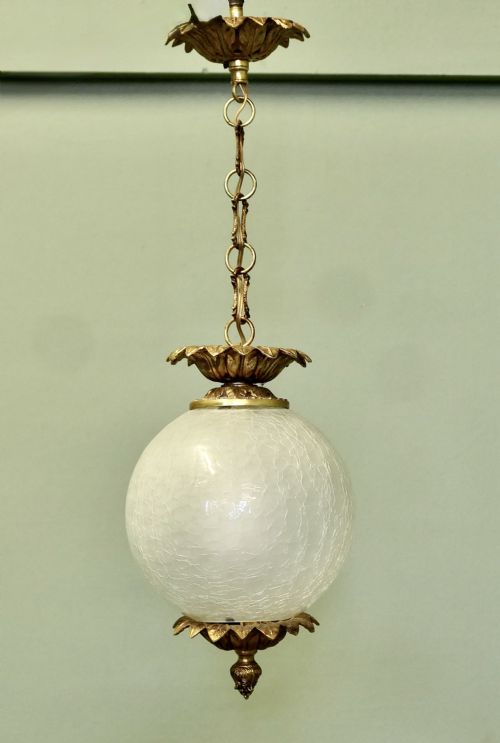
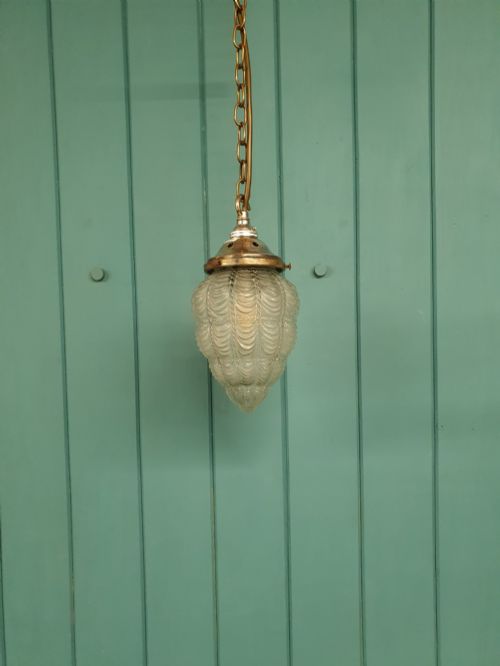


Clear Glass Ceiling Lantern
A clear glass ceiling lantern brings a crisp, focused pool of light to an entrance hall or high-ceilinged landing.
Clear Glass Ceiling Lantern
A clear glass ceiling lantern combines functional overhead illumination with architectural presence, hanging snugly from corridors and stairwells. These fixtures span periods from the late Victorian era through Edwardian classicism to the geometric lines of the 1920s and 1930s.
Most examples encountered here take the form of bell jars, globes, or hexagonal frames suspended on chains or short rods. French Louis XVI style gilt bronze models sit alongside English Edwardian brass pendants and industrial prismatic shades.
Makers utilised metal mounts to secure blown, pressed, or cut glass bodies designed to catch and refract light evenly across a space. The variety ranges from restrained late nineteenth-century round lanterns to decorative French Art Deco globes.
How they were made
Metal frames in brass, bronze, gilt bronze, and silver plate provide the structural skeleton, holding the glass panels or blown globes securely in place. Craftsmen formed these mounts through casting, spinning, and soldering individual components before finishing the surfaces.
The glass elements themselves display both hand-blown techniques with diamond cutting and machine-pressed prismatic patterns designed to diffuse glare. Holophane shades and heavy crystal bell jars demonstrate the distinct methods used to manipulate light in domestic settings.
Listings span from the late nineteenth century through the Edwardian period into the 1920s and 1930s, using brass, cut glass, and gilt bronze.
What varies in quality
Quality reveals itself in the weight and purity of the metalwork, where thick cast brass and chased gilt bronze surpass thin pressed sheet metal. Heavier mounts maintain structural integrity over decades of hanging and support complex glass forms safely.
The clarity and thickness of the glass distinguish finer examples, particularly where hand-cut facets create sharp, clean refractions rather than soft distortions. Superior pieces feature well-fitted panels and original suspension hardware that match the period of the lantern body.
The Clear Glass Ceiling Lantern Glossary
- Bell jar
- A rounded glass shade shaped like a laboratory bell jar, frequently used for hanging hall lanterns to enclose the burner or bulb entirely.
- Holophane
- A brand of scientific prismatic glass engineered to direct and diffuse light efficiently while reducing glare in commercial and domestic interiors.
- Gilt bronze
- Metal cast in bronze and treated with a gold wash or leaf application, providing a durable and decorative surface finish.
- Prism
- A cut or moulded piece of glass designed to refract light into distinct beams, common in Edwardian and early twentieth-century chandeliers.
- Silver plated
- A thin layer of silver applied over a base metal foundation, offering the appearance of solid silver for lighting mounts.
Clear Glass Ceiling Lantern: Frequently Asked Questions
Where should I hang a glass lantern?
These fixtures suit hallways, entrance lobbies, and stairwells where overhead illumination requires both downward focus and ambient spread.
Ensure sufficient ceiling height allows clearance beneath the drop of the chain or rod.
How do I date a brass and glass lantern?
Examine the construction of the metal frame, screw threads, and the style of the glass cutting or pressing.
Edwardian and Victorian pieces often feature heavy cast brass components and hand-blown elements, whereas 1920s and 1930s examples lean towards geometric Art Deco or industrial prismatic designs.
Can I use modern bulbs in these lights?
Standard modern electrical fittings can usually be accommodated within the original frames by a qualified electrician.
Choose low-heat LED bulbs that match the vintage aesthetic and protect old wiring and fragile glass from excess heat.
How do I clean an antique glass lantern?
Dismantle accessible glass panels carefully from the metal frame to wash them in warm, soapy water.
Polish the brass or bronze mounts gently with a dry cloth to preserve any patination accumulated over the decades.