
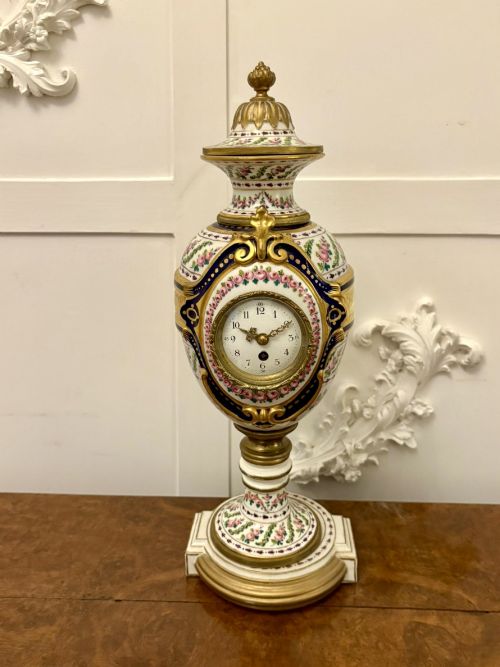


Classical Urn Clock
A classical urn clock brings neoclassical balance and striking presence to a mantelpiece.
Classical Urn Clock
A classical urn clock takes the form of a decorative urn housing a clock movement, frequently accompanied by matching side garnitures. You are looking at nineteenth century French and Victorian pieces that draw heavily on neoclassical and Louis XVI design.
The versions you will most commonly meet on this page feature cases formed from Sienna marble, white marble, brass, ormolu, and gilt bronze, often incorporating hand-painted porcelain or enamel dials. These objects served both to tell the time and to anchor the symmetry of a formal room.
Mantel clock garniture sets dominate the selection, combining a central urn clock with matching side ornaments to create a complete decorative scheme. The aesthetic relies on architectural discipline, classical motifs, and rich metalwork rather than plain utility.
How they were made
Makers utilised cast bronze, brass, and ormolu to form the structural cases, often combining these metals with carved Sienna or white marble. Gilt finishes were applied to metal surfaces to catch the light, while internal mechanisms required precise brass gear-cutting for eight-day striking movements.
Decorative elements frequently included hand-painted porcelain panels and enamel dials fitted with delicate hands. The integration of stone, metal, and ceramic required specialised collaboration between founders, masons, and horologists.
Listings feature nineteenth century mantel clocks utilising marble, brass, and gilt bronze within neoclassical and Victorian styles.
What varies in quality
The distinction between ordinary and superior pieces rests on the crispness of the metal chasing and the depth of the marble carving. Heavier gauge ormolu and finely detailed cast bronze ornament separate standard production from exceptional workshops.
The integration of the clock body with its garniture pieces and the finish of the hand-painted porcelain elements dictate the overall standing of the object. Movement complexity, such as eight-day striking capability by documented makers, also shifts a piece toward the upper end.
Pons de Paul·A.D Mougin·James Ritchie and Son
The Classical Urn Clock Glossary
- Ormolu
- Gilded bronze produced by applying a mercury and gold amalgam to cast bronze and firing it. This technique gives the metal a distinctive warm lustre found on many nineteenth century clock cases.
- Garniture
- A set of decorative matching objects for a mantelpiece, usually consisting of a central clock flanked by two matching vases, urns, or candelabra. These sets created a balanced arrangement in formal period interiors.
- Neoclassical
- A style drawing inspiration from the classical art and architecture of ancient Greece and Rome. It emphasises symmetry, restrained ornamentation, and classical urn motifs.
- Sienna marble
- A decorative yellow-brown marble quarried in Italy, featuring dark grey or purple veining. It provides a rich, colourful stone body for nineteenth century clock cases.
Classical Urn Clock: Frequently Asked Questions
How do I wind a classical urn clock?
Use the appropriate winding key on the dial apertures, turning gently until you feel resistance. Do not overwind the spring.
Ensure you turn the key in the correct direction for time and strike trains depending on the specific movement.
What is a clock garniture?
A clock garniture is a matching set comprising a central clock and two side ornaments, such as urns or vases. These pieces were designed to be displayed together on a mantelpiece.
They provide visual symmetry and echo the materials and decorative motifs of the main clock body.
How do I tell French and Victorian pieces apart?
French pieces often bear maker stamps from Paris or provincial workshops and typically employ ormolu, gilt bronze, or fine marble. Victorian pieces made in Britain frequently use white marble or local stone.
Inscriptions on the dial or movement backplate usually indicate the origin and retailer.
Where should I place a marble clock?
Place the clock on a sturdy, level surface capable of supporting considerable weight, such as a sturdy mantelpiece or heavy sideboard. Marble is heavy and requires stable foundations.
Keep the clock away from direct sunlight and damp environments to protect the metalwork and dial enamel.