



Classical Stone Vases
Classical stone vases bring enduring architectural symmetry to a room, offering the carved presence of antiquity through alabaster, marble, and reconstituted stone.
Classical Stone Vases
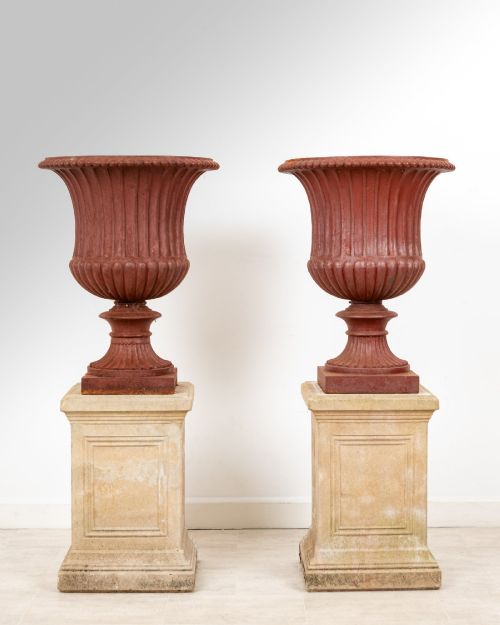
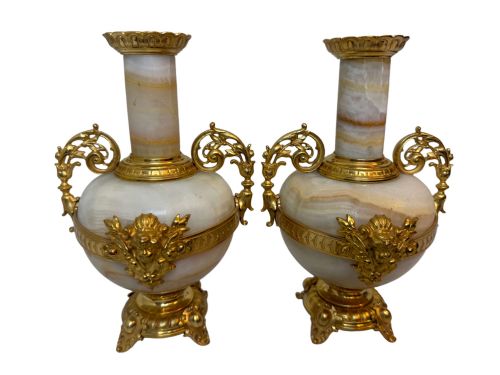
Classical stone vases encompass decorative vessels, garden urns, and campana forms shaped from materials such as marble, alabaster, white onyx, and stone. These objects draw directly upon historical vocabulary, referencing ancient forms intended for display both indoors and out.
The versions most commonly met on this page span the nineteenth century, including Victorian interpretations and Grand Tour souvenirs brought back from Italy. Pieces frequently appear in matched pairs or as single statements, utilising pedestals to elevate the vessel.
Makers and origins stretch across European workshops, incorporating French taste and Italian craftsmanship into classical shapes. The aesthetic unites Regency neoclassical styles with later nineteenth-century revivals, resulting in objects designed for visual impact.
Materials and construction methods
Carving stone requires precise reduction of heavy blocks, utilising varieties like Ashford marble, serpentine marble, and breccia medicea to achieve striking natural veining. Alabaster and white onyx offer a translucent quality, allowing light to penetrate the surface of smaller decorative vases.
Many nineteenth-century examples incorporate secondary elements such as gilt bronze mounts to accent the rims and plinths of marble bodies. Cast iron and reconstituted stone appear in larger garden urns, providing robust structural integrity for outdoor placement.
Nineteenth-century tourists famously packed heavy alabaster urns into horse-drawn carriages to bring a slice of Rome back to damp English parlours.
Assessing quality in carved vessels
Quality rests heavily upon the selection of the stone and the crispness of the carving, particularly around acanthus leaves and classical moulded details. Finer pieces display harmonious natural mineral patterns within the marble or alabaster rather than dull, uniform coloration.
The integration of mounts, such as cast gilt bronze, separates standard production from exceptional work through secure fitting and refined chasing. Proportion also dictates worth, as well-balanced campana profiles maintain architectural dignity without feeling heavy or clumsy.
Selim Bright
The Classical Stone Vases Glossary
- Campana urn
- A bell-shaped vessel with a flaring rim and a pedestal foot, widely utilised in neoclassical design. This form originates from ancient pottery and bronze prototypes.
- Grand Tour
- A cultural journey undertaken by wealthy Europeans in the eighteenth and nineteenth centuries to study classical art. Souvenirs from these travels frequently included carved alabaster and marble vases.
- Breccia marble
- A composite stone made of broken fragments cemented together by a fine-grained matrix. It creates a dynamic, multicolored visual texture on nineteenth-century decorative urns.
- Ashford marble
- A Derbyshire limestone used for inlay work and decorative objects rather than true metamorphic marble. It provides a dark, polished background for inlaid floral or geometric motifs.
- Serpentine marble
- A green mineral rock resembling snakeskin, favoured for its rich mottled tones. It was frequently carved into classical vases during the nineteenth century.
Classical Stone Vases: Frequently Asked Questions
Where should I place a stone vase?
These vessels suit prominent architectural positions, such as entrance halls, mantlepieces, or central pedestals where their silhouette can be appreciated from multiple angles. Smaller alabaster versions function well on side tables where close inspection reveals the translucent stone.
Larger garden urns made from stone or cast iron anchor outdoor spaces, standing effectively on lawns or terrace walls to introduce classical structure to planting schemes.
How do I care for marble and alabaster?
Dust marble and alabaster regularly with a soft, dry cloth to prevent particulate accumulation in carved recesses. Avoid using chemical cleaners, acidic substances, or excess water, particularly on softer stones like alabaster which absorb moisture easily.
Wax polishing can help maintain the sheen on indoor marble pieces, but should be applied sparingly and buffed thoroughly. Outdoor stone items require winter protection against frost expansion if the material is porous.
What is a campana shape?
The campana shape refers to an inverted bell profile characterised by a wide, flaring rim, a deep tapering body, and a circular foot often raised on a square plinth. This silhouette is fundamentally tied to neoclassical urn design.
Craftsmen adopted this ancient Greek and Roman form throughout the nineteenth century for both interior decorative vases and large garden containers.
Are these pieces from the nineteenth century?
The majority of pieces seen here originate from the nineteenth century, encompassing Regency, Victorian, and later Grand Tour periods. This era saw a sustained revival of classical taste across European workshops.
Characteristics such as hand-carving marks, natural mineral variations in the marble, and historical patination on bronze mounts help distinguish these period items from modern reproductions.