

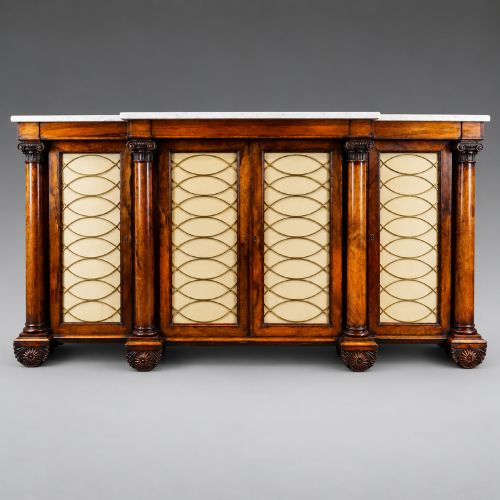
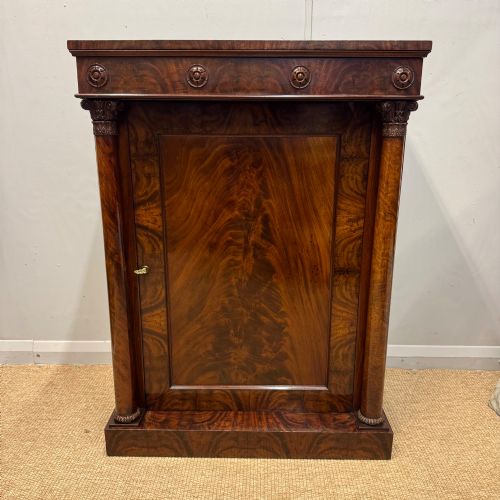
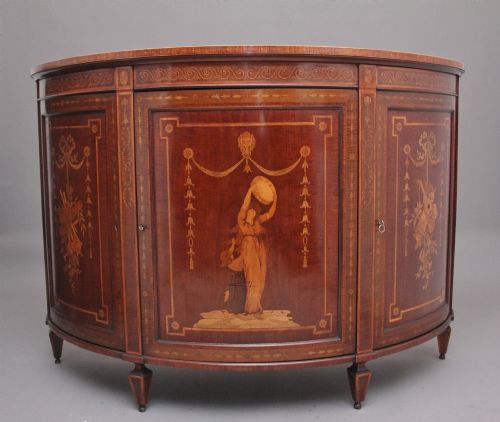

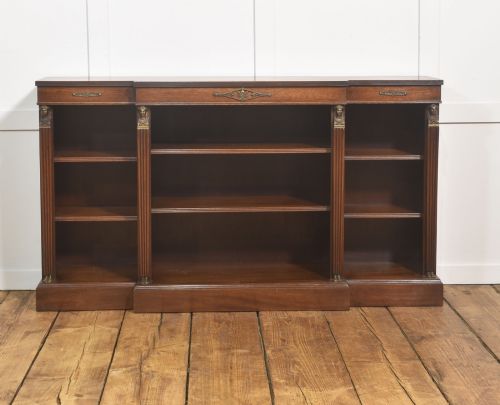
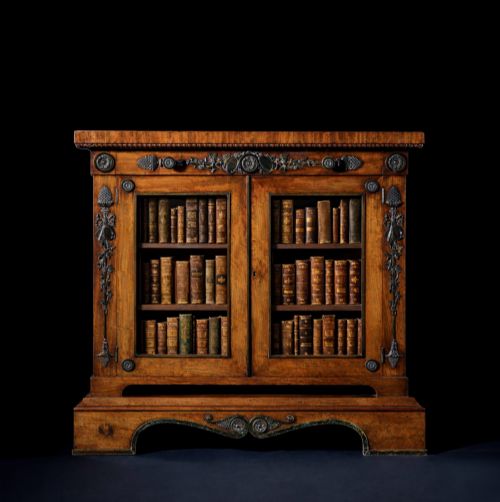
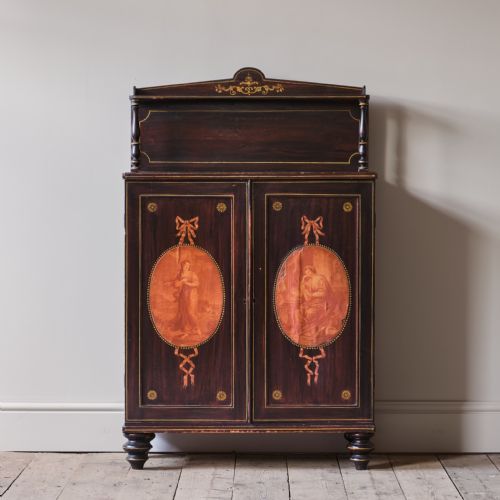


Classical Side Cabinet
A classical side cabinet brings architectural order and polished timber into a room, offering both display and concealed storage.
Classical Side Cabinet
A classical side cabinet embodies formal symmetry and balanced proportions, drawing on Regency, Victorian, and revival idioms to organise a room's interior. When you search for a classical side cabinet, you encounter low bookcases, commodes, demi-lune storage pieces, and pedestal cupboards.
The pieces on this page span the nineteenth century through the early twentieth century, taking in Regency origins and later Sheraton Revival and Neoclassical revivals. These works range from substantial breakfront credenzas to compact bedside cabinets and painted satinwood stands.
Materials and construction
Cabinet makers utilised dense primary timbers such as mahogany and satinwood, frequently enriched with contrasting veneers, marquetry inlay, and simulated rosewood paint. Structural surfaces often incorporate marble tops, brass galleries, and ormolu or bronze mounts.
Joinery techniques supported complex silhouettes, from serpentine and demi-lune fronts to cylindrical stands and breakfront libraries. Decorative schemes relied on hand-painted classical panels, parcel gilding, and fine stringing to articulate the timber surfaces.
Classical Side Cabinet Retail Price Guide 2026
Typical asking prices for classical side cabinet among the pieces listed under this phrase on Sellingantiques today, from the lower quarter to the upper quarter. They describe what is for sale here now, not the wider market.
Listings feature satinwood, mahogany, and marble alongside painted finishes and gilt bronze mounts from the nineteenth and twentieth centuries.
Distinctions in craftsmanship
Excellence in these pieces rests upon the precision of the timber selection and the crispness of any marquetry or painted decoration. Master workshops achieved seamless curves on demi-lune and serpentine fronts where lesser pieces relied on simpler rectilinear forms.
The integration of bronze or ormolu mounts and the weight of the marble tops differentiate standard production from exhibition pieces. Refined internal details, such as adjustable shelving and finely fitted drawers, mark out the upper tier of cabinet making.
Keeble London·Pietro Ferrario·Jean-Henri Riesener·Edwards and Roberts·Lamb of Manchester
The Classical Side Cabinet Glossary
- Demir-lune
- Half-moon shape, commonly applied to the plan of commodes and side cabinets designed to stand flush against a wall.
- Marquetry
- Decorative veneer work forming pictures or geometric patterns using various coloured woods laid onto a carcase.
- Ormolu
- Gilded bronze used for mounts, feet, and decorative handles on finer cabinets.
- Breakfront
- A cabinet facade where the central section projects forward from the flanking wings.
- Credenza
- A low side cabinet or sideboard, frequently featuring glazed or panelled doors and architectural mouldings.
Classical Side Cabinet: Frequently Asked Questions
Where do I place a side cabinet?
These cabinets suit dining rooms, hallways, and drawing rooms where surface space and closed storage are both required. Their finished backs and compact depths also allow them to sit effectively beneath windows or along passage walls.
Smaller formats function well as bedside tables or lamp stands, bringing architectural timber into intimate spaces without dominating the floor plan.
How do I care for satinwood?
Satinwood benefits from minimal intervention, requiring only a soft, dry cloth to remove dust. Avoid placing these pieces in direct sunlight or near heat sources to prevent the timber from drying out.
Polish should be applied sparingly, if at all, to protect painted panels and delicate marquetry work from chemical build-up over time.
What defines Regency style?
Regency design draws heavily on classical Greek and Roman motifs, favouring clean architectural lines, rosewood and mahogany timbers, and restrained brass or gilt mounts. Proportions tend to be severe yet elegant, with an emphasis on symmetry.
Later revival periods reinterpreted these classical rules with lighter satinwood grounds and painted neo-classical ornamentation.
How are marble tops maintained?
Marble surfaces require prompt wiping of liquid spills to prevent staining, particularly on porous varieties found on nineteenth-century commodes and stands. Use warm water and a neutral soap for cleaning, avoiding acidic or abrasive household cleaners.
Polished finishes can be maintained with specialised stone soap that guards against everyday wear without altering the natural grain.