
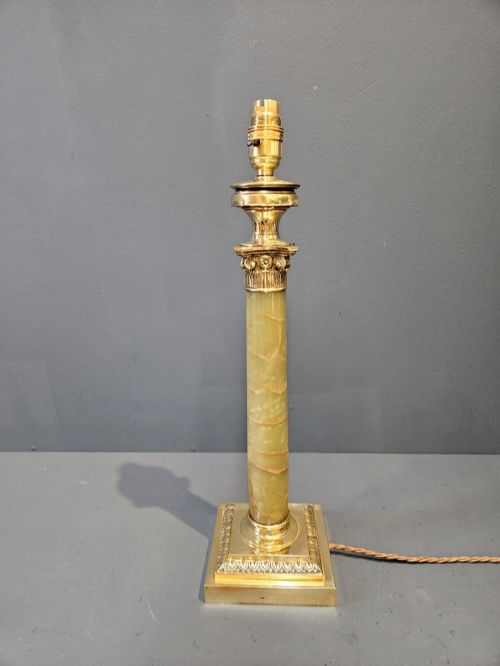
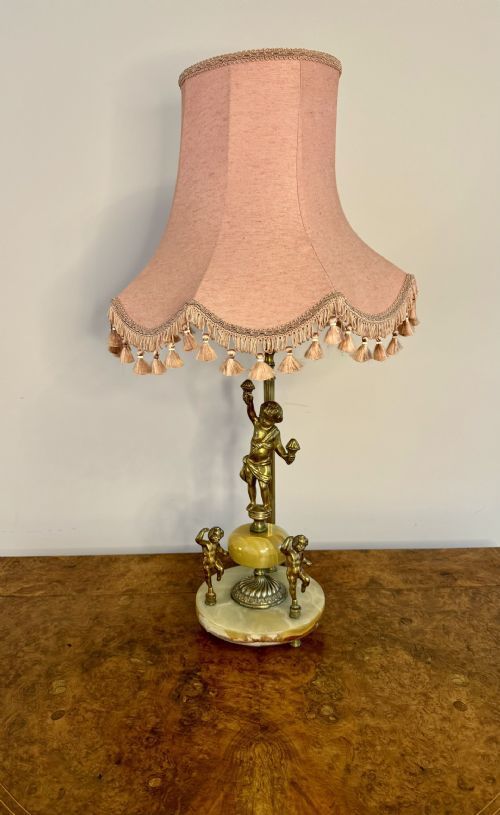


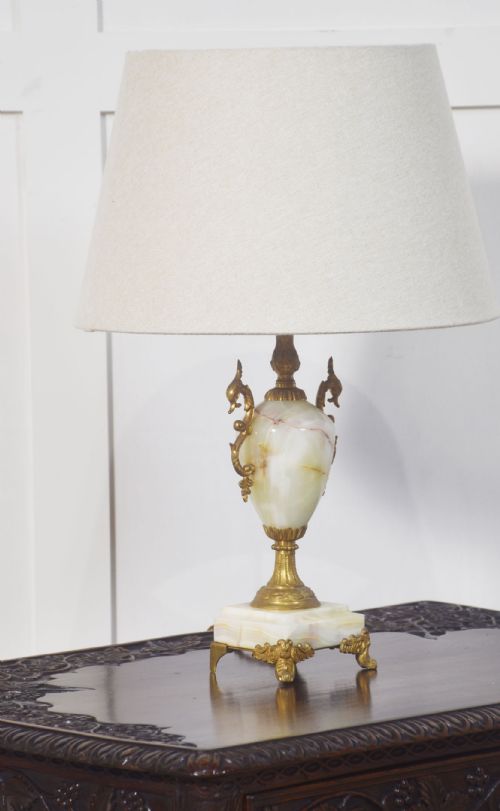


Classical Onyx Table Lamps
Classical onyx table lamps bring together banded stone, cast metal and period illumination from the nineteenth and early twentieth centuries.
Classical Onyx Table Lamps
When you search for classical onyx table lamps, you encounter lighting fixtures shaped by Victorian, Edwardian and Art Deco aesthetics. These pieces merge turned stone shafts with metal mounts, drawing on neoclassical design vocabulary.
The selection on this page relies heavily on early twentieth-century interpretations, alongside late nineteenth-century examples. Many pieces originate from French and Italian workshops, shifting between column forms and amphora shapes.
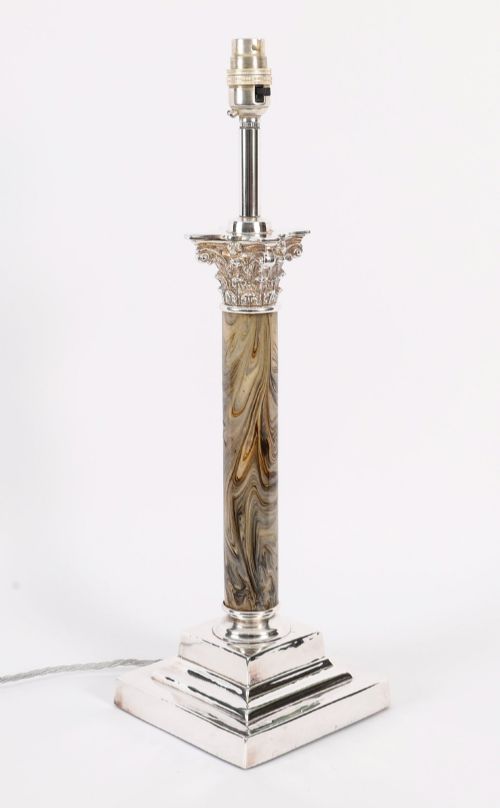
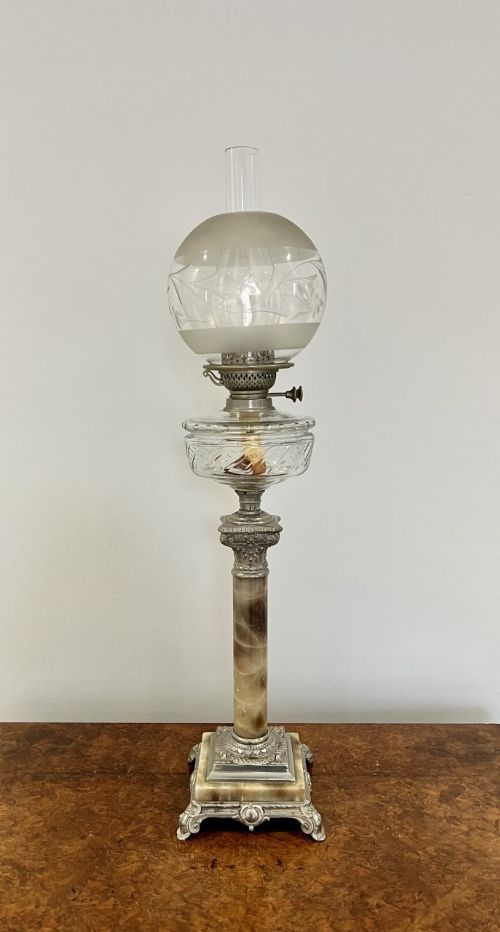
Forms range from converted oil lamps with stepped bases to fitted electrical table lamps supported by paw feet. The primary stone is frequently paired with brass, gilt bronze or ormolu mounts.
How they were made
The construction of these lamps depends on turning and polishing natural stone into smooth columns, urns and cassolettes. Artisans combined onyx and marble with cast brass, gilt bronze and silver-plated metal components.
Metal mounts were cast, chased and gilded before being fitted to the stone bodies with threaded rods or secure collars. Many early examples began as oil lamps before undergoing conversion for electrical use.
Listings span from the 1880s through the 1930s, uniting Victorian mass with Edwardian refinement and Art Deco curves.
What varies in quality
Quality in these lamps rests on the crispness of the metal casting and the depth of the stone's natural banding. Finer examples feature heavy ormolu or gilt bronze mounts with detailed chasing rather than lightweight stamped brass.
Proportion and stone selection dictate the overall presence of the piece. Uniform veining in the onyx combined with solid architectural forms distinguishes higher-grade productions from simpler utilitarian variations.
The Classical Onyx Table Lamps Glossary
- Onyx
- A form of chalcedony with parallel bands of colour, used extensively for the turned shafts and bodies of these lamps.
- Cassolette
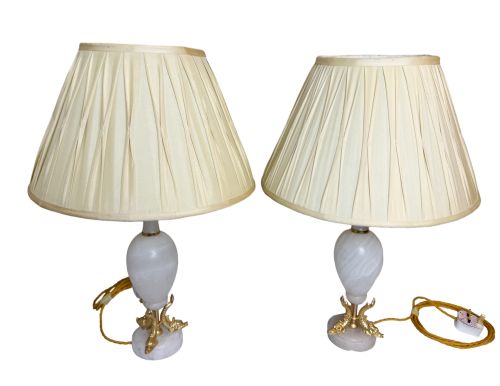
- A decorative vase or urn with a removable cover, frequently adapted into a table lamp or matched pair.
- Ormolu
- Finely ground high-carat gold applied to a bronze base, commonly found on French neoclassical mounts.
- Corinthian Column
- An architectural support featuring an ornate capital decorated with acanthus leaves, often replicated in lamp standards.
- Alabaster
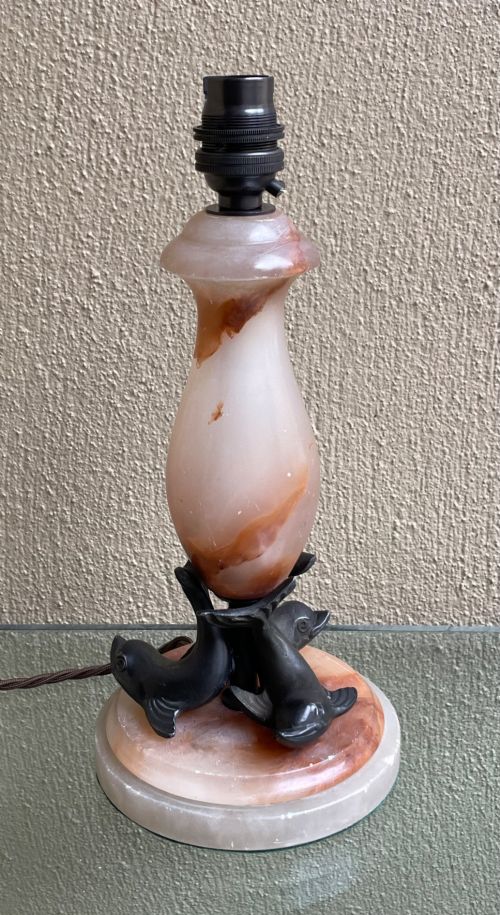
- A fine-grained translucent stone used for carved sculptural lamp bases, particularly during the Edwardian and Art Deco periods.
Classical Onyx Table Lamps: Frequently Asked Questions
Were these always electric lamps?
Many examples began life as oil lamps during the Victorian and Edwardian eras before being adapted for modern wiring.
Conversion methods varied, but surviving fittings often retain elements of their original fuel mechanisms beneath the newer electrical components.
How do I identify French pieces?
French lamps typically display cast ormolu or gilt bronze mounts with classical motifs like paw feet and amphora shapes.
They often appear as matched pairs with more elaborate metalwork than their British counterparts of the same era.
What is the difference between onyx and marble?
Onyx is a banded variety of quartz with translucent qualities, whereas marble is a metamorphic rock formed from recrystallised carbonate minerals.
Both materials were utilised interchangeably by makers to achieve heavy, decorative column and urn forms.
How do I clean the stone?
Maintenance requires only a soft, dry cloth to remove dust from the polished stone surfaces and metal mounts.
Harsh chemical cleaners and excessive water should be avoided to protect the integrity of the gilt finishes and porous stone.