
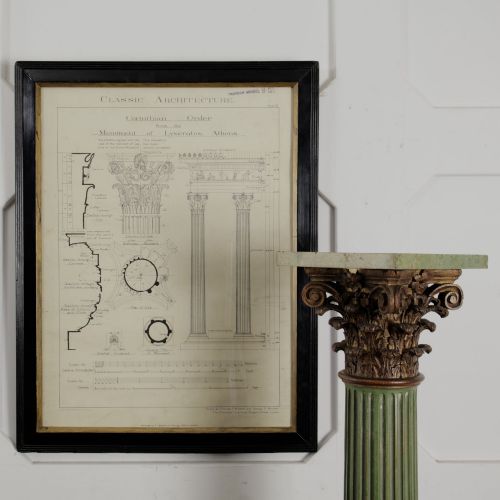


Classical Column Engraving
These classical column engraving pieces bring architectural dignity into a room, offering striking depictions of ancient orders and monuments.
Classical Column Engraving
A classical column engraving presents detailed architectural studies of ancient orders, temples, and structural elements on paper. When searching for a classical column engraving, buyers typically encounter works depicting iconic forms such as the Corinthian order or monumental temple ruins. These items document centuries of fascination with Greco-Roman design and engineering.
The selections span from the eighteenth century through the nineteenth century and into 1920. Many pieces capture architectural scenes, architectural prints, and specific subjects like the Gran Candelabro or the Doric Portico in Athens. Framed prints and wall art dominate the available forms, alongside related items such as a silver plated lamp.
Neoclassical and Neoclassical Revival styles define the aesthetic of these works. The geographic origin varies across French and other European publishing traditions, reflecting a shared continental interest in classical antiquity. Buyers find both individual plates and sets of four or larger groupings.
How they were made
These works rely on copper engraving techniques executed on paper with ink, producing fine lines capable of rendering intricate architectural details. Artisans sometimes applied hand colouring to enrich the printed architectural scenes, as seen in set of four large coloured prints. The precision required for these plates allowed publishers to distribute accurate renderings of distant ruins and column orders.
Framing typically involves wood, occasionally accented with gold leaf to complement the classical subject matter. Protective glass covers the paper works to prevent environmental damage. Related decorative items incorporate metalworking techniques, utilising silver plate over base metals.
Listings feature paper works spanning the eighteenth century, the nineteenth century, and 1920.
What varies in quality
The clarity and crispness of the ink impressions on the paper separate superior plates from worn examples. Master engravers achieved deep, distinct lines that retain architectural precision, whereas plates printed from worn copper matrices lose definition in fine capitals and fluting. The retention of original hand colouring, where present, also influences the visual impact of a print.
Mounting and framing choices reflect the care given to the paper over time. High quality framing protects the edges and margins of the sheet without compromising the paper integrity. The presence of complete margins provides collectors with evidence of an uncompromised print sheet.
Alessandro Mocchetti·Harrison Brothers And Howson
The Classical Column Engraving Glossary
- Copper engraving
- A printmaking technique where an artist cuts an image directly into a copper plate using a sharp metal tool called a burin. Ink is then forced into the recessed grooves and transferred under pressure to paper.
- Neoclassical
- A Western cultural movement drawing inspiration from the art and culture of classical antiquity. This style emphasises proportion, classical orders, and monumental architectural symmetry.
- Corinthian order
- One of the classical orders of architecture, characterised by slender columns and ornate capitals decorated with acanthus leaves. It frequently appears in architectural prints of ancient temples.
- Plate
- A sheet of metal bearing an engraved or etched image used for printing multiple impressions. In publishing contexts, a plate refers to the printed page itself bound within a volume or issued separately.
- Architectural print
- A graphic representation of buildings, ruins, or structural elements produced for study or decoration. These works document archaeological discoveries and classical design theory.
Classical Column Engraving: Frequently Asked Questions
What is a classical column engraving?
A classical column engraving is a printed sheet depicting architectural elements, orders, or ancient ruins. These works were produced to record archaeological discoveries and architectural theory.
Publishers issued them individually or as part of larger architectural folios during the eighteenth and nineteenth centuries.
How do I date these architectural prints?
Dating relies on paper characteristics, printing style, and publisher details often found in the margins. Eighteenth-century examples generally feature heavier laid paper and distinct plate marks.
Nineteenth-century iterations and early twentieth-century plates often show finer machine-made papers and different typographic styles.
How were these prints used originally?
Architectural prints served as reference materials for architects, designers, and students of classical antiquity. They allowed scholars to study proportions and column orders without visiting ancient sites.
Wealthy collectors also bound them into large folios or framed them for display in libraries and studies.
How should I frame and display them?
Framing should incorporate acid-free mounts to prevent the paper from yellowing or degrading over time. UV-filtering glass helps protect the ink and any applied colour from fading under direct light.
Display these works away from moisture and direct sunlight to preserve the paper integrity.