
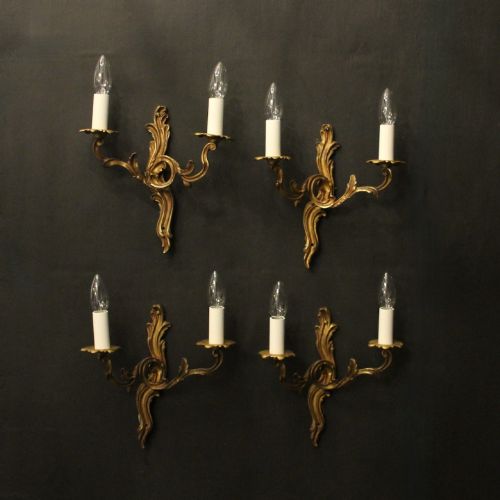


Classical Brass Wall Brackets
Classical brass wall brackets bring enduring architectural light to a room, cast in heavy metal and styled after antique French and English models.
Classical Brass Wall Brackets
When you search for classical brass wall brackets, you encounter wall lights and wall sconces designed to illuminate interior spaces with traditional character. The pieces available span the nineteenth century, the Edwardian era, and the early twentieth decades up to the nineteen-thirties, drawing heavily upon neoclassical, French Louis XVI, and Rococo design traditions.
You are most likely to meet pairs or sets of four twin-arm fixtures executed in cast brass, gilded bronze, or ormolu. These wall-mounted fittings range from restrained Adams style examples to ornate French creations featuring cherub motifs and cut glass elements.
The architectural lineage of these objects places them firmly within formal and period domestic schemes. Makers and workshops of the nineteenth and early twentieth centuries utilised historical vocabularies to create decorative illumination that remains functional today.
Materials and construction methods
The fabrication of these wall fittings relies heavily on traditional foundry techniques, primarily casting brass, ormolu, and gilt bronze to create durable and ornate structural arms. Metal surfaces are frequently finished with gilding, silvering, or patination to achieve specific tonal depths and decorative highlights.
Designers incorporated secondary elements such as cut glass and applied mahogany details to enhance the visual complexity of the brackets. The assembly typically involves multi-part cast components joined securely to form stable wall sconces and lights.
Listings feature pieces spanning the nineteenth century, the Edwardian period, and the decades up to nineteen-thirty, utilising gilt bronze, brass, ormolu, and cut glass.
Distinctions in quality and finish
The refinement of the casting work separates standard production from superior pieces, evident in the crispness of neoclassical ornament and foliate detail. Finer examples display meticulous hand-chiselling after the cast stage, whereas lesser items retain softer, more generalised surface textures.
The choice of surface treatment dictates the longevity and visual richness of the object, with genuine ormolu and deep fire-gilding offering a warmer presence than simple modern plating. Matching sets and complete arm configurations naturally command greater cohesion within an interior scheme.
F. & C. Osler
The Classical Brass Wall Brackets Glossary
- Ormolu
- Finely ground high-carat gold applied to a bronze base through a mercury-gilding process. This technique produces a rich, enduring metallic lustre seen on superior nineteenth-century pieces.
- Neoclassical
- A design style inspired by the classical art and architecture of ancient Greece and Rome. It prioritises symmetry, restraint, and classical motifs such as urns, swags, and acanthus leaves.
- Rococo
- An ornate, asymmetrical style characterised by scrolling curves, shell motifs, and exuberant natural forms. French interpretations of this aesthetic appear frequently in antique lighting.
- Sconce
- A wall-mounted light fixture designed to hold candles or electric lamps and project illumination outwards into a room. Pairs of these fixtures traditionally flank mirrors or architectural focal points.
Classical Brass Wall Brackets: Frequently Asked Questions
How were classical brass wall brackets used?
These fixtures were mounted directly to interior walls to provide ambient or task lighting in principal rooms, hallways, and stairwells. They were frequently positioned in pairs to frame mirrors, fireplaces, or architectural doorways.
Historically, they held candles before being adapted for electricity during the twentieth century. Their decorative presence added architectural structure to domestic interiors even when unlit.
How do I date these wall brackets?
Dating relies upon analysing the stylistic vocabulary, the method of metal casting, and any accompanying construction markers. Pieces showing nineteenth-century neoclassical or ormolu traits differ perceptibly from Edwardian Adams style or nineteen-twenties French gilt productions.
Examining the wiring channels, screw types, and mounting plates also assists in determining the manufacturing era. Stylistic revivals often emulate earlier centuries, requiring careful observation of surface patination.
Are these brackets wired for electricity?
Many surviving wall lights have been converted for modern electrical use at various points in their history. Buyers should inspect the internal wiring and consult a qualified electrician to ensure safety standards are met.
Some fixtures may retain older lamp holders or require rewiring to suit contemporary domestic regulations. The physical conversion process rarely alters the external antique appearance of the brass or bronze arms.
How do I care for antique brass and bronze?
Maintenance requires gentle dusting with a soft, dry cloth to prevent the accumulation of grime on intricate castings. Harsh commercial metal polishes should be avoided, as they can strip away delicate gilding, silvering, or aged patination.
Preserving the original surface finish maintains the historical integrity and visual depth of the metal. Occasional professional inspection of the wall fixings ensures the secure suspension of heavy bronze or ormolu pieces.