

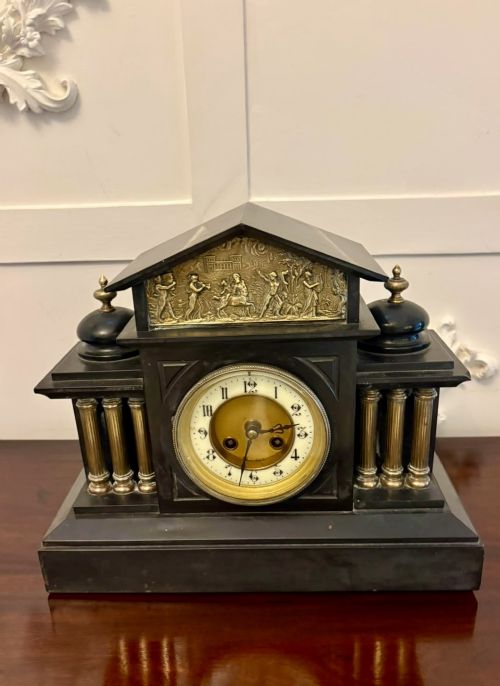
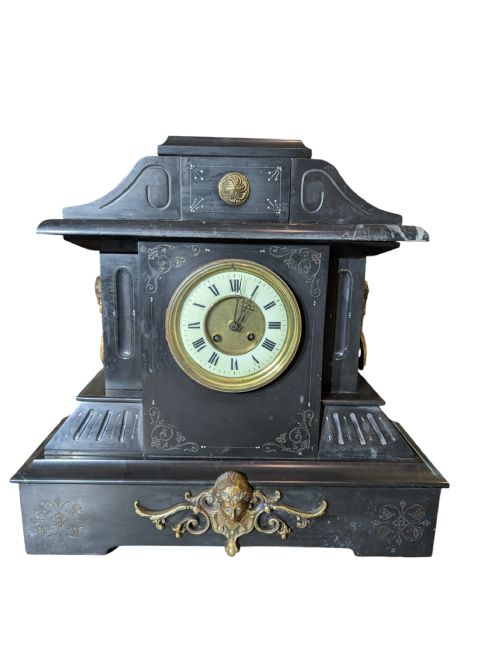


Classical Architectural Mantel Clock
A classical architectural mantel clock brings temple-front proportions and heavy stone presence into a room.
Classical Architectural Mantel Clock
A classical architectural mantel clock takes its cues from ancient temples, porticos, and monumental buildings, translating stone facades and columns into heavy shelf-bound timepieces. You will most frequently meet solid marble or slate examples housing enamel or silvered dials beneath glass bezels.
These pieces draw on Victorian, Neoclassical, and French Second Empire styles, often utilising pediments, pilasters, and patinated bronze mounts. The form ranges from austere black slate temple cases to elaborate ormolu-mounted portico clocks set with cut crystal.
Originating across the nineteenth century, these clocks serve as structural anchors for a mantelpiece, combining architectural gravity with mechanical precision. The surviving examples lean heavily toward substantial Victorian stone cases and French-made movements.
Materials and construction
Makers built these clocks around heavy structural bodies of black slate, rouge marble, sienna marble, and mahogany, often mounting them with cast brass, ormolu, and gilt bronze. Stone cases required skilled stonemasonry to achieve precise architectural lines, mitred corners, and polished column shafts.
Movements inside these heavy enclosures typically relied on eight-day mechanisms, sometimes configured with fusee or striking trains to keep steady time. Dials were formed from white enamel with painted numerals or engraved silvered metal, protected behind thick bevelled glass.
Materials recur across black slate, alabaster, sienna and rouge marble, alongside mahogany, cut crystal, and gilt bronze mounts.
Distinctions in quality
The division between ordinary and exceptional examples rests on the crispness of the stonework, the depth of the marble polishing, and the weight of the bronze mounts. Finer pieces integrate architectural details with architectural accuracy rather than relying on superficial applied ornaments.
Movement quality separates workshop standards, visible in the precision of the escapement, the clarity of the dial inscriptions, and the inclusion of matching garnitures or signed plates. A well-proportioned case with harmonious bronze mounts holds its presence far better than a heavy stone box with routine cast fittings.
Philippes Paris·Baby and Jannings·FATTON ELEVE DE BREGUET LONDON NO 35·Benson 67 Ludgate Hill London
The Classical Architectural Mantel Clock Glossary
- Portico clock
- A clock housed in a frame supported by columns, resembling a classical portico. These often feature pendulum bobs swinging openly between the pillars.
- Fusee
- A conical pulley used in better mechanical clocks to maintain even tension on the gear train as the mainspring unwinds. This mechanism improves timekeeping consistency.
- Garniture
- A set consisting of a central clock flanked by matching decorative objects such as urns or vases. They provide symmetry when arranged on a mantelpiece.
- Ormolu
- Gilded bronze produced by applying a mercury and gold amalgam to cast bronze and firing it. The technique yields a rich, durable surface finish.
- Escapement
- The internal mechanism that controls the release of power from the gear train to the pendulum. It gives the clock its steady ticking rhythm.
Classical Architectural Mantel Clock: Frequently Asked Questions
How do I wind an eight day mantel clock?
Use the correct winding key to turn the arbours slowly until you feel firm resistance, taking care not to overwind the spring. Most movements require a full turn on both the time and strike sides once a week.
Keep the key straight and steady during winding to avoid damaging the delicate square shafts connected to the mainspring barrels.
Why does my clock gain or lose time?
Variations in timekeeping usually stem from temperature changes or an out-of-beat escapement rather than a failing movement. Adjusting the small nut at the base of the pendulum bob will speed up or slow down the swing.
Ensure the heavy stone case sits on a completely level surface so the pendulum swings with an even, symmetrical beat.
How do I tell an 1860 clock from an 1890 one?
Earlier pieces from the mid-nineteenth century tend to use heavier solid marble or slate blocks with restrained bronze mounts and traditional enamel dials. Later nineteenth-century examples frequently incorporate mixed stones, faux finishes, or lighter architectural proportions. Nail down the period by checking the movement backplate for maker signatures, serial numbers, and French foundry stamps.
Where should I place a heavy marble clock?
Select a sturdy mantelpiece, sideboard, or pier table capable of supporting significant stone weight without sagging. The surface must be completely rigid to prevent vibrations from disrupting the pendulum.
Avoid placing the clock in direct sunlight or near active heat sources, which can dry out lubricants and discolour sensitive marble surfaces over time.