

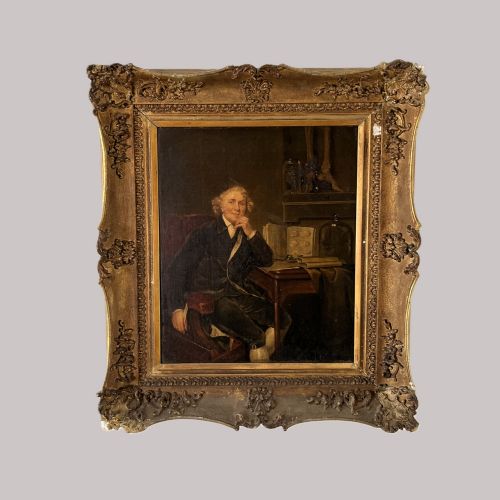
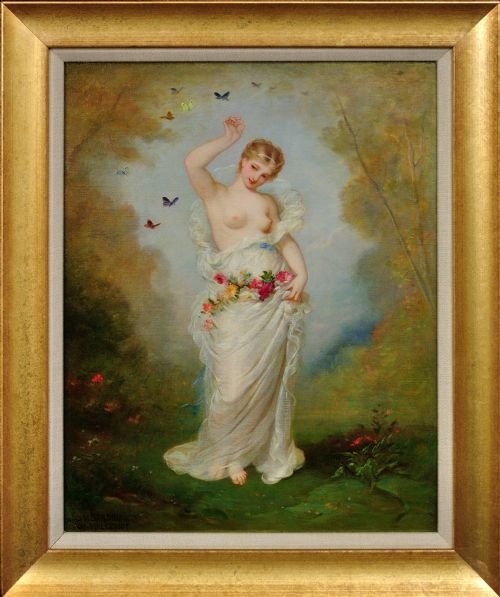


Classical Academic Portrait Canvas
A classical academic portrait canvas brings traditional discipline and rigorous draughtsmanship into a room, offering deep historical presence.
Classical Academic Portrait Canvas
A classical academic portrait canvas represents rigorous academic training, focusing on historical subjects, careful likenesses, and detailed figurative compositions. These works draw upon traditions of realism and historicist revival, capturing subjects ranging from individual sitters to narrative genre scenes.
Most examples found here date from the nineteenth century into the early twentieth century, spanning Victorian, Edwardian, and French academic styles. The subjects often include named historical figures, literary characters, and studio studies rendered with precise tonal control.
Framing is an integral part of these pieces, with many surviving within their original giltwood and gesso frames. Buyers encounter both intimate half-length studies and large-scale compositions executed in oil paint.
Materials and construction
These works rely on oil paint applied to a stretched woven canvas substrate, allowing artists to build rich layers of glaze and opaque pigment. The preparation of the ground and the handling of the paint reflect academic standards of permanence and finish.
Frames are constructed from wood, frequently embellished with moulded gesso and finished in gold leaf or gilt wood. This heavy ornamentation complements the academic weight of the paintings.
Musicians and smokers share the canvas space in nineteenth-century pairs, proving that brass instruments and tobacco have long kept company.
Judging quality and execution
Quality rests in the certainty of the draughtsmanship and the subtlety of the tonal modelling across the flesh and drapery. Superior works demonstrate an anatomical precision and a psychological depth that elevate them above standard commercial portraiture.
The preservation of the original giltwood and gesso frame contributes significantly to the integrity of the piece. Intact paint layers without excessive intervention also distinguish the finest examples.
André Charles Voillemot·Hermann Armin Kern·James Clark·Fernand Jean Barbier·Willem Johannes Martens·Pierre-Louis Bouchard
The Classical Academic Portrait Canvas Glossary
- Academic style
- Art produced under the influence of European academies of art, following strict rules of composition, proportion, and historical subject matter. This approach prioritises finish and traditional technique.
- Giltwood
- Wood that has been coated with gold leaf or a gold-coloured metallic finish. It forms the primary decorative element for traditional picture frames.
- Gesso
- A paint mixture consisting of a binder mixed with chalk, gypsum, or pigment. It is applied to wooden frames before gilding to create a smooth, carved surface.
- Genre scene
- A painting depicting aspects of everyday life, often featuring ordinary people engaged in common activities. These works frequently carry narrative or moral undertones.
- Oileograph
- A mechanical reproduction on canvas designed to imitate an oil painting, sometimes embellished by hand. It mimics the texture of genuine brushwork.
Classical Academic Portrait Canvas: Frequently Asked Questions
What defines an academic portrait?
An academic portrait follows the strict compositional and technical rules taught by European art academies. These works emphasise precise draughtsmanship, idealised forms, and traditional subject matter.
Such paintings often depict historical, mythological, or literary themes alongside formal likenesses of sitters.
How should I care for an oil painting on canvas?
Keep the canvas away from direct sunlight, dampness, and rapid fluctuations in temperature to prevent the paint from cracking. Dust the surface gently with a soft, dry brush without applying pressure.
Avoid using water or chemical cleaners on either the canvas or the gilt frame.
Are these paintings usually framed?
Most of these works retain their period frames, frequently constructed from wood with gesso ornamentation and gold leaf finishes. These frames are selected to match the heavy aesthetic of nineteenth-century academic art.
The condition of the frame is an important part of the overall object's historical integrity.
What is the difference between a portrait and a genre scene?
A portrait focuses primarily on recording the likeness and character of a specific individual or group. A genre scene depicts a narrative moment involving everyday people in domestic or public settings.
Academic artists frequently combined these approaches by placing identifiable models into historical or literary scenarios.