



Classic Brass Appliques
Classic brass appliques are decorative wall lights and sconces in brass, bronze, and gilt finishes that bring period illumination to interior schemes.
Classic Brass Appliques
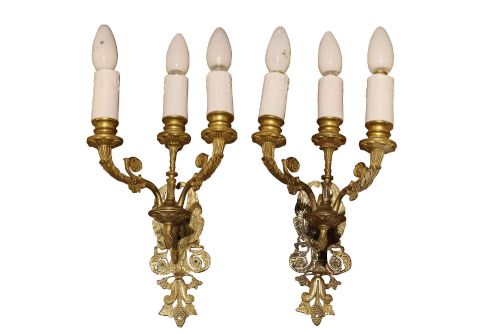
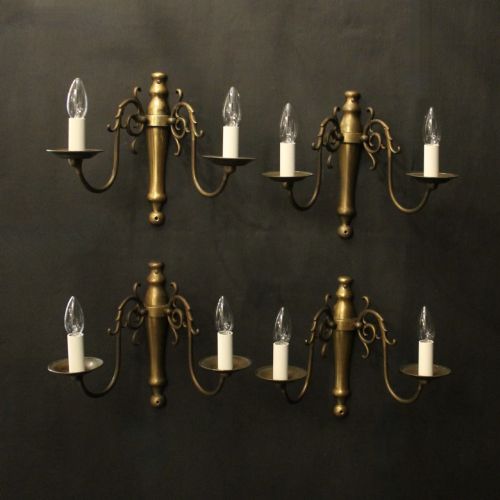
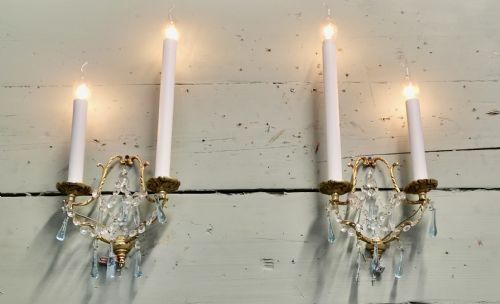
Classic brass appliques are wall-mounted lighting fixtures designed to hold multiple candles or bulbs, appearing primarily as twin-branch and triple-arm wall lights, wall sconces, and wall chandeliers. When searching for classic brass appliques, buyers find pieces originating from French and English traditions, spanning the nineteenth century through the 1920s and 1930s.
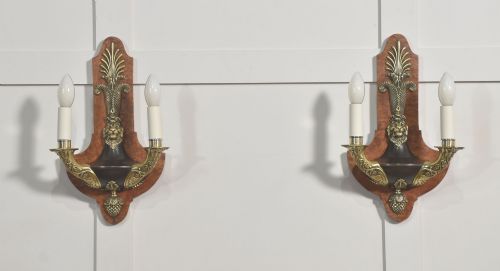
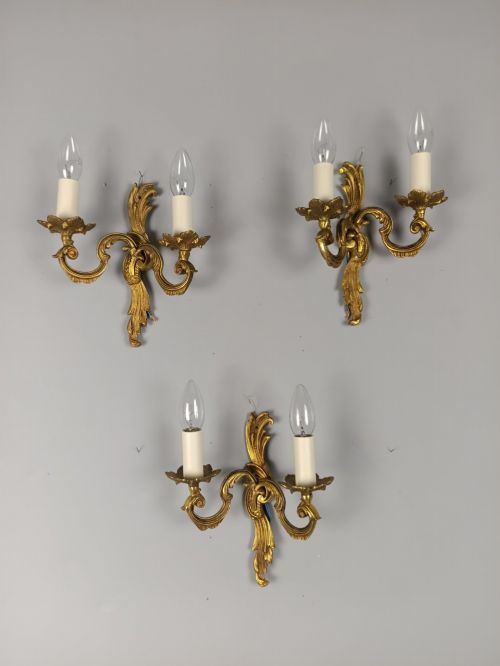
The pieces on this page heavily feature French origins, adopting styles such as French Rococo, French Neoclassical, Louis XVI, Louis XVI Revival, French Empire, and Empire Style, alongside traditional English wall lights. Forms range from pairs of decorative three-branch wall sconces to tall wall chandeliers and sets of gilded twin-arm fixtures.
Makers and designers drew upon historical vocabularies, pairing cast brass with crystal and cut glass, or incorporating burr walnut backplates. Buyers are most likely to encounter matched pairs of gilded bronze or brass wall lights dating from the 1920s and 1930s, as well as mid-nineteenth-century examples.
What varies in quality
The distinction between tiers of quality rests in the crispness of the metal casting and the depth of the chased detail across the brass and gilt bronze surfaces. Superior examples display sharply rendered ornamentation and refined proportions, whereas lesser pieces exhibit softer contours and shallower relief in their decorative elements.
Material selection and assembly methods also differentiate the range, seen in the weight of the cast brass, the quality of the gilding, and the integration of complementary elements like cut glass or burr walnut backplates. Consistency within matched pairs indicates the level of original craftsmanship.
Classic Brass Appliques Retail Price Guide 2026
Typical asking prices for classic brass appliques among the pieces listed under this phrase on Sellingantiques today, from the lower quarter to the upper quarter. They describe what is for sale here now, not the wider market.
Several sets feature intricate French Rococo scrolling, ensuring your wall fixings possess more swirling movement than a runaway garden hose.
The Classic Brass Appliques Glossary
- Applique
- A wall-mounted decorative light fixture or sconce designed to hold candles or electrical fittings. These pieces project from vertical surfaces to provide ambient illumination.
- Gilt Bronze
- Bronze metal treated with a fine layer of gold gilding, frequently utilised in French antique lighting to create a rich, durable surface finish.
- Empire Style
- A neoclassical design movement originating in early nineteenth-century France, characterised by martial motifs, symmetry, and classical restraint. Pieces in this style often incorporate bold geometric forms and rich metallic finishes.
- Louis XVI
- An eighteenth-century French style revived in later periods, distinguished by straight lines, neoclassical urns, swags, and refined botanical details.
- Twin-Branch
- A wall light configuration featuring two arms extending from a central backplate to hold multiple light sources.
Classic Brass Appliques: Frequently Asked Questions
How do I identify French Empire style?
French Empire pieces display classical motifs, heavy symmetry, and architectural discipline rooted in nineteenth-century design aesthetics.
Look for formal proportions, cast bronze surfaces, and decorative elements drawn from classical antiquity.
Can antique wall lights be wired?
Most antique fixtures can be adapted by professional electricians to accommodate modern internal wiring and standard bulb fittings.
Careful installation preserves the original brass and gilt bronze structure while meeting contemporary safety standards.
What is the difference between brass and gilt bronze?
Brass is an alloy of copper and zinc with a natural golden metallic colour, whereas gilt bronze consists of a bronze base covered in a thin layer of gold.
Gilt bronze typically exhibits a deeper, more uniform golden lustre when polished.