





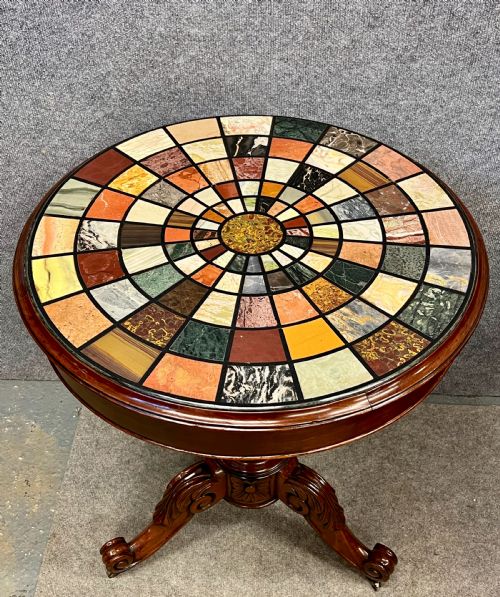

Circular Marble Inlay Table
A circular marble inlay table brings rich Italian craftsmanship and striking geological variety straight into a room.
Circular Marble Inlay Table
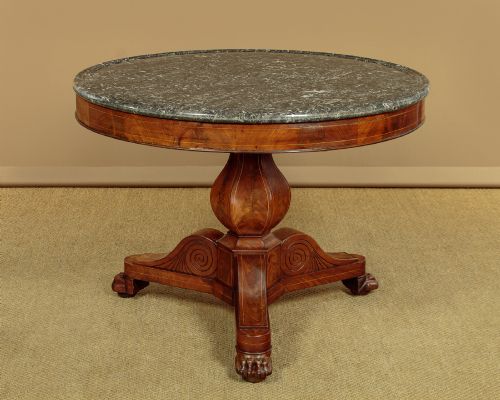
A circular marble inlay table is a solid statement piece designed to anchor a principal room, often functioning as a centre table, side table, or occasional table. These items span periods from the Regency era through to the Victorian period, reflecting classic European interior tastes.
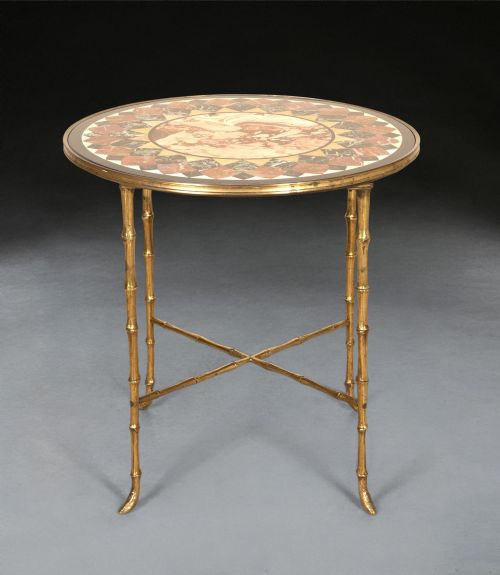
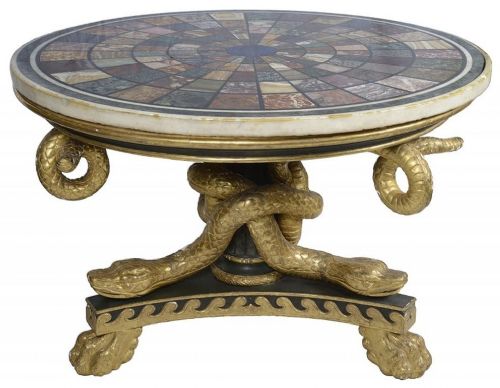
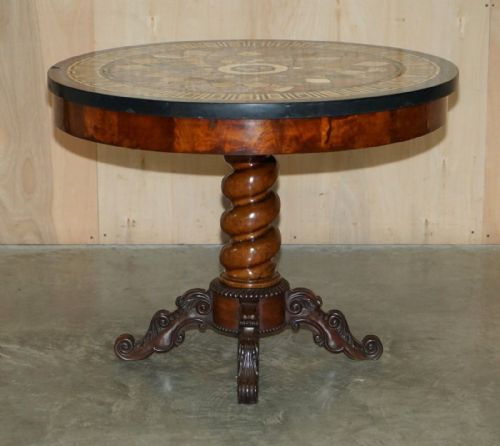
The versions most frequently met on this page belong to the nineteenth century and incorporate elaborate specimen marble or pietra dura work. They frequently arrive from Italian workshops or reflect the aesthetic of the Grand Tour, pairing circular stone tops with mahogany, walnut, or giltwood bases.
How they were made
The construction relies on heavy stone tops fitted onto substantial timber or gilded frames made from mahogany, walnut, satin birch, and giltwood. Artisans shaped and polished individual geological specimens to fit seamlessly together into intricate geometric or pictorial arrangements.
Techniques such as pietra dura and scagliola allowed makers to embed hardstones or coloured plaster into marble matrices to form lasting motifs. Brass inlays and revolving mechanisms also appear in certain Victorian iterations, adding complexity to the underlying cabinetwork.
Materials recorded across the inventory include hardstone, giltwood, brass, and purple marble.
What varies in quality
Quality rests upon the precision of the stone cutting and the variety of the minerals utilised within the top. Finer examples display tight, seamless joins between the inlaid specimens and feature complex pictorial subjects like birds alongside rich purple marble.
The sophistication of the supporting base further distinguishes the pieces, separating standard turned supports from sculptural Grand Tour frames or refined brass detailing. The integration of high-status secondary timbers like mahogany and satin birch elevates the overall status of the furniture.
The Circular Marble Inlay Table Glossary
- Pietra dura
- An artistic technique using cut and fitted polished coloured stones to create decorative designs. This meticulous method produces smooth, painting-like stone surfaces.
- Specimen marble
- A decorative arrangement featuring numerous distinct varieties of marble and mineral collected for their diverse colours. Tops composed of these pieces showcase an array of geological samples.
- Gueridon
- A small circular table supported by a central column or figures, originating in seventeenth-century France. These decorative forms remain popular for displaying objects.
- Scagliola
- A composite substance made from selenite, glue, and pigments used to imitate marble and other fine stones. Artisans apply this material to achieve elaborate inlay effects at a slightly different scale.
- Grand Tour
- A traditional trip of Europe undertaken by upper-class young European men of means to flourish their cultural education. Travellers frequently returned home with Italian marble tables and artwork.
Circular Marble Inlay Table: Frequently Asked Questions
Where should I place a circular marble inlay table?
These tables naturally suit the middle of a principal room or a spacious hallway where the top can be appreciated from all angles.
Because they function well as centre tables or occasional tables, they also anchor seating groups effectively.
How do I clean a marble tabletop?
Dust the surface regularly with a soft, dry cloth to prevent micro-abrasions from accumulated grit.
Avoid acidic cleaning products, as harsh chemicals will etch the polished stone surface over time.
What is pietra dura?
Pietra dura involves inlaying precisely cut pieces of hardstone into a marble base to create detailed pictures or geometric patterns.
This painstaking Italian technique results in a completely smooth, durable decorative surface.
Are these tables heavy?
Yes, the combination of solid stone tops and dense timbers like mahogany or walnut makes these pieces remarkably heavy.
It is advisable to have assistance when moving them to prevent structural strain on the base.