




Circular Mahogany Library Desk
A circular mahogany library desk offers a revolving surface and deep frieze drawers, bringing classic order and proportion to a study.
Circular Mahogany Library Desk
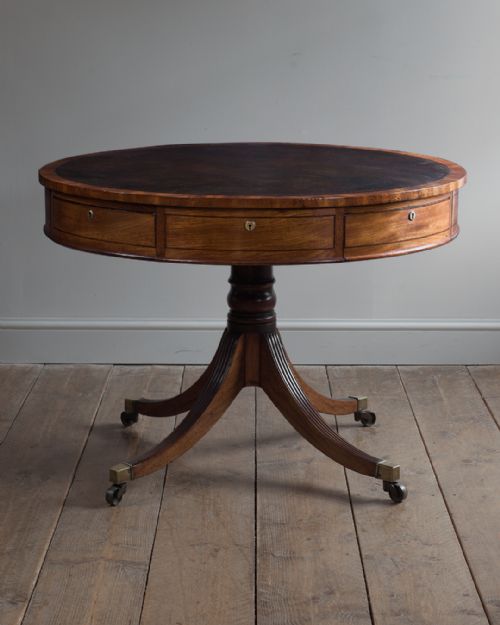
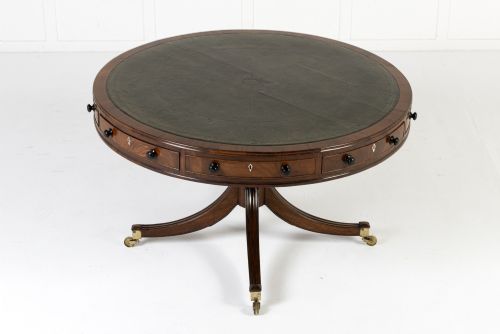
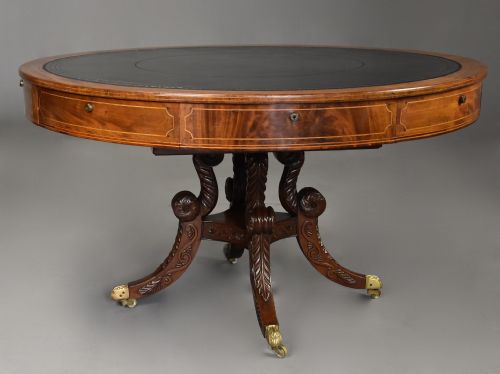
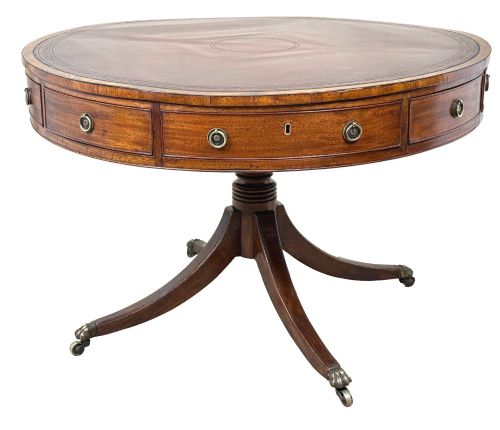
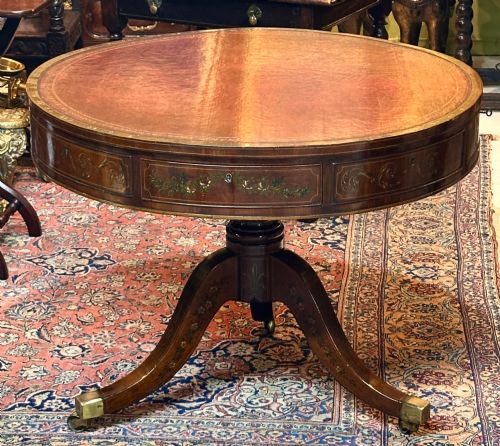
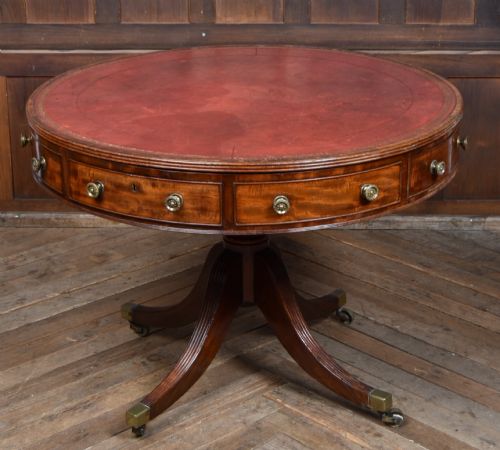
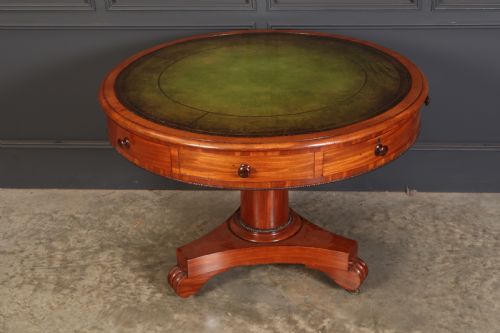
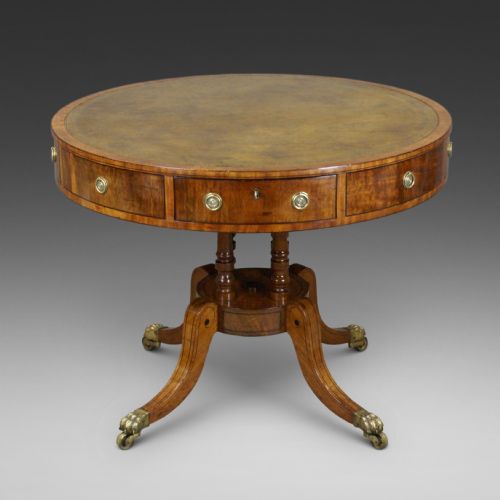
A circular mahogany library desk, frequently styled as a drum table, combines a spinning round top with functional drawers arranged around its perimeter. These pieces appear primarily from the Georgian, Regency, and Victorian periods, reflecting the architectural taste of their eras.
Most examples found on this page belong to the Georgian and Regency epochs, alongside later 19th-century interpretations and Georgian Revival pieces. They stand on central pillar supports, often ending in tripod or quadruple legs, designed to sit in the middle of a room rather than against a wall.
The form functions as both a writing surface and a storage unit, with alternating drawers typically fitted for ledgers and papers. Their compact footprint makes them practical for modern studies while retaining a commanding presence.
Materials and construction
Makers built these tables using solid mahogany and figured flame mahogany veneers over secondary timbers, selecting wood for rich grain patterns and deep colour. Brass hardware, including castors and escutcheons, provides structural reinforcement and functional movement.
Leather inserts, often tooled in gold, form the writing surface at the centre of the top. The revolving mechanism relies on a central pivot and internal framing that allows the entire top to turn smoothly on its base.
Circular Mahogany Library Desk Retail Price Guide 2026
Typical asking prices for circular mahogany library desk among the pieces listed under this phrase on Sellingantiques today, from the lower quarter to the upper quarter. They describe what is for sale here now, not the wider market.
Listings span the Georgian, Regency, and Victorian periods, incorporating materials such as flame mahogany, brass, and leather.
Judging quality
Quality rests on the choice of timber and the precision of the cabinetwork, particularly in the figuring of the flame mahogany veneer and the seamless fit of the revolving top. Superior pieces display book-matched veneers that radiate evenly from the centre.
Hardware and interior construction reveal the maker's care, from hand-cut dovetails on the drawer linings to original brass castors and working locks. The integrity of the turning mechanism dictates how steadily the table rotates.
The Circular Mahogany Library Desk Glossary
- Drum table
- A circular library table with a deep frieze containing alternating drawers around the circumference. The design became popular during the late eighteenth century for studies and libraries.
- Flame mahogany
- A veneer cut from the fork of the mahogany tree, creating a distinctive flamed or feathered pattern. Cabinetmakers reserved this timber for the most prominent surfaces.
- Frieze
- The horizontal band beneath the top of the table that houses the drawers. On these pieces, it accounts for the substantial depth characteristic of drum tables.
- Book-matched
- A technique where adjacent veneer leaves are opened like a book to mirror each other's grain pattern. This creates a symmetrical decorative effect across the table top.
- Revolving top
- A rotating mechanism built into the pillar and framing, allowing the user to access different drawers without walking around the table.
Circular Mahogany Library Desk: Frequently Asked Questions
What is a circular mahogany library desk?
A circular mahogany library desk is a round freestanding table featuring a revolving top and a deep frieze fitted with functional drawers.
Cabinetmakers designed these pieces for the centre of a room to hold books, papers, and writing implements.
How were these tables used originally?
Libraries and studies utilised these tables as central writing desks where multiple people could access stored documents from different sides.
The revolving top allowed users to reach various drawers without moving the chair or walking around the furniture.
How do I care for the leather top?
Leather writing surfaces require gentle dusting and occasional conditioning with appropriate leather balms to prevent drying and cracking.
Direct sunlight and excessive heat should be avoided to preserve the colour and gold tooling.
How can I tell the period of the table?
Dating relies on examining the timber construction, the style of the pillar support, and the joinery methods used in the drawers.
Georgian and Regency examples show hand-cut dovetails and specific leg configurations, while later revival pieces often utilise machine-made components.