





Circular Brass Barometer
A circular brass barometer measures atmospheric pressure with precision and brings solid Victorian and Edwardian craftsmanship directly to your wall.
Circular Brass Barometer
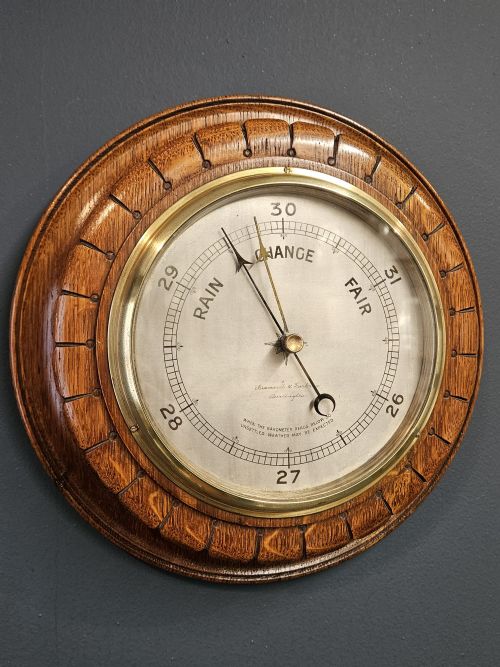
A circular brass barometer is primarily an aneroid instrument housed within a sturdy metal rim, designed for domestic forecasting and interior display during the Victorian and Edwardian eras. These pieces range from simple wall-hanging designs to complex scientific instruments with altitude adjustments.
You are most likely to meet wall-mounted aneroid barometers featuring silvered metal dials housed in oak, walnut, or ebonised wood frames alongside the polished brass bezels. Many examples hail from the latter half of the nineteenth century up to the early twentieth century.
Makers ranged from notable London opticians to regional provincial watchmakers, creating works that combined practical utility with decorative appeal. The forms remain remarkably consistent, adhering to a circular format that suits hallways, studies, and libraries.
Construction and materials
Makers utilised heavy brass for bezels and mountings, pairing the metal with dense cabinet timbers such as oak, walnut, beech, and ebonised wood for the outer cases. Glass protected the delicate silvered metal dials and the pointers within.
The aneroid mechanism inside relies on a sealed metallic vacuum cell that expands or contracts with air pressure changes, linked mechanically to the visible indicator hand on the dial face.
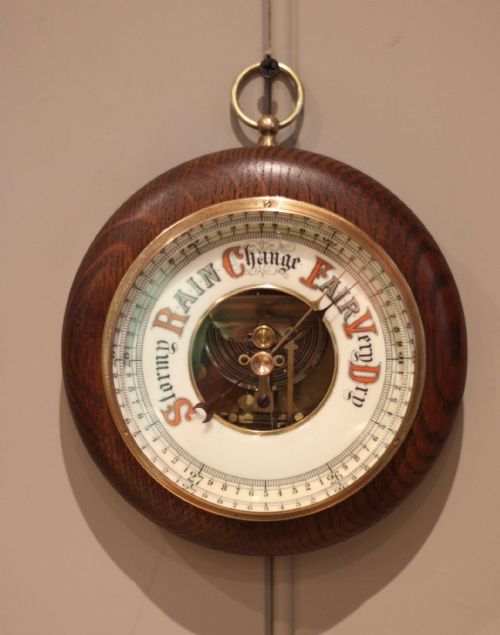
Some Victorian barometers include tiny engraved weather predictions like 'much rain' or 'set fair', offering cheerful optimism regardless of the actual sky.
Assessing quality and execution
Quality shows in the crispness of the engraved markings on the silvered metal dial and the robustness of the brass casting around the bezel. Finer pieces display meticulous attention to case joinery, particularly in geometric or carved wooden surrounds.
The reputation of the maker heavily influences the standing of a piece, with signed instruments from established London scientific retailers demonstrating superior mechanical refinement compared to unmarked provincial items.
Short and Mason·Bramwell and Harbron·Negretti and Zambra·Blake and Son·Dollond of London·M Pillischer
The Circular Brass Barometer Glossary
- Aneroid barometer
- An instrument that measures air pressure without using liquid, relying instead on a flexible sealed metal box. This mechanism allowed barometers to be made in compact circular wall-hanging formats.
- Silvered dial
- A metal face treated to achieve a brushed silver finish upon which graduations and maker details are engraved. This treatment reduces glare and ensures high legibility.
- Bezel
- The metal rim that holds the protective glass in place over the dial face. In these pieces, it is invariably cast from brass.
- Hypsometer
- A specialised instrument used to calculate altitude by measuring the boiling point of water, often combined with aneroid barometers in scientific contexts.
Circular Brass Barometer: Frequently Asked Questions
How do I hang a wall barometer?
Ensure you use a secure wall fixing suited to the weight of the timber case and brass bezel. Hang it firmly at eye level away from direct heat sources and exterior doors.
Check that the instrument hangs plumb against the wall so the internal mechanical linkages operate without friction or binding.
Can these barometers be calibrated?
Most aneroid barometers feature a small adjustment screw accessible from the back or through the dial face. You can set this against a reliable local weather reading.
Turn the screw gently while tapping the glass lightly until the indicator needle aligns with the known barometric pressure for your exact altitude.
What is a skeletonised barometer?
A skeletonised barometer exposes the internal mechanical levers and vacuum chambers through a partially open dial face. This design allows the owner to observe the intricate workings in action.
Such pieces were often produced to showcase the precision engineering of late Victorian instrument makers.
How do I date an Edwardian barometer?
Edwardian barometers generally date from the period between nineteen hundred and the First World War. Look at the typography on the dial and the style of the wood casing for clues.
Simpler oak frames and cleaner dial layouts often point towards this early twentieth-century era rather than the heavier ornamentation of the mid Victorian period.