
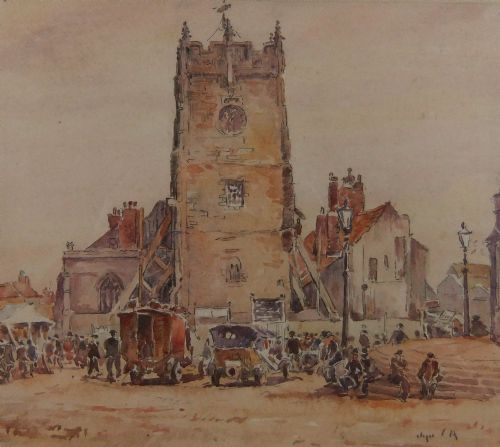


Church Landscape Watercolour
These church landscape watercolour works capture rural and urban spires across Britain, prized for their delicate washes and quiet topographies.
Church Landscape Watercolour
A church landscape watercolour depicts sacred buildings within British countryside, village or town settings, originating primarily across the nineteenth and early twentieth centuries. Buyers encounter diverse regional subjects, from Yorkshire abbeys to Norfolk parishes, rendered on paper support.
The pieces on this page span styles such as Victorian, Edwardian landscape, and British impressionism, reflecting both provincial topography and professional studio execution. Formats range from single framed paintings to diptychs and street scenes featuring graveyards and churchyards.
Makers represented in the historical record include named artists working in regional schools alongside skilled practitioners of the English watercolour tradition. These works document local topography and architectural history through direct observation.
Materials and Technique
Works are executed using watercolour pigment and ink on paper, sometimes complemented by bodycolour for highlights. The application typically relies on transparent washes built up to create atmospheric depth across skies and architectural stone.
Framing often involves gilt wood mouldings and protective glass, preserving the delicate pigments from light exposure and environmental damage. Pigments vary from earth tones to vibrant washes depending on the period and palette of the artist.
Materials recorded across these listings include paper, watercolour pigment, ink, gilt wood, and glass.
Distinctions in Quality
Quality rests upon the sensitivity of the brushwork and the management of light within the composition. Masterful handling of transparent washes allows the texture of the paper to breathe through the architectural forms.
Provenance and documentation elevate certain examples, particularly when signed by known members of regional art groups or exhibited practitioners. The precision of topographical detail balanced against atmospheric mood dictates the standing of individual sheets.
John Smith Atherton·Alfred George Morgan·John Edward Bale·Rowland Henry Hill·Maurice Asselin·David Bates·Fred Lawson·John Thurtle·Thomas Henry Hunn·Max Ludby·Joseph Pighills·Alfred Augustus Glendening·Edwin Moore·Edwin Ridsdale Tate·John Wynne Williams·Daniel Sherrin·Frederick Dove Ogilvie·William Wiehe Collins
The Church Landscape Watercolour Glossary
- Watercolour
- A painting method in which the paints are made of pigments suspended in a water-based solution. The paper support remains partially visible to let light reflect through the translucent washes.
- Diptych
- A painting comprising two separate panels or sheets displayed as a pair. This format appears in devotional and landscape works designed to be viewed side by side.
- Gilt Wood
- Wood that has been covered with a thin layer of gold leaf or gold paint. Such frames are standard for housing works on paper of the period.
- Norwich School
- A regional group of artists inspired by the landscapes of Norfolk. Members practiced plein-air watercolour painting long before the impressionist movement gained widespread popularity.
- Bodycolour
- Watercolour paint mixed with a white pigment to make it opaque. Artists utilise this technique to add highlights and solid opaque areas to a transparent wash drawing.
Church Landscape Watercolour: Frequently Asked Questions
What periods do these watercolours date from?
The works span from the early nineteenth century through the mid twentieth century, encompassing the Victorian and Edwardian eras. Regional British schools dominate the timeline.
Artists during these periods recorded evolving rural and urban parish settings across England and Wales.
How should I frame and display a watercolour?
Watercolours require conservation framing behind glass to protect the paper and pigments from ultraviolet light and humidity. Acid-free mounts prevent chemical damage over time.
Display the pieces away from direct sunlight on interior walls to preserve the integrity of the original washes.
Are these paintings signed by the artists?
Many examples feature artist signatures, monograms, or inscriptions detailing the specific church and location in the lower margins or verso. Unsigned works are often attributed through style or historical provenance.
Inscriptions frequently name specific parishes in Yorkshire, Norfolk, and London.
What subjects besides churches appear in these scenes?
Compositions frequently incorporate surrounding churchyards, rectories, grazing cattle, street scenes with figures, and adjacent rivers. These elements provide local context to the primary ecclesiastical architecture.
Topographical details capture the social and architectural landscape of British villages and towns.