
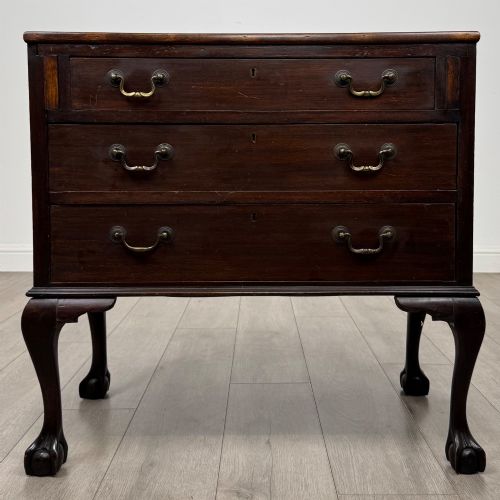
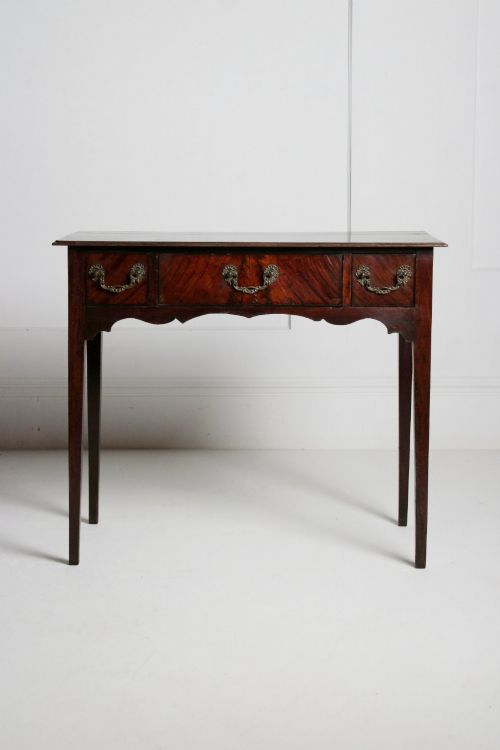


Chippendale Mahogany Lowboy
A chippendale mahogany lowboy offers compact storage and elegant proportions, making it a versatile surface for any room.
Chippendale Mahogany Lowboy
When you search for a chippendale mahogany lowboy, you encounter low dressing tables and side tables primarily originating from the eighteenth century and the Georgian period, alongside later Edwardian and twentieth-century revival pieces. These items function as compact chests of drawers or side tables, frequently featuring multiple drawers set within a low frame.
The pieces listed on this page span the eighteenth century, George III period, Edwardian era, and later revivals, reflecting both original cabinetmaking and subsequent interpretations. Most examples take the form of lowboys, side tables, or dresser bases, providing low-slung surfaces that bridge the gap between a chest of drawers and a writing table.
Buyers meet variations ranging from country house vernacular pieces to formal Georgian designs with serpentine tops. While eighteenth-century originals set the benchmark for the form, Edwardian and Chippendale revival pieces from the twentieth century frequently appear in the listings.
Materials and construction
Makers built these lowboys predominantly using mahogany for the primary surfaces and framing, frequently pairing it with secondary woods such as oak for drawer linings and internal framing. This dense timber provided the structural integrity required for carved details and slender legs.
Hardware played a functional and decorative role, with brass handles and escutcheons fitted to the drawer fronts. Joinery techniques ensured stability across the low frame, supporting the weight of the timber top and multiple drawers without relying on bulky supports.
Listings feature pieces spanning the Georgian era, the Edwardian period, and twentieth-century revivals, constructed primarily in mahogany with oak and brass.
Assessing quality
Quality in these lowboys rests on the crispness of the timber grain, the handling of the mahogany, and the integrity of the secondary woods like oak used in the interior construction. Superior examples display thoughtful timber selection where the grain patterns on the drawer fronts align harmoniously.
The refinement of the proportions and the execution of any carved elements separate standard utility pieces from finer examples. Structural honesty, where original brasses and undisturbed secondary timbers remain intact, elevates the standing of an individual lowboy.
Elkington & Co·Muirhead Moffat & Co
The Chippendale Mahogany Lowboy Glossary
- Lowboy
- A small table with low legs and one or more rows of drawers, commonly used as a dressing table or side table in eighteenth-century interiors.
- Serpentine top
- A table top or drawer front featuring a curved outline that bows outward in the centre and concaves at the sides.
- Dresser base
- A heavy wooden low storage unit fitted with drawers, serving a similar domestic function to a sideboard or lowboy.
- Chippendale style
- A cabinetmaking style inspired by the designs of Thomas Chippendale, characterising mid-eighteenth-century English furniture and later revivals.
Chippendale Mahogany Lowboy: Frequently Asked Questions
What is a lowboy used for?
A lowboy functions primarily as a small side table or a dressing table, offering a surface for display alongside drawer storage. Historically placed in bedrooms or parlours, it holds smaller personal items while maintaining a low profile that does not crowd a room.
Today, buyers utilise them in hallways, living rooms, or as compact writing surfaces. Their modest footprint allows them to fit into spaces where a full-sized chest of drawers or sideboard proves too large.
How do I tell an 18th century lowboy from a revival piece?
Distinguishing period pieces from later revivals involves examining the construction methods, timber ageing, and secondary woods. Eighteenth-century examples typically show hand-cut dovetails and timber characteristics consistent with period cabinetmaking.
Revival pieces, such as those from the Edwardian era or the twentieth century, often employ different machining marks or standardised internal components. Comparing the drawer linings and overall wear patterns helps clarify the age of the piece.
What is the difference between a lowboy and a side table?
While the terms frequently overlap in historical listings, a lowboy specifically incorporates one or more rows of drawers beneath the work surface. A standard side table may simply consist of a flat top supported by legs without integrated drawer storage.
Many lowboys double as side tables due to their general proportions and surface utility. The presence of functional drawers remains the defining architectural feature that separates a lowboy from a basic table.
How do I care for a mahogany lowboy?
Maintaining a mahogany lowboy requires stable indoor humidity and protection from direct sunlight, which can fade the rich tones of the wood. Regular dusting with a soft, dry cloth preserves the finish without building up chemical residues.
Avoiding excessive moisture and placing the piece away from direct heat sources prevents the timber and secondary oak framing from warping. Gentle treatment of the original brass hardware ensures the fixings remain secure over time.