
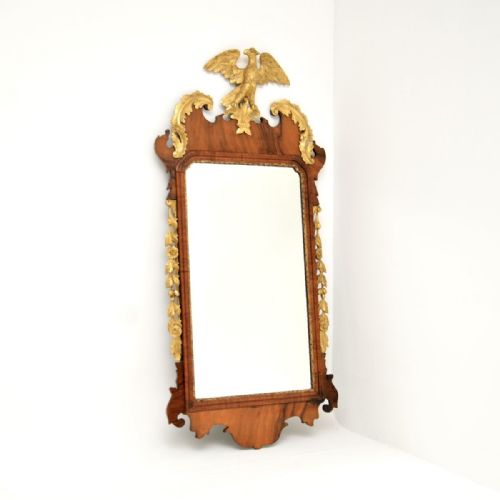
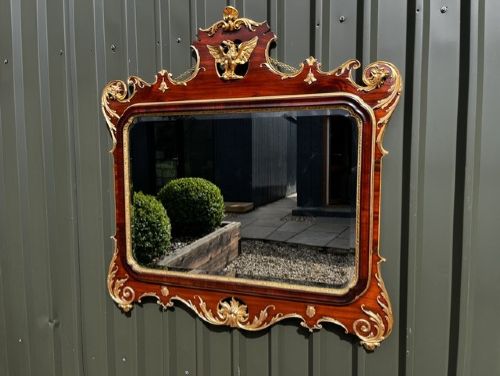
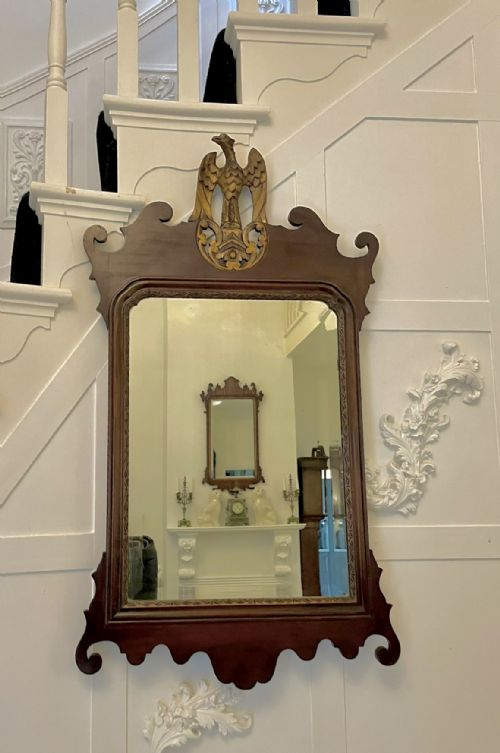


Chippendale Eagle Cresting Mirror
These chippendale eagle cresting mirror examples bring remarkable Georgian presence to a room through carved timber and historic glass.
Chippendale Eagle Cresting Mirror
When you search for a chippendale eagle cresting mirror, you are looking at wall-hanging and overmantel looking glasses rooted primarily in the 18th century, alongside later revivals from the Victorian, Edwardian, and 19th century periods. These pieces combine decorative fretwork frames with classic timber constructions, often featuring carved giltwood details or parcel gilt enrichment.
The versions most commonly met on this page span Georgian originals and subsequent revival pieces executed in mahogany and walnut. Forms range from large overmantel mirrors to smaller fretwork wall mirrors, frequently integrating traditional Vauxhall mirror plates within intricately shaped wooden borders.
Materials and construction
Cabinetmakers constructed these frames using solid timbers of mahogany and walnut, shaping the outlines with intricate fretwork saws. Gesso and gold leaf were then applied to highlight specific carved sections, creating a sharp contrast between the dark polished wood and the bright gilded highlights.
Mirrors of this type often relied on traditional Vauxhall plates set within the wooden rabbet. The combination of carved giltwood, parcel gilding, and dense hardwoods gave these looking glasses both structural rigidity and a reflective focal point.
Early glass plates occasionally retain tiny bubbles trapped within the liquid silica, reminding us of the rudimentary furnaces that melted them.
Assessing quality and execution
The distinction between ordinary and exceptional examples rests in the crispness of the fretwork carving and the depth of the gilding. Finer pieces display hand-cut details with sharp internal corners and well-preserved gold leaf applied over traditional gesso grounds.
Proportion and timber selection further separate the range. Superior mirrors utilise richly figured mahogany or walnut with harmonious grain patterns, whereas simpler interpretations rely on plain boards and less articulated scrollwork.
The Chippendale Eagle Cresting Mirror Glossary
- Fretwork
- Openwork ornamentation cut into thin timber using a fret saw to create geometric or scrolling patterns. It defines the silhouette of many traditional wall mirrors.
- Parcel Gilt
- A technique where only specific raised portions of a wooden object are covered in gold leaf while the underlying timber remains visible. This creates a balanced contrast between wood and gold.
- Gesso
- A plaster-like mixture applied to timber as a smooth base for subsequent gilding. It allows carvers to achieve sharp relief details beneath the gold leaf.
- Vauxhall Mirror
- A historical term for high-quality English looking glass plates distinguished by their thinness and slight bevelled edges. They date back to the famous London glasshouse.
Chippendale Eagle Cresting Mirror: Frequently Asked Questions
Where should I hang a large overmantel mirror?
These large looking glasses sit naturally above a fireplace mantel or anchor a principal wall in a reception room. Their substantial scale allows them to reflect light and expand the visual depth of the space.
Ensure the wall construction supports the combined weight of the timber frame and glass plate safely. Fixings should attach directly to structural studs or use appropriate wall anchors.
How do I distinguish an original Georgian mirror from a revival?
Examination of the timber backing, fixings, and glass plate provides the clearest clues to age. Georgian pieces often display hand-beveled Vauxhall plates and older construction methods behind the frame.
Revival pieces from the Victorian and Edwardian eras utilise machine-sawn elements and newer backing boards while copying the earlier Chippendale and George II styles.
What is parcel gilt?
Parcel gilt refers to partial gilding where gold leaf highlights particular carved motifs, scrollwork, or edges on a wooden frame. The remainder of the piece shows the polished grain of the underlying mahogany or walnut.
This decorative method was widely used during the 18th century to add brightness to dark cabinet wood without completely covering the natural material.