
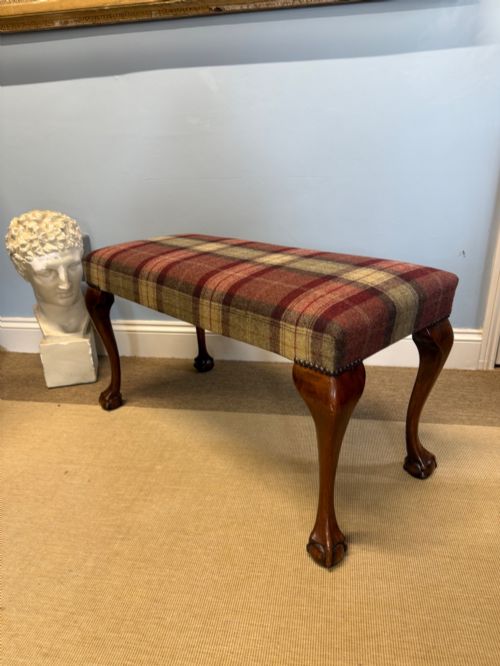
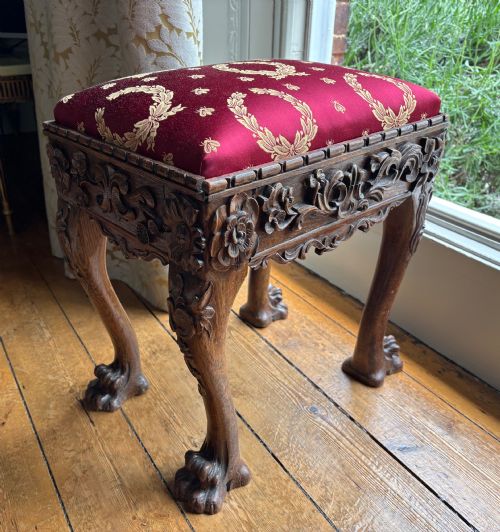
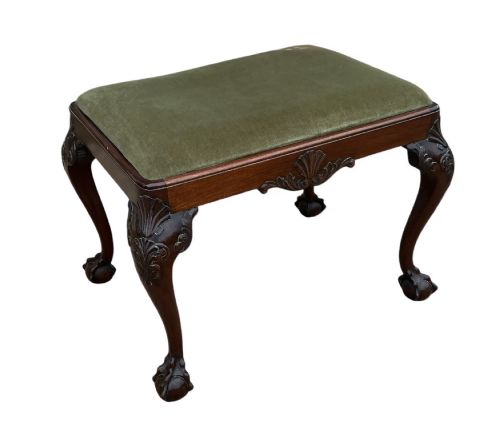
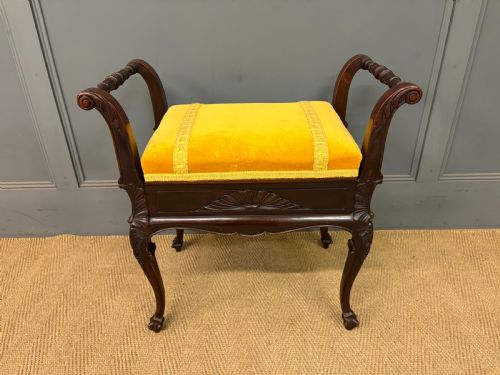




Chippendale Dressing Seat
These Chippendale dressing seats combine mahogany timber with period upholstery to provide practical seating.
Chippendale Dressing Seat
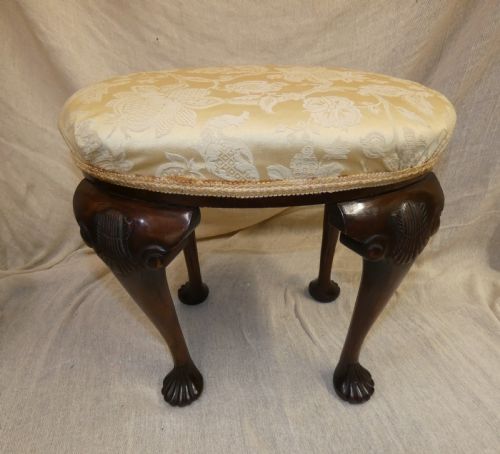
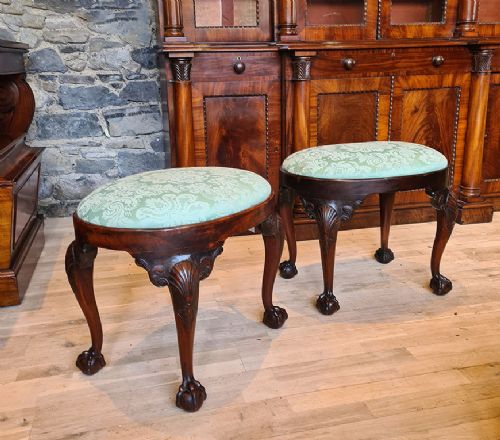
A Chippendale dressing seat is a stool or bench used historically for grooming, dressing or playing the piano. These pieces take various forms including serpentine shapes and oval designs.
Buyers browsing this selection will most frequently encounter Chippendale Revival examples from the late nineteenth and early twentieth centuries, alongside genuine Georgian pieces from the eighteenth century. These seats function as dressing stools, piano stools and footstools within domestic interiors.
Originating in the eighteenth century and revived in later decades, these seating forms reflect historical cabinet-making traditions. The inventory ranges from straightforward mahogany frames to elaborate carved seating.
Materials and construction methods
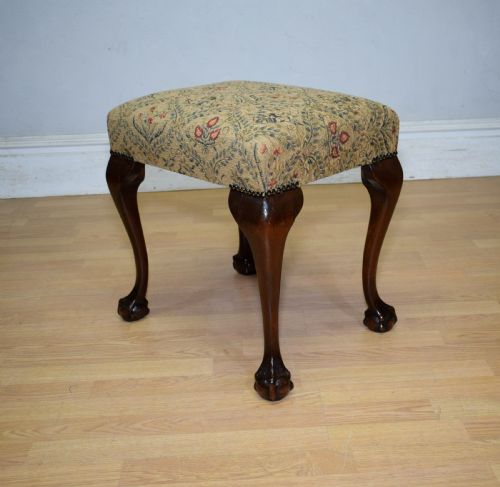
Makers constructed these frames primarily from solid mahogany and walnut timber, relying on the natural strength and dark grain of the wood for structural integrity. Timber sections were shaped through carving to achieve characteristic stylistic outlines.
Upholstery forms an essential part of construction, utilising fabrics such as velvet, damask, leather, wool and general textile coverings fastened over internal padding. Brass elements occasionally appear as decorative accents or hardware details on specific examples.
Listed forms range from serpentine dressing stools and oval benches to piano stools and footstools.
Distinctions in quality and execution
Quality in a Chippendale dressing seat depends upon the crispness and depth of the timber carving on the frame. Skilled execution shows distinct relief work and balanced proportions across the legs and rails.
The choice of covering material and the precision of the upholstery work indicate the tier of production. Finer pieces feature carefully fitted traditional textiles like damask and velvet that complement the underlying woodwork.
The Chippendale Dressing Seat Glossary
- Chippendale Style
- A design classification drawing upon the eighteenth-century pattern books associated with Thomas Chippendale. These pieces often feature carved cabriole legs and intricate woodwork.
- Serpentine Shape
- A contour marked by a wave-like line with a convex centre flanked by concave curves. This contour frequently appears on the frames of eighteenth-century stools.
- Damask
- A reversible figured fabric traditionally woven on a jacquard loom with patterns formed by contrasting weaves. This textile frequently appears as upholstery on nineteenth and twentieth century revival seating.
- Cabriole Leg
- A furniture leg that bends outward in a convex curve at the top and tapers inward in a concave curve below, ending in a pad or claw foot. This form is common in Georgian seating design.
Chippendale Dressing Seat: Frequently Asked Questions
Where do you put a dressing seat?
These seats sit comfortably in front of dressing tables or bedrooms where low seating is required. They also function as occasional piano benches in living spaces.
Their compact dimensions allow them to tuck under surfaces or serve as portable footstools next to armchairs.
Are these seats from the eighteenth century?
The selection includes both genuine eighteenth-century Georgian examples and later revival pieces from the nineteenth and early twentieth centuries. Craftsmanship details and timber patination help separate the periods.
Revival pieces from periods like the Edwardian era emulate earlier eighteenth-century aesthetics while utilising contemporary workshop methods of their own time.
What woods are used for these frames?
Mahogany and walnut form the primary timbers for the frames seen in this selection. These dense hardwoods provided the structural stability needed for intricate hand carving.
Both timbers develop a deep patination over decades of use, which distinguishes older wood from modern substitutes.
How should I clean the upholstery?
Maintenance depends upon the specific textile covering, whether it is velvet, damask, wool or leather. Gentle surface brushing removes dust without damaging the woven fibres.
Professional textile cleaning is recommended for antique fabrics to preserve the integrity of the original material.