

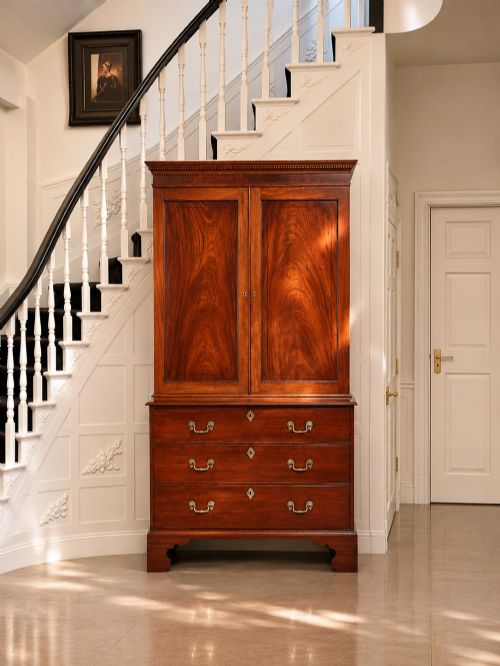

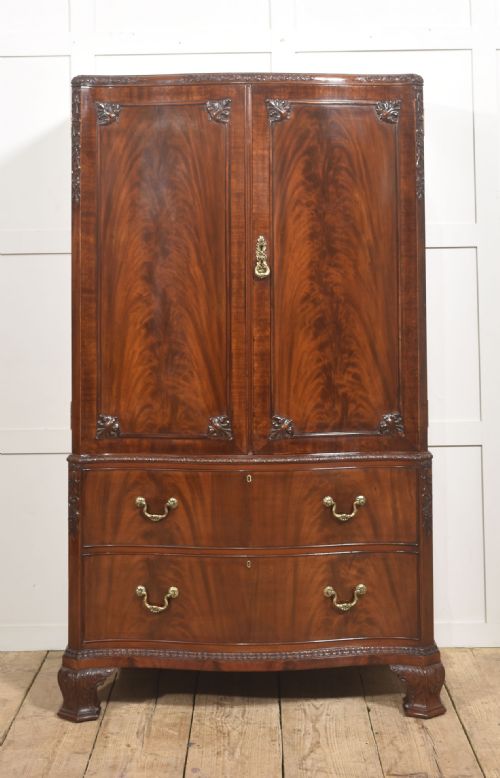


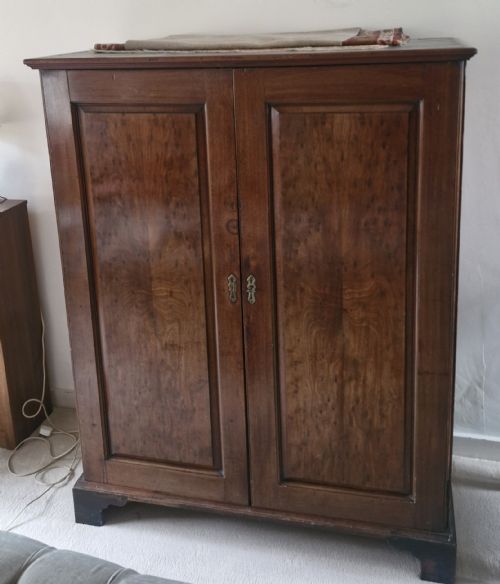
Chippendale Clothes Press
A chippendale clothes press is a substantial mahogany storage piece offering deep drawers and linen space, built for a grand bedroom.
Chippendale Clothes Press
A chippendale clothes press combines upper cupboard doors with lower drawer storage, giving a commanding presence in a room. When you examine a chippendale clothes press, you most often encounter pieces from the Georgian era or later revival periods spanning the nineteenth and twentieth centuries.
The form functions primarily to store linens and garments, evolving from eighteenth-century housekeepers cupboards into tallboys and compactum wardrobes. These pieces rely on solid mahogany or flame mahogany veneer, reflecting the traditional preferences of period cabinet makers.
Materials and construction methods
Makers built these pieces predominantly from solid mahogany, frequently applying flame mahogany veneer to the primary surfaces to create dramatic grain patterns. Structural carcases often incorporate secondary woods such as oak, providing robust internal framing for heavy drawers.
Brass hardware, including handles and escutcheons, complements the dark timber, while decorative carving appears on cornices and canted corners. Joinery relies on traditional techniques that allow the timber to move naturally over centuries of use.
Chippendale Clothes Press Retail Price Guide 2026
Typical asking prices for chippendale clothes press among the pieces listed under this phrase on Sellingantiques today, from the lower quarter to the upper quarter. They describe what is for sale here now, not the wider market.
Listings feature pieces spanning from the mid-eighteenth century through to the mid-twentieth century, predominantly constructed from mahogany with brass hardware.
Judging the quality of a press
Quality rests upon the selection of the timber, particularly how matched the flame mahogany veneers are across the primary facade. Finer examples display crisp, hand-carved detail on the mouldings rather than soft or cast ornamentation.
The interior configuration and the survival of original brass fittings significantly affect the character of the piece. Depth of colour and the condition of the surface finish distinguish superior examples from later revival work.
Thomas Chippendale
The Chippendale Clothes Press Glossary
- Flame mahogany veneer
- A thin slice of timber cut from the fork of the mahogany tree to produce a flickering, flame-like grain pattern. This was applied to primary surfaces for visual impact.
- Compactum wardrobe
- A multi-section wardrobe combining hanging space, sliding trays, and drawers within a single unit. It represents a more complex development of the traditional press.
- Tallboy
- A chest of drawers stacked upon another chest, creating a tall storage unit. In this context, it often incorporates clothes press functionality in the upper section.
- Housekeepers cupboard
- A large storage cabinet traditionally used in grand homes for linens and household stores. These utilitarian pieces formed the functional basis for later decorative presses.
- Patina
- The surface sheen and softening of colour developed by timber over long periods of handling and exposure to light. A desirable aged appearance cannot be readily manufactured.
Chippendale Clothes Press: Frequently Asked Questions
How were these presses used originally?
In large households, staff and owners used these cabinets to store folded table linen, bed sheets, and garments before hanging wardrobes became standard. The sliding trays inside the upper section kept textiles neatly stacked and accessible.
The deep drawers below accommodated heavier items and accessories, keeping chambers orderly and free of clutter.
How do I fit one into a modern room?
Because a chippendale clothes press is exceptionally heavy and tall, measuring your ceiling height and stair clearance before purchase is essential. They function well in spacious bedrooms or dressing rooms as a focal storage point.
Ensure the room has stable humidity levels to protect the mahogany timber and veneer from drying out or splitting.
How do I tell an eighteenth-century press from a revival piece?
Examining the construction methods, secondary timbers like oak, and the nature of the hand-cut joints helps determine the age of the carcase. Eighteenth-century pieces exhibit natural wear patterns and eighteenth-century hardware conventions.
Revival pieces from the Victorian and Edwardian eras often show machine-sawn elements, standardised fixings, and brighter internal timbers while faithfully copying earlier proportions.