


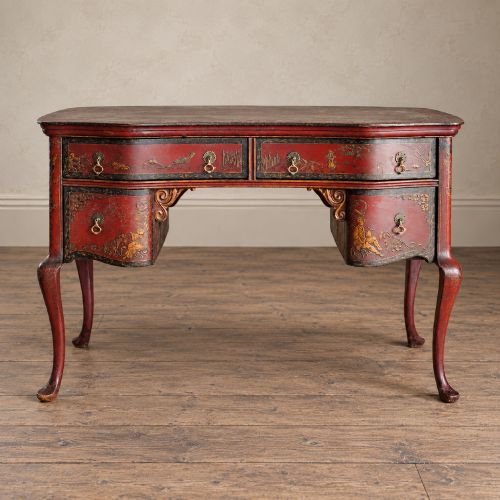


Chinoiserie Dressing Table
These chinoiserie dressing table pieces bring lacquered surfaces, painted motifs and period elegance into a room.
Chinoiserie Dressing Table
A chinoiserie dressing table encompasses lowboys, side tables, kidney-shaped forms and complete bedroom suites finished with oriental motifs. Buyers searching for a chinoiserie dressing table encounter items dating from the eighteenth century through to the Edwardian period and the 1920s.
The selection ranges from early export mirrors and black lacquered toilet mirrors with miniature bureau bases to late Edwardian walnut suites and ebonised dressing table mirrors. Forms include dressing tables, side tables, writing tables, desks and lowboys reflecting styles such as Regency, Queen Anne and Chinese Export.
Materials and construction
Pieces are constructed from wood, softwood, walnut and painted wood, utilising lacquer, brass and mirror glass. Surfaces feature painted decoration and ebonised finishes.
Construction methods support distinct forms including kidney-shaped tables, kneehole desks and side tables paired with matching table mirrors or stools.
Chinoiserie Dressing Table Retail Price Guide 2026
Typical asking prices for chinoiserie dressing table among the pieces listed under this phrase on Sellingantiques today, from the lower quarter to the upper quarter. They describe what is for sale here now, not the wider market.
Current listings span the eighteenth century, nineteenth century, Victorian era, Edwardian period and 1920.
Distinctions in quality
Quality rests in the execution of the lacquerwork and painted oriental style decoration across the wood and softwood structures. The depth of the ebonised or lacquered finish separates standard production from finer cabinetmaking.
Integration of original brass hardware and the preservation of antique mirror glass influence the character of each piece. Cohesion within larger bedroom suites also defines the finer examples.
Whytock and Reid
The Chinoiserie Dressing Table Glossary
- Chinoiserie
- European interpretation of Chinese and East Asian artistic traditions, expressed through painted and lacquered motifs on furniture.
- Lowboy
- A small side table or dressing table featuring one or more rows of drawers, commonly standing on four legs.
- Toilet mirror
- A small adjustable looking glass mounted on a stand or miniature base, designed to sit atop a chest of drawers or dressing table.
- Kidney-shaped
- Describing a curved, kidney contour characteristic of specific dressing tables found in the later Victorian period.
Chinoiserie Dressing Table: Frequently Asked Questions
What periods do these tables cover?
The pieces span several centuries, beginning with eighteenth-century Chinese export items and Queen Anne toilet mirrors. Later examples move through the nineteenth century, including Regency side tables and Victorian lacquered furniture.
Twentieth-century items are also represented, extending into Edwardian suites and pieces from the 1920s. Each era brings distinct structural forms and decorative treatments to the category.
How were these dressing tables used?
These tables served primarily for personal grooming and morning toilet routines in domestic bedchambers. Many incorporated surface space for toilet mirrors, small drawers for cosmetics, or writing surfaces.
Some items functioned as multi-purpose writing desks or side tables, particularly the lowboys and kneehole formats. Stools and matching bedroom suites completed the dressing arrangements in period homes.
What materials make up the surface finish?
Surfaces rely heavily on lacquer, painted wood and ebonised finishes to create the characteristic oriental aesthetic. Details are often applied over wood and softwood foundations.
Mirror glass and brass hardware frequently accompany these finishes, particularly on toilet mirrors and drawer mounts. Walnut also appears in later Edwardian suites.
How do I identify a Queen Anne style piece?
Queen Anne style items in this selection date to the eighteenth century and feature characteristic forms such as black lacquered toilet mirrors with miniature bureau bases. They often employ dark lacquer and traditional cabinet proportions.
Later nineteenth-century pieces occasionally adopted this aesthetic as a revival style, incorporating similar decorative motifs on side and dressing tables.