

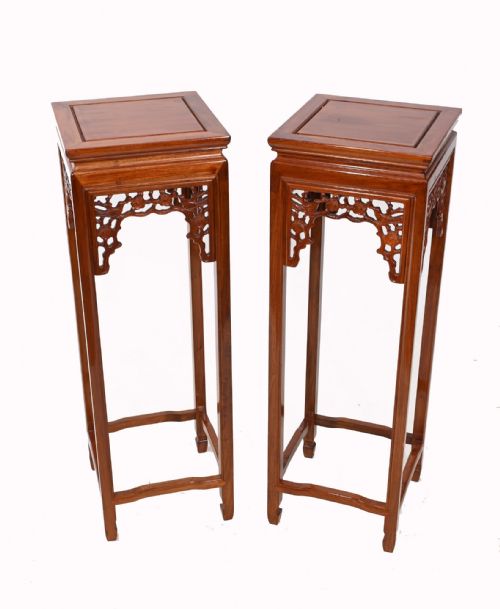


Chinese Openwork Carved Table
These Chinese openwork carved table pieces bring intricate fretwork and solid timber into a room, offering both surface space and striking sculptural form.
Chinese Openwork Carved Table
A Chinese openwork carved table encompasses forms like altar tables, low opium tables, nests of tables, desks, and console or side tables. Buyers seeking this style find items designed for display, daily utility, and structural elegance.
The pieces on this page span the Victorian era, the nineteenth century, and the early decades of the twentieth century, including the late Qing Dynasty period. They frequently appear as matched pairs, quartetto nests, or individual accent stands.
Originating within Chinese traditional and export traditions, these tables showcase pierced and perforated carving techniques that reveal complex motifs. Their versatility suits them for placement as centre tables, coffee tables, or occasional pedestals.
How they were made
Carpenters utilised dense exotic timbers such as hongmu, padouk, rosewood, elm, and burr wood to construct these items. These hardwoods provided the structural strength needed to support deep, intricate piercing without losing stability.
Artisans applied hand-carved openwork techniques directly to the timber, cutting away background material to create layered, pierced relief designs. Traditional joinery secured the framework of legs, aprons, and tops without relying on modern metal fasteners.
Chinese Openwork Carved Table Retail Price Guide 2026
Typical asking prices for chinese openwork carved table among the pieces listed under this phrase on Sellingantiques today, from the lower quarter to the upper quarter. They describe what is for sale here now, not the wider market.
Materials recorded across the inventory include hongmu, padouk, rosewood, elm, burr wood, and general carved hardwood.
What varies in quality
The depth and crispness of the openwork carving determine the visual merit of each piece, distinguishing flat surface work from deeply undercut, highly detailed piercing. Finer items exhibit precise control over complex fretwork patterns across aprons and panel inserts.
The choice and figuring of the timber influence the overall standard, particularly when burr wood panels are contrasted against darker hongmu or padouk framing. Superior examples maintain structural integrity and balanced proportions through skilled application of traditional joinery.
The Chinese Openwork Carved Table Glossary
- Openwork
- Carving technique where material is pierced and cut completely through to create a pattern with negative space. This method allows light to pass through panels and aprons.
- Hongmu
- A dense, heavy Chinese hardwood prized for its deep reddish-brown tone and durability. It provides a stable base for intricate joinery and fine surface carving.
- Altar table
- A traditional rectangular form featuring upturned flange ends or recessed legs, originally designed for ritual display. These pieces now serve as console or side tables in domestic interiors.
- Quartetto
- A matched set of four tables designed to graduate in size so they slide neatly beneath one another. This form is commonly found in nesting table sets from the late nineteenth and early twentieth centuries.
- Padouk
- A sturdy tropical timber with a distinct reddish hue used in nineteenth-century cabinetmaking. Its stability suits it for heavily carved desks and occasional tables.
Chinese Openwork Carved Table: Frequently Asked Questions
What is an altar table?
An altar table is a long, narrow rectangular table traditionally used for ceremonial display in Chinese homes and temples. These pieces feature characteristic recessed legs and sometimes upturned flanges at the short ends.
Today, buyers place them in hallways or living spaces as console or side tables. Their elevated height and narrow proportions make them practical for displaying decorative objects against a wall.
How do nesting tables work?
Nesting tables consist of a graduated set of four tables, often called a quartetto, designed to fit compactly beneath each other. Each table shares a matching style and construction method.
This arrangement allows owners to store multiple surfaces in the footprint of a single small table. Users pull them out individually when extra surface space is needed for drinks or books.
What is hongmu wood?
Hongmu translates literally as red wood and refers to a category of dense, heavy tropical hardwoods used in traditional Chinese furniture. It possesses natural strength and a rich, dark colour that ages well.
This timber accepts fine detail carving without splintering, making it ideal for the pierced aprons and openwork panels found on these tables. Its substantial weight gives the furniture a solid feel.
How do I date these tables?
Dating relies on stylistic markers, construction methods, and recorded production periods such as the late Qing Dynasty or the Victorian era. Pieces from the nineteenth and early twentieth centuries often display specific joinery traits and timber selections.
Examining the wear patterns, carving depth, and finish helps differentiate nineteenth-century examples from later 1920s productions. Comparing the form to documented export styles provides further chronological context.