
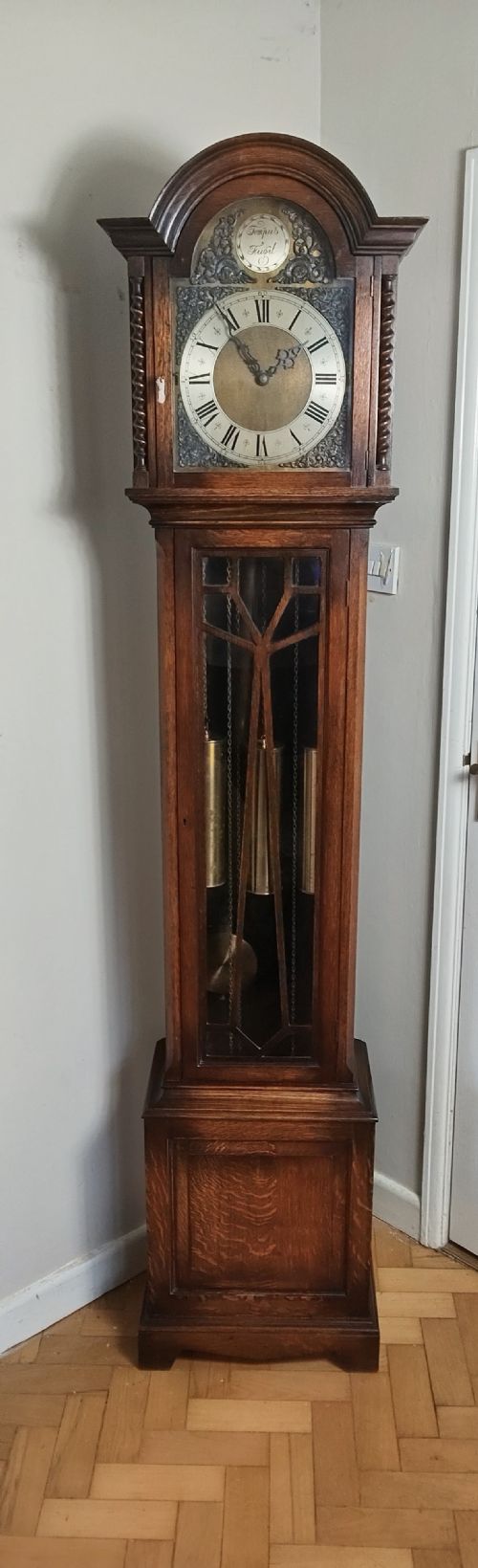
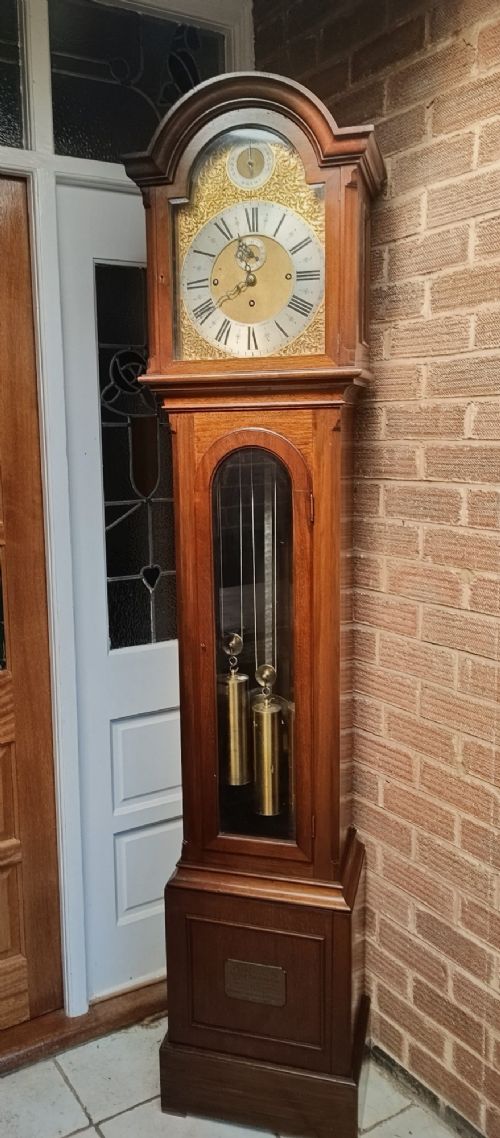
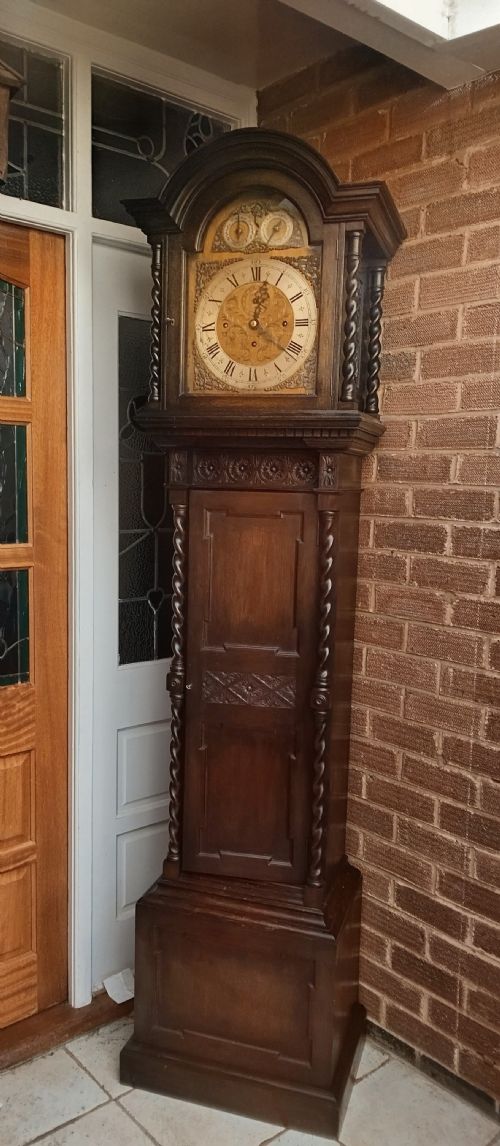
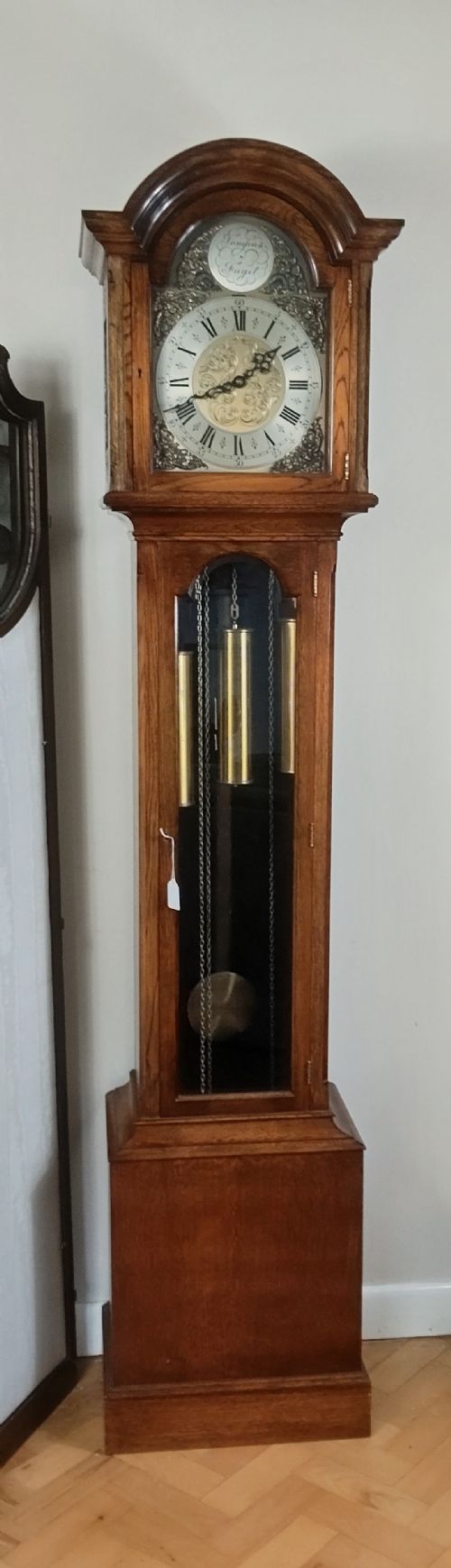


Chiming Oak Floor Clock
A chiming oak floor clock fills a room with deep acoustic resonance and dependable mechanical timekeeping across multiple revival styles.
Chiming Oak Floor Clock
A chiming oak floor clock stands as a substantial vertical timepiece housed in a wooden case, predominantly emerging in grander tall forms such as grandfather clocks and more compact variations like grandmother clocks.
The pieces appearing on this page span several decades from the Victorian era through the Edwardian period and into the 1920s and 1930s, encompassing English Traditional, Art Deco, and Jacobean Revival styles.
Buyers encountering this selection will find tall case clocks featuring brass faces, glass viewing doors, and complex internal chimes driven by weights or springs.
What varies in quality
The sophistication of the internal movement dictates the upper tier of the range, separating simple time-and-strike mechanisms from elaborate triple-weight musical systems playing multiple tunes on bells or tubes.
Cabinetry craftsmanship sets the standard for physical preservation, distinguishing heavily carved or elegantly proportioned oak cases from simpler utilitarian enclosures.
Signatures by recognised makers or established retailers elevate the standing of a clock, linking the physical piece to documented horological provenance.
Listings feature oak cabinetry paired with brass and glass, spanning periods from Victorian to 1930s Art Deco.
Elliott·Bravingtons·Enfield·Harrods·W Prior Skipton
The Chiming Oak Floor Clock Glossary
- Grandfather clock
- A tall freestanding weight-driven timekeeper enclosed in a wooden case exceeding six feet in height. These floor-standing instruments serve as both furniture and precise chronometers.
- Grandmother clock
- A smaller version of the traditional tall case clock, standing under six feet high. This compact format fits modest domestic spaces while retaining full mechanical chimes.
- Longcase clock
- An alternative term for a tall pendulum clock housed inside a protective wooden trunk. The swinging pendulum descends inside the vertical body of the case.
- Triple weight
- A movement driven by three separate suspended weights powering timekeeping, hour striking, and musical carillons. Each weight requires periodic manual descent management.
- Carillon
- A set of tuned bells or tubes struck by hammers to play melodies or quarter-hour chimes. These musical arrays define the acoustic character of advanced floor clocks.
Chiming Oak Floor Clock: Frequently Asked Questions
How do I wind a chiming oak floor clock?
Winding requires raising the suspended weights using a crank key inserted into holes on the dial face. Care must be taken not to overwind the springs or pull the weight chains too rapidly.
Most eight-day movements require weekly attention, while other configurations demand more frequent interaction to maintain continuous operation and chime sequences.
Where should I place a floor clock?
Position the piece against an interior wall away from direct sunlight, heating vents, and exterior doors. Stable room temperatures protect the wooden cabinetry from splitting and warping.
Ensure the floor surface is entirely level so the pendulum swings symmetrically and the escapement ticks with an even rhythm.
How do I tell an Edwardian clock from a 1930s piece?
Edwardian examples often incorporate revival ornamentation such as carved oak panels, brass filigree, and traditional English proportions. Pieces from the 1930s frequently lean toward cleaner geometric lines and Art Deco influences.
Dial typography and bezel shapes also shift across these decades, moving from ornate Roman numerals on engraved brass plates to simplified Arabic layouts.
What is the difference between a grandfather and a grandmother clock?
The primary distinction lies in overall height, with grandmother clocks measuring noticeably shorter than traditional grandfather clocks. This reduced scale suits rooms with lower ceilings.
Despite the smaller cabinet dimensions, these compact variants often house fully functioning eight-day movements and chime trains.