
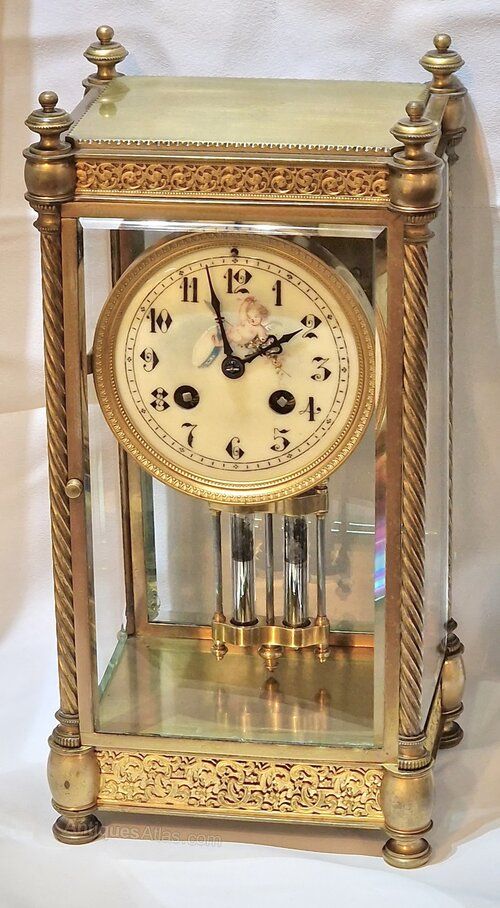


Cherub Dial Clock
A cherub dial clock brings sculptural grace and precise mechanical movement to a room, driven by continental bronze work and gilded metal.
Cherub Dial Clock
When you search for a cherub dial clock, you are looking at mantel timepieces, table clocks, and cartel clocks featuring cast figures of putti or cherubs integrated into the dial or case. The versions you are most likely to meet on this page hail predominantly from nineteenth-century French workshops, spanning the Victorian era through the Belle Epoque.
These timepieces appear in styles such as French Rococo Revival, Louis XVI Revival, and Empire Revival, often paired with matching garnitures or mounted on white marble and ormolu bases. Makers across London and Paris produced these pieces utilising gilt bronze, patinated bronze, and hand-painted enamel dials.
The architectural forms range from four-glass mantel clock designs to elaborate onyx and gilt bronze clock sets. Each piece merges timekeeping utility with classical figural sculpture, placing the cherub motif centrally as a symbol of domestic harmony.
How they were made
The construction of these pieces relies heavily on cast ormolu and gilt bronze, where intricate mounts and figural cherubs are shaped from molten metal before being finely chased and gilded. Bronze casters applied patination techniques alongside fire gilding to achieve lasting depth and contrast in the metallic surfaces.
Clockmakers housed mechanical movements inside heavy marble, onyx, or cast bronze cases, often incorporating hand-painted enamel dials with delicate numerical markers. Skilled artisans assembled fusee or pendulum movements, ensuring each dial integrated seamlessly with the surrounding sculptural bronze figures.
Listings for this phrase include materials such as white marble, pink marble, onyx, gilt bronze, and patinated bronze across nineteenth-century styles.
What varies in quality
Material selection also dictates overall merit, with solid white marble or heavy onyx bases outperforming lighter alloy substitutes. Original signed movements by known Parisian or London makers elevate a clock above standard anonymous production.
Leon Message·Jollet et Cie·BELLENOT PARIS·John Bennett Cheapside London·Henry Berkeley Square London
The Cherub Dial Clock Glossary
- Ormolu
- Gilded bronze produced by applying a mercury and gold amalgam to a bronze base and heating it. This technique creates a durable golden finish seen on many nineteenth-century clock mounts.
- Cartel clock
- A wall-mounted clock enclosed in an ornate frame made of bronze, wood, or gilt metal. These pieces hang directly on interior walls rather than resting on mantelpieces.
- Four-glass clock
- A timepiece encased in four glass panels that expose the mechanical movement from multiple angles. This design became popular during the late Victorian period for mantel display.
- Fusee
- A conical pulley used in clock mechanisms to maintain even tension on the mainspring as it unwinds. This device improves the timekeeping accuracy of the movement.
- Garniture
- A set consisting of a central clock flanked by matching decorative objects such as urns or candelabra. These matched suites decorate nineteenth-century mantelpieces.
Cherub Dial Clock: Frequently Asked Questions
How do I wind a cherub dial clock?
Most mechanical clocks require a key inserted into the winding arbors on the dial face or back plate. Turn the key gently until you feel resistance, taking care not to overwind the mainspring.
Keep a consistent schedule for winding, typically once a week depending on the movement type. Handle the pendulum with care if the clock needs relocation.
Where should I place a mantel clock?
Position the clock on a stable, level surface away from direct sunlight, dampness, and heavy vibrations. Mantelpieces and sideboards provide solid support for heavy bronze and marble cases.
Ensure there is adequate clearance around the piece for airflow and regular maintenance access. Avoid placing mechanical clocks near active heat sources that could dry out internal lubricants.
How do I identify a French nineteenth-century clock?
Examine the movement back plate and dial for maker stamps, serial numbers, and country of origin marks. Stylistic cues like Rococo curves and fire-gilded ormolu point toward continental production.
Compare the casting quality of the cherub figures against known Victorian examples. Heavy bronze cases and hand-painted enamel dials are typical indicators of this period.
What maintenance do these clocks need?
Professional servicing every few years ensures the mechanical movement remains clean and properly lubricated. Dust the exterior bronze and marble gently using a soft, dry cloth without harsh chemical cleaners.
Avoid tampering with the escapement or suspension spring yourself. Regular gentle care preserves both the mechanical function and the patinated finish.