


Champleve Enamel Table Clock
A champleve enamel table clock brings brilliant colour and intricate metalwork to a desk or mantel, combining decorative panels with precise mechanics.
Champleve Enamel Table Clock
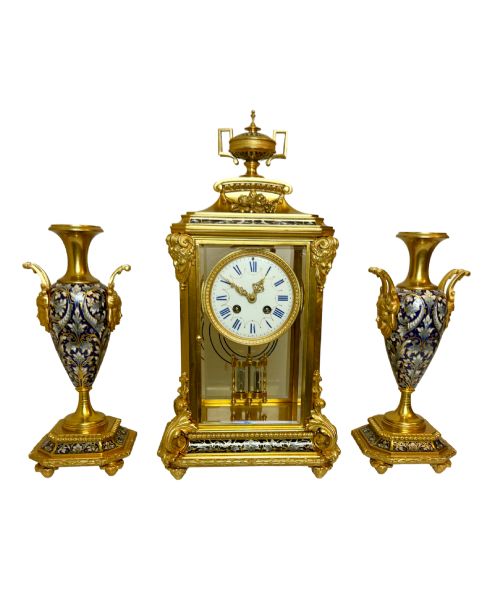
A champleve enamel table clock combines heavy metallic mounts with vibrant decorative compartments, spanning periods from the Victorian era into the early twentieth century. These pieces predominantly originate from French workshops adhering to styles such as Napoleon III, French Rococo Revival, and Belle Epoque.
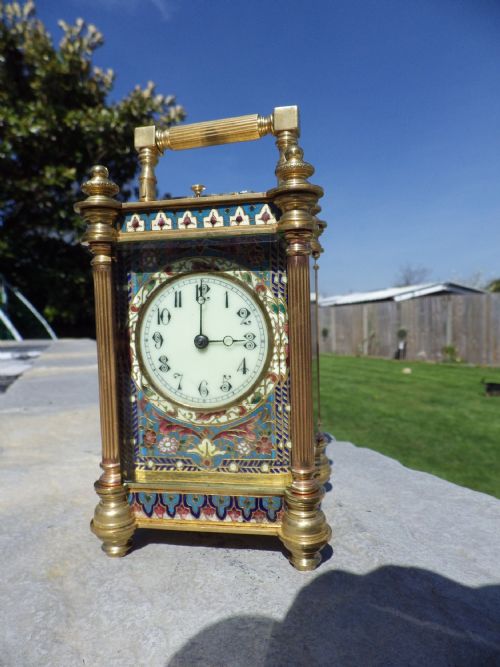
Buyers commonly encounter mantel clocks, carriage clocks, and four glass regulators fitted with enamel dials or inlaid panels. Variants range from small strut easel bedside clocks to grand clock garniture sets accompanied by matching ornaments.
The aesthetic leans heavily towards ornate architectural forms and classical styling, often integrating glass panels that reveal the interior movement. Most examples date from the later nineteenth century, specifically around the eighteen eighties and nineties.
Materials and construction
Gilt bronze, brass, and ormolu form the primary structural housings for these timepieces, providing a durable foundation for the decorative elements. Artisans cast these metal mounts into elaborate revivalist shapes before applying gilding to achieve a bright surface finish.
Champleve enamel involves carving troughs directly into the metal surface, filling the recesses with coloured vitreous paste, and firing the piece at high temperatures. Enamel and glass are then polished flush with the surrounding metal to create smooth, patterned panels across the clock body.
Listings show champleve enamel table clocks executed in gilt bronze, brass, and ormolu, spanning the Victorian and Edwardian periods.
Factors of quality
Quality reveals itself in the crispness of the cast metal mountings and the depth of the champleve enamel work. Finer examples display precise chasing on the bronze and brass surfaces alongside evenly fused enamel colours without surface pitting.
The integration of the movement within the housing also separates standard pieces from superior works. Clocks featuring multi-piece matching garnitures or complex crystal regulator housings demonstrate a higher level of original workshop ambition.
Le Roy and Fils·Barwise London
The Champleve Enamel Table Clock Glossary
- Champleve enamel
- A technique where troughs are hollowed out of a metal base and filled with vitreous enamel before firing. This method creates bold, colourful patterns bordered by thin lines of exposed metal.
- Ormolu
- Gilded bronze used extensively in French clockmaking to provide a rich golden appearance. The technique involves applying a mercury and gold amalgam to a bronze base.
- Crystal regulator
- A mantel clock enclosed in glass panels on four sides, allowing a clear view of the mechanical movement and pendulum. These typically date from the late nineteenth century.
- Clock garniture
- A set comprising a central clock flanked by matching decorative objects such as urns or candelabra. These sets were designed to sit harmoniously on a mantelpiece.
Champleve Enamel Table Clock: Frequently Asked Questions
What is a champleve enamel table clock?
A champleve enamel table clock is a decorative timepiece featuring metal housings inlaid with fired vitreous enamel. These pieces are typically French in origin and date from the nineteenth century.
They encompass various forms, including mantel clocks, carriage clocks, and glass regulators, often incorporating gilt bronze or ormolu mounts.
How do I identify the period?
Periods are identified by the stylistic traits, metal finishes, and structural designs associated with Victorian, Edwardian, and nineteenth-century French manufacturing. Details such as rococo revival motifs or crystal regulator cases point towards specific decades like the eighteen eighties or nineties.
Makers' signatures or specific regional styles inscribed on the clock face or movement can also help narrow down the production era.
What maintenance do they require?
Maintenance involves gentle cleaning of the glass and metal surfaces using soft, dry cloths without harsh chemical polishes. Mechanical movements require professional servicing by a horologist to ensure proper functioning.
Keeping the clock away from direct sunlight and excessive moisture helps preserve the enamel colours.