
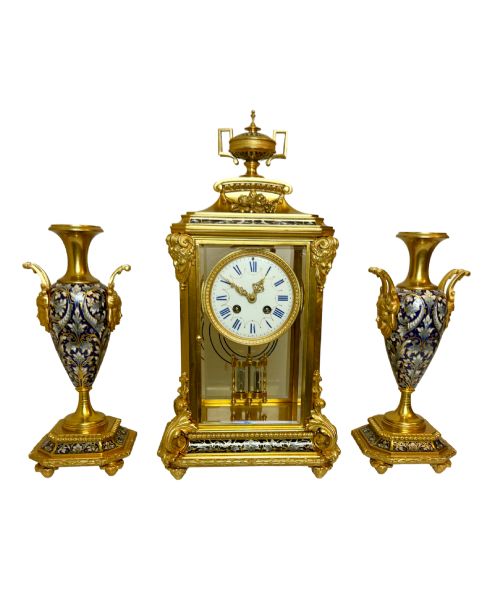


Champleve Enamel Mantel Clock
These champleve enamel mantel clocks combine heavy cast bronze frames with vivid, recessed colour fields, offering a striking centrepiece for a traditional interior.
Champleve Enamel Mantel Clock
A champleve enamel mantel clock is a domestic timekeeper featuring metalwork carved to create hollows that are filled with vitreous enamel paste and fired. These objects originate largely from French workshops during the nineteenth century, spanning periods from the second empire to the belle epoque.
The most common formats on this page include large garniture sets flanked by matching ornaments, crystal regulators with glass panels revealing the movement, and smaller carriage clocks fitted with enamel bandings. Most examples deploy traditional architectural or revivalist forms, frequently paired with gilt bronze, brass, or ormolu mounts.
How they were made
The construction relies on founding heavy bronze, brass, or ormolu into structural cases and decorative plinths. Artisans then hollowed out patterns directly into the metal surface to form troughs for the coloured glass paste.
Vitreous enamel powder was packed into these recessed channels and fired in a kiln until melted, after which the entire surface was ground flat and polished to a uniform lustre.
Listings feature French and British pieces spanning the Victorian era through the early twentieth century, utilising glass, gilt bronze, porcelain, and ormolu.
What varies in quality
Quality rests on the depth of the metal casting and the precision of the hand-carved channels holding the enamel work. Finer specimens display crisp, deeply chased bronze or ormolu mounts alongside cleanly separated colour panels without surface pitting.
The intricacy of the accompanying movement and dial decoration also separates standard productions from superior examples, particularly where hand-painted porcelain dials or repeating mechanisms are integrated into the housing.
Le Roy and Fils·Barwise London
The Champleve Enamel Mantel Clock Glossary
- Champleve enamel
- A technique where troughs are gouged into a metal base, filled with enamel powder, and fired. This creates flush coloured patterns across the metal surface.
- Ormolu
- A finely ground gold powder amalgamated with mercury and applied to a bronze base by heat. The finish provides a bright, durable metallic sheen.
- Garniture set
- A clock accompanied by matching side ornaments or vases designed to sit together on a mantelpiece. These groupings share identical metalwork and enamel palettes.
- Crystal regulator
- A clock housed within glass panels that expose the internal gear train and pendulum from multiple angles. These often feature enamel inlays along the brass framework.
- Repeating carriage clock
- A portable timekeeper equipped with a mechanism that sounds the last hour or quarter-hour upon pressing a button. These frequently incorporate enamel dials and decorative side panels.
Champleve Enamel Mantel Clock: Frequently Asked Questions
How were these clocks used originally?
Nineteenth-century households placed these timekeepers on prominent mantelpieces in drawing rooms and parlours to regulate daily schedules and display household standing. The garniture sets served as decorative centrepieces flanked by matching urns or candelabra.
Smaller variations such as carriage clocks or bedside timepieces were built for portable use during travel or placement in private chambers. Their repeating mechanisms allowed owners to check the time audibly in total darkness.
Where should I place my clock at home?
Position the piece on a stable, level surface such as a wooden mantelpiece, console table, or heavy sideboard away from direct sunlight and dampness. A secure foundation ensures the mechanical pendulum swings evenly and keeps accurate time.
Avoid locations near active heat sources or drafty windows, as temperature fluctuations can affect the metal housing and the internal brass components. Adequate clearance around the case also allows easy access for routine winding.
How do I identify the period of my clock?
Examine the stylistic cues of the bronze casting and the form of the enamel panels to determine the era of production. Pieces styled during the second empire often display heavier classical proportions, whereas later belle epoque or crystal regulator designs tend toward lighter glass-and-brass housings.
Look for maker signatures stamped on the backplate of the internal movement or engraved along the dial face. Comparing these markings against known workshop records helps narrow down the decade of manufacture.