

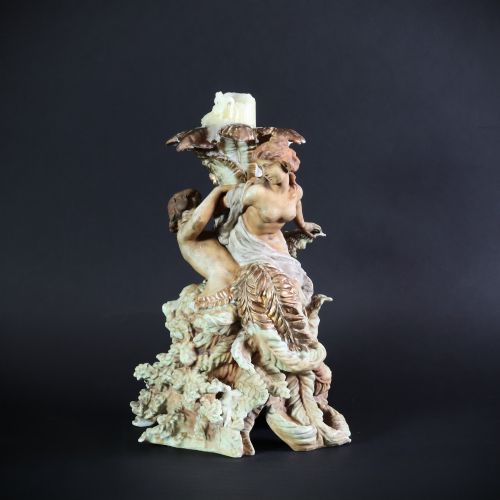

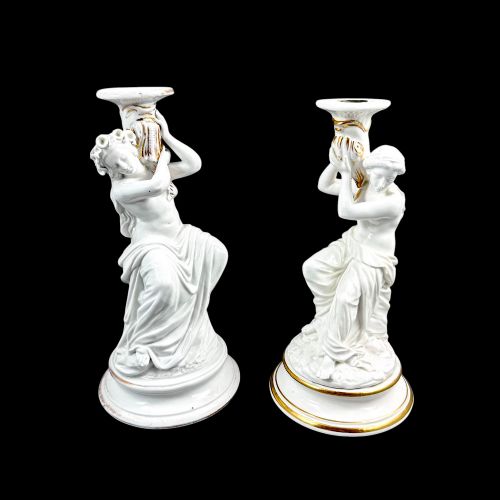


Ceramic Figural Candle Holders
These ceramic figural candle holders combine sculptural modelling with domestic utility, bringing 18th and 19th-century character directly onto the mantelpiece.
Ceramic Figural Candle Holders
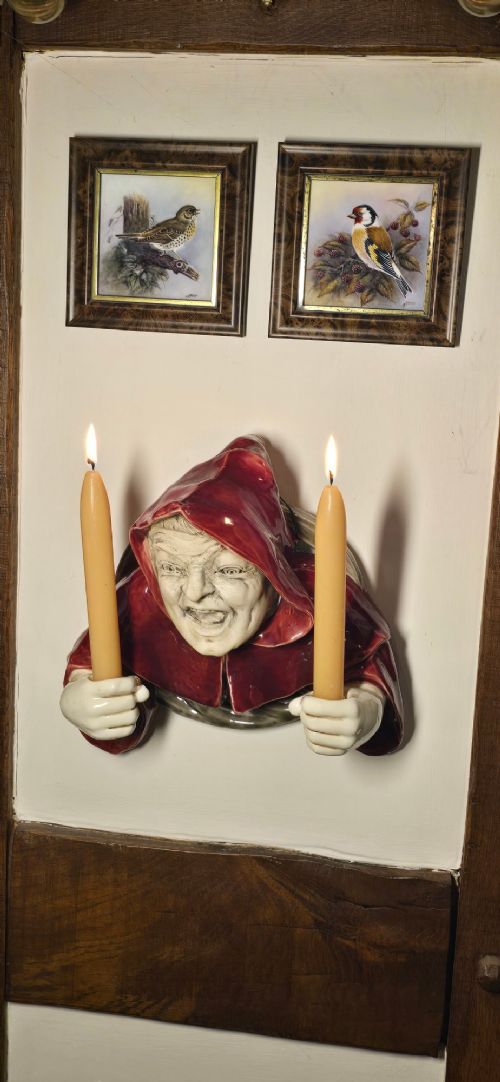
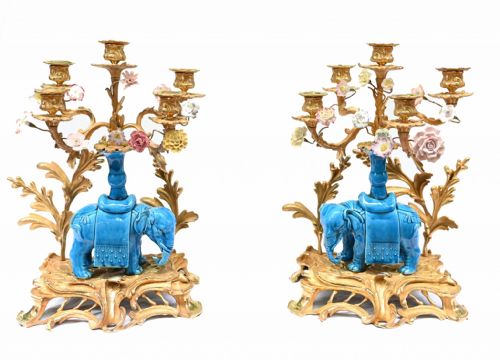
Ceramic figural candle holders span a range of centuries, featuring figures from allegorical representations to children, musicians, and dancers. When exploring ceramic figural candle holders, buyers encounter forms such as single candlesticks, multi-arm candelabra, and wall hanging pieces.
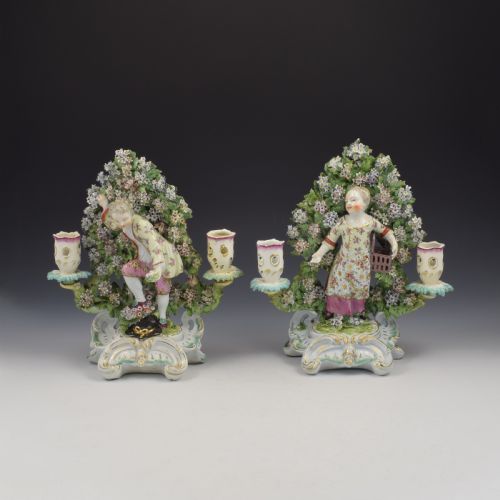
The material origins reach from English factories like Derby, Chelsea, Royal Worcester, Minton, and Sutherland & Sons to continental German works including Meissen, Volkstedt, Sitzendorf, and Dresden. These pieces often arrive in pairs, modelled with floral bases, rococo scrolls, and bocage backgrounds.
Pieces span periods from the Georgian and Victorian eras through to the early 20th century, encompassing 1880, 1890, and 1910 designs. Victorian neoclassical and rococo revival styles heavily influence the visual presentation of these sculptural lights.
Materials and technique
Makers utilised soft-paste porcelain, pottery, and standard porcelain bodies, shaping them into elaborate three-dimensional figures and structural candle nozzles. Surfaces were finished with detailed glaze, enamel painting, and selective application of gold leaf, gilt, and gilding.
Techniques relied on careful hand-modelling of intricate details like foliate bocage, baskets, and facial expressions before firing. Workshops such as Royal Worcester and continental factories employed specialised painters to apply enamels and metallic leaf by hand.
Ceramic Figural Candle Holders Retail Price Guide 2026
Typical asking prices for ceramic figural candle holders among the pieces listed under this phrase on Sellingantiques today, from the lower quarter to the upper quarter. They describe what is for sale here now, not the wider market.
Materials recorded across these items include soft-paste porcelain, pottery, enamel, and gold leaf highlights.
Assessing quality
Quality rests in the crispness of the modelling and the precision of the hand-painted enamel work across the figures and floral bases. Finer examples retain delicate bocage leaves and gilding with minimal rubbing, whereas simpler pieces show broader brushwork and heavier porcelain casting.
The reputation of the manufactory, from Derby and Chelsea to Meissen and Sitzendorf, dictates the artistic ambition and technical mastery of the piece. Larger multi-arm candelabra and pieces attributed to named modellers or signed by artists demonstrate greater complexity.
Royal Worcester·James Hadley·Meissen·Sitzendorf·Derby·Chelsea·Minton·Helena Wolfsohn·Volkstedt·Sutherland & Sons
The Ceramic Figural Candle Holders Glossary
- Bocage
- Background foliage made of applied ceramic leaves and flowers that frames the central figures. This technique appears frequently on 18th-century English porcelain.
- Candelabra
- A branched candle holder designed to support multiple tapers from a single base. These often feature matching figural supports.
- Gilt
- A thin layer of gold applied to the ceramic surface or highlights to accentuate rococo scrolls and garment details. It requires careful handling during cleaning.
- Soft-paste porcelain
- A ceramic composition containing glass frit and white clay, fired at lower temperatures than hard-paste porcelain. It is characteristic of early English factories.
- Rococo Revival
- A 19th-century design style emulating 18th-century asymmetric scrolls, naturalistic curves, and shell motifs. It dominates many Victorian figural candlesticks.
Ceramic Figural Candle Holders: Frequently Asked Questions
Were these candle holders used for daily lighting?
Many of these decorative pieces served as formal table ornaments or mantelpiece displays during the Georgian and Victorian periods. Their elaborate figures and fragile porcelain foliage suggest they were prized for display rather than heavy domestic use.
Candles were inserted into the sconces for special dining occasions, though many survive with minimal wax residue due to their ornamental role.
How can I tell English pieces from German pieces?
English factories such as Derby and Chelsea often utilised soft-paste porcelain and distinctive patch marks on the underside during the 18th century. Victorian Royal Worcester pieces frequently bear factory stamps associated with James Hadley.
Continental works from Meissen, Sitzendorf, and Volkstedt typically employ hard-paste porcelain and distinct blue underglaze factory marks. Their figural styles lean heavily into rococo revival and allegorical themes.
What does allegorical figure mean?
Allegorical figures represent abstract concepts such as the seasons, virtues, or elements through human form. Examples include figures personifying Summer, Autumn, or specific children representing concepts like liberty and matrimony.
These subjects were popular in European porcelain workshops throughout the 18th and 19th centuries as decorative philosophical statements.