
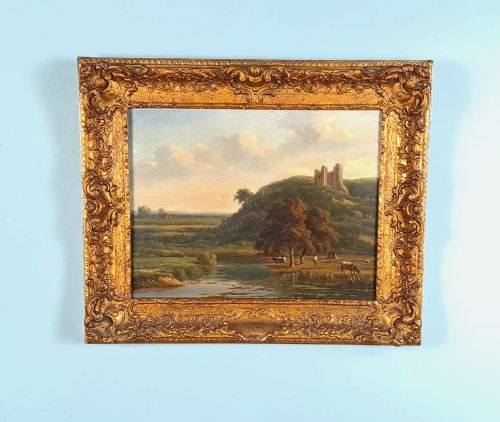


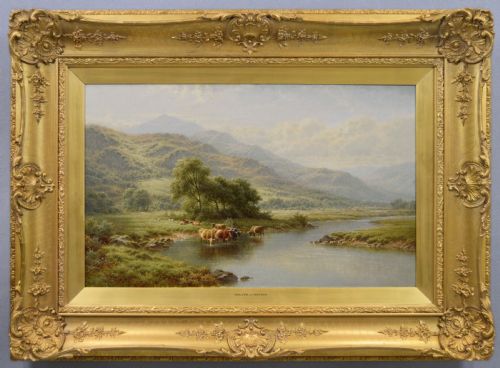


Cattle River Landscape Oil
When you search for cattle river landscape oil, you enter a pastoral tradition celebrating rural life along waterways.
Cattle River Landscape Oil
These works depict domestic livestock resting or watering beside rivers, streams, and upland waterways across Britain, Wales, and Scotland. Most examples date from the nineteenth century into the early twentieth century, aligning with Victorian pastoral movements and British landscape realism.
Compositions often feature cows or drovers navigating rural banks, framed by hills, trees, and bridges. Painters such as William Sidney Cooper and Sidney Richard Percy established a familiar visual language where livestock provides scale and tranquillity to the natural scene.
Materials and Technique
Artists painted primarily using oil on stretched canvas, though boards and wood panels also appear within the collection. Canvas provided a durable surface for building layered brushwork, capturing the light on water and the texture of cattle hides.
Original presentation relies heavily on giltwood and gesso frames, often intricately moulded and gilded. These frames complement the pastoral subject matter by containing the view within a reflective metallic border.
Materials recorded across the archive include oil paint, giltwood, gesso, milk glass, and wood panels spanning the 1850s to the 1920s.
Quality Variations
Superior works demonstrate confident handling of light, atmospheric depth, and anatomical accuracy in the rendering of animals. Master painters balanced the naturalism of the cattle with the surrounding landscape topography, avoiding stiff or formulaic placement.
The integrity of the original gilt frame and the clarity of the artist's signature or inscription further distinguish finer pieces. Works bearing documented provenance to specific locations like the River Dart or the River Stour hold additional historical weight.
T C Hofland·William Sydney Cooper·George Vicat Cole·Sidney Richard Percy·Thomas Baker·Claude Cardon·William Traies·Henry Cheadle·Henry Birtles·Walter J Watson·Alfred de Breanski·Thomas Thomas·Thomas E Francis·Thomas Sidney Cooper·Etty Horton·Owen Bowen·A Wallace·William E Tindall·Alfred Augustus Glendening·Emma Von Boeckh·Jean-Baptiste Coene·Alfred Vickers·Edmond De Schampheleer·WJ Ellis·Edwardian
The Cattle River Landscape Oil Glossary
- Giltwood
- Wood carved and covered with a thin layer of gold leaf or metal powder. It forms the classic shimmering border characteristic of nineteenth-century picture frames.
- Gesso
- A paint mixture consisting of a neutral binder mixed with chalk, gypsum, or pigment. It is applied to wooden frames to create a smooth surface for gilding.
- Stretcher
- The wooden frame that holds a canvas taut. Inscriptions regarding the title or artist are frequently written directly upon this structural wooden element.
- Pastoral
- A genre of art depicting the rural countryside and agricultural life. These scenes emphasise simplicity, peace, and harmony between animals and nature.
- Provenance
- The chronological history of the ownership of a painting. Documented attribution helps verify the authenticity and origin of nineteenth-century canvases.
Cattle River Landscape Oil: Frequently Asked Questions
What canvas sizes are common?
Dimensions vary considerably, ranging from intimate cabinet paintings on board to large gallery-scale canvases spanning several feet. Mid-sized formats intended for domestic Victorian drawing rooms appear most frequently in the collection.
The scale usually reflects the ambition of the composition and the prominence of the artist within the British school.
Are these paintings cleaned?
Over decades, traditional oil varnishes naturally darken and collect ambient pollutants, altering the original balance of blues and greens in the river and sky. Professional conservation can remove this discoloured layer to reveal the artist's original palette.
Examining the surface under specialised light helps determine whether a painting retains its original varnish or has undergone past restoration.
How should I frame them?
These works look best when housed within period-appropriate giltwood or moulded frames that match the aesthetic of the nineteenth century. Swept or gilded frames enhance the warm tones of the pastoral landscape.
Avoid overly modern mouldings, which can clash with the traditional technique and historical character of oil on canvas.