


Traditional Welsh Mountain Art
Traditional welsh mountain art captures the rugged scenery and river valleys of Wales through nineteenth and early twentieth century oils and watercolours.
Traditional Welsh Mountain Art
Traditional welsh mountain art comprises oil and watercolour paintings depicting the distinct topography of locations such as Snowdon, the Conwy valley, and the pass of Llanberis. These works document nineteenth and early twentieth century landscapes through the eyes of period artists.
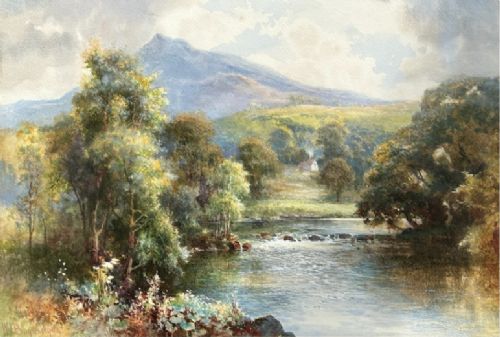
The watercolours and oils on this page most commonly present pastoral and realist views of Welsh rivers, mountain ranges, and rural labourers. These paintings emerge from the Victorian and Edwardian eras, capturing rural topography before modern development.
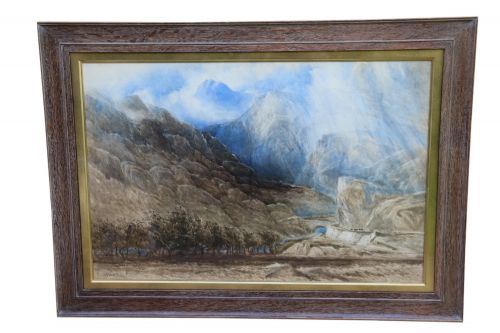
Collectors encounter framed works executed on canvas or paper, frequently housed in giltwood and gesso frames. The subjects focus closely on recognisable peaks like Moel Siabod alongside pastoral river scenes.
How these works were made
Artists applied oil paint to canvas or watercolour pigments to paper, capturing atmospheric conditions and natural light across Welsh terrain. These paintings utilise traditional media suited to both studio completion and plein-air sketching.
Surviving works frequently retain their original giltwood and gesso frames, constructed from wood and embellished with moulded ornamentation. These frames complement the scale and period of the paintings they enclose.
What varies in quality
Quality rests upon the artist's ability to render light, atmosphere, and topographical accuracy within the landscape. Finer works display confident brushwork and balanced composition, particularly when depicting shifting weather over mountain ranges.
The preservation of the paper or canvas, alongside the integrity of the original giltwood frame, influences the overall character of the piece. Stronger examples maintain clear signatures and distinct provenance linking them to recognised painters.
William Joseph Boyes·Henry Martin Pope·Sidney Richard Percy·Thomas Spinks·Charles Leslie·Walter J Watson·J Barclay·Cornelius Pearson·Samuel Towers·Benjamin Williams Leader·James Poole
The Traditional Welsh Mountain Art Glossary
- Oil on Canvas
- Pigment mixed with drying oil applied to a stretched woven fabric support. This medium allows for rich colour depth and textured brushwork.
- Watercolour
- Paint consisting of water-soluble pigments applied to paper. It produces transparent washes that capture light effects in landscape studies.
- Giltwood
- Wood that has been coated with a thin layer of gold leaf or gilt paint. It provides an ornate decorative border for period paintings.
- Gesso
- A plaster-like mixture applied to wood surfaces as a base for moulding or gilding. It gives period frames their crisp ornamental details.
- Victorian Realism
- An artistic approach focusing on accurate, unidealised representation of subjects. In these landscapes, it manifests as detailed recording of actual Welsh terrain and weather.
Traditional Welsh Mountain Art: Frequently Asked Questions
What subjects do these paintings show?
The artworks depict Welsh topography, focusing on rivers, mountain ranges, and valleys such as Snowdon and the Conwy. They frequently include pastoral elements like farm workers and travellers within the landscape.
Scenes range from calm summer weather to passing showers over peaks, reflecting nineteenth and early twentieth century artistic interests in rural British scenery.
How should I hang a framed watercolour?
Watercolours on paper require protection from direct sunlight to prevent fading of the pigments over time. Position them on interior walls away from moisture and heat sources.
Ensure the frame is securely hung using appropriate fixings suited to the weight of the giltwood and gesso surround.
Are these works signed by the artists?
Many of the paintings feature signatures or documentation connecting them to period artists active during the Victorian and Edwardian eras. These inscriptions help identify the specific painter and location depicted.
Attributions rely on recorded styles, period techniques, and historical records associated with nineteenth century British landscape painting.