
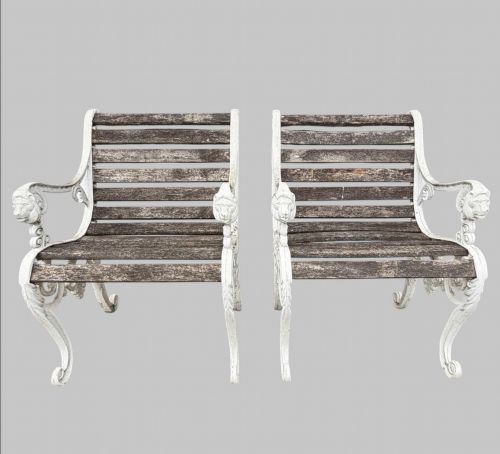


Cast Iron Armchair
These cast iron armchair examples range from robust Victorian garden seating to heavy maritime revolving chairs, offering distinct industrial character and lasting utility.
Cast Iron Armchair
A cast iron armchair combines a rigid metal structural frame with functional seating purposes, spanning domestic, commercial and exterior settings. When you search for a cast iron armchair, you encounter diverse forms ranging from garden chairs to swivel office desks and ship seating.
The pieces on this page heavily feature garden sets and conservatory armchairs from the Victorian period alongside interwar maritime and office examples. Makers utilised the strength of metal to create durable armchairs for both heavy daily use and outdoor endurance.
Victorian industrial designs sit alongside Edwardian, Art Deco and 1930s incarnations, demonstrating how iron framing adapted across decades. You find both purely metal garden iterations and hybrid forms incorporating wooden or upholstered elements.
Materials and construction methods
The primary material is cast iron, utilised for structural frames, decorative backs and bases, often paired with oak, satinwood or mahogany components. Metal is poured into moulds to create intricate patterns such as lion masks or industrial bracing, while secondary materials provide seating comfort.
Upholstered versions incorporate leather, fabric and button-back padding supported by wood and brass fixings. Office and ships chairs frequently feature revolving mechanisms and polished oak seats, balancing metallic rigidity with practical movement.
Surface treatments include historical paint and polished finishes that protect the metal while revealing the underlying texture of the casting. Wrought iron and brass elements occasionally supplement the main cast iron framework.
Some chairs spent their early days on P & O ships and polo club sidelines before settling down indoors.
Distinctions in quality and execution
Quality rests upon the crispness of the casting detail and the integrity of the structural frame. Finer examples display sharp definition in decorative motifs such as lion masks and intricate pierced backs, whereas simpler versions show softer contours.
The grade of secondary materials significantly elevates a piece, distinguishing standard garden seating from high-end maritime or office furniture featuring carved oak, mahogany and re-leathered swivelling bases. Robust mechanical components in revolving chairs also mark superior production standards.
The Cast Iron Armchair Glossary
- Cast iron
- A strong, hard alloy of iron and carbon poured into a mould to form complex shapes. It forms the essential structural and decorative basis for these chairs.
- Revolving chair
- A seat mounted on a central pivot allowing it to turn full circle. These are commonly found in maritime and office contexts from the late nineteenth and early twentieth centuries.
- Button back
- An upholstery style where depressions are formed in the padding by pulling buttons deep into the stuffing. This technique secures the material and creates a tufted appearance.
- Victorian industrial
- A style combining nineteenth-century manufacturing utility with decorative aesthetic touches. It reflects the era's heavy reliance on metal framing for functional furniture.
- Patio set
- A coordinated group of outdoor tables and chairs designed for garden or conservatory use. They frequently utilise matching cast iron frames across all pieces.
Cast Iron Armchair: Frequently Asked Questions
Are these chairs suitable for outdoor use?
Many of these chairs originated as garden or patio seating built to withstand external conditions. However, pieces incorporating delicate upholstery, leather or polished wood require sheltered placement.
Examine the specific materials listed to determine whether a piece belongs in a garden conservatory or an interior study.
How do I identify a maritime chair?
Maritime chairs often feature revolving mechanisms designed to stay stable on moving ships. They frequently incorporate durable woods like oak alongside heavy iron frames.
Look for evidence of ship or club provenance in the description to confirm their nautical origins.
What is the difference between garden and office chairs here?
Garden chairs typically feature open cast iron scrollwork or decorative motifs meant for weather resistance and exterior display. Office and desk variants add revolving mechanisms, wooden seats or leather upholstery.
Both types share a heavy metallic structural foundation but serve entirely different environments.
How should I care for the metal frame?
Maintain cast iron by keeping it clean and dry, addressing any surface wear appropriately depending on whether the finish is painted or polished. Avoid placing vulnerable upholstered or wooden versions in damp spaces.
Regular gentle dusting preserves the historical character of both the metal and the secondary materials.